Full Metal Planète
| Developer: Hitech | Graphics: |
 | |
| Publisher: Infogrames | Sound: |
| |
| Year: 1989 | Difficulty: |
 | |
| Genre: Strategy | Lastability: |
| |
| Number of players: 4 alternating | Rating: |
7/10 | |
Four rival (and militarised) companies are fighting for control of a mineral-rich planet, partly covered by water. A race begins to grab as many resources as possible before the great tide that has been announced swallows everything up…
It’s a faithful adaptation of the French board game of the same name, released in 1988. It came with a cardboard map of the world (overlaid with the traditional hexagonal grid), lead figurines representing the forces involved (tanks, boats, ore collectors…) and real little pebbles standing for the deposits.
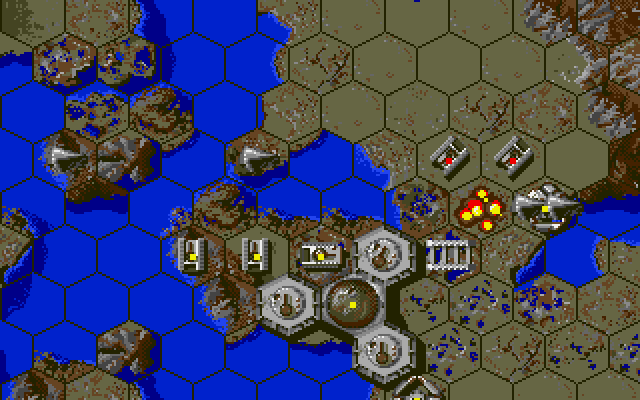
The formula draws on the fundamentals of war games (exploration, expansion, exploitation, extermination), with three particularities, however. First, action points are allocated to the players rather than to individual units, and it’s up to each player to distribute them. The number of actions per turn is thus greatly reduced, which forces you to settle on a clear strategy: bringing back ore, for example, or launching an attack on the enemy base. This has the advantage of shortening the other players’ waiting time, and the strict limit of 25 turns stops the game from dragging on.
A similar system of pooled movement points was used in an earlier board game, Conquest (1972), but each type of piece had a movement cap, reflecting the idea that in a given period of time, a foot soldier will go less far than a cavalryman. That isn’t the case in Full Metal Planète. Feel free to spend all your points on a single tank to send it across half the map in one turn. On the other hand, if you want to move a squad of three, it will only cover a third of the distance. The logic is debatable, but this rule at least has the merit of creating logistical constraints that fit very nicely with the second distinctive feature…
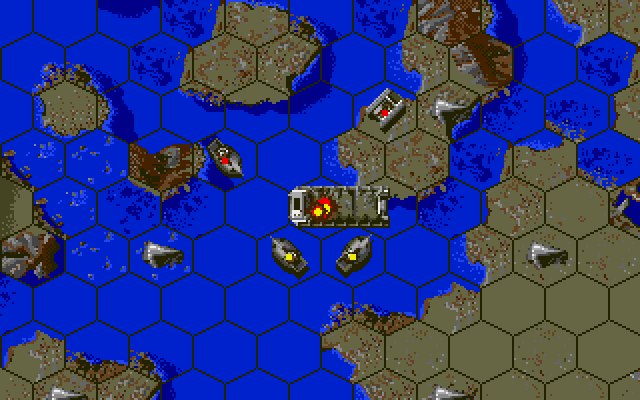
Here, destroying or capturing an enemy vehicle requires two attacking units to cooperate. A lone tank is absolutely useless. Engagements follow a precise protocol, involving the notion of a “fire zone” that I won’t venture to explain… Just remember that you can’t simply pile up forces to overwhelm the enemy. It’s essential to calculate your moves around the position of enemy units, anticipate their reaction, and even save some of your action points (in blocks of five) to support your assault on the following turn. In other words, you exploit dynamic factors as much as material ones, exactly as in chess!
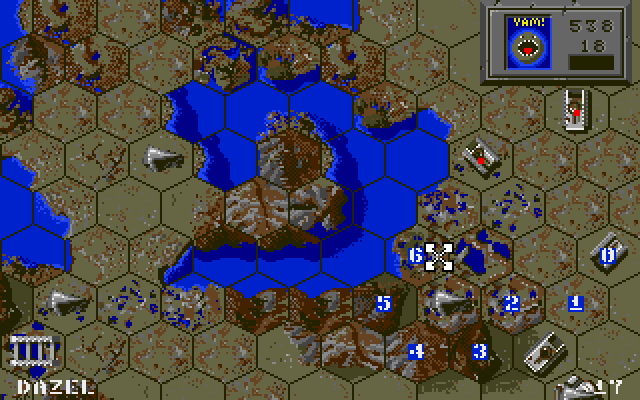
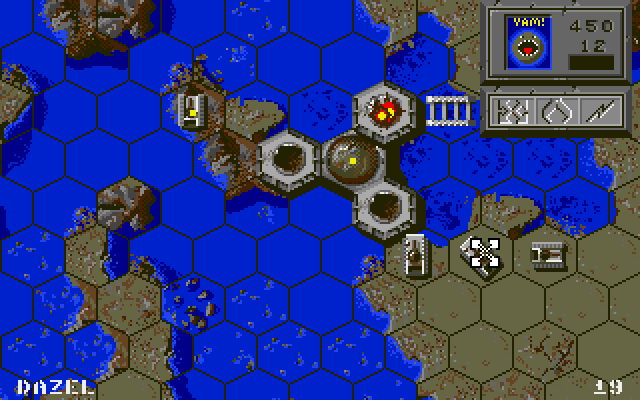
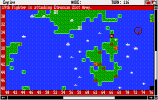
The third unique feature is the different types of terrain: sea, reefs, marshes, plains and mountains differ in their elevation and their “state”, which varies with the tidal cycle. Reefs and marshes, for instance, can only be crossed by tanks at low tide, and by boats at high tide. Since the tide phase changes every turn, units can end up “bogged down” or “run aground” respectively, temporarily unable to act. This parameter must be taken into account to coordinate your land and naval units effectively.
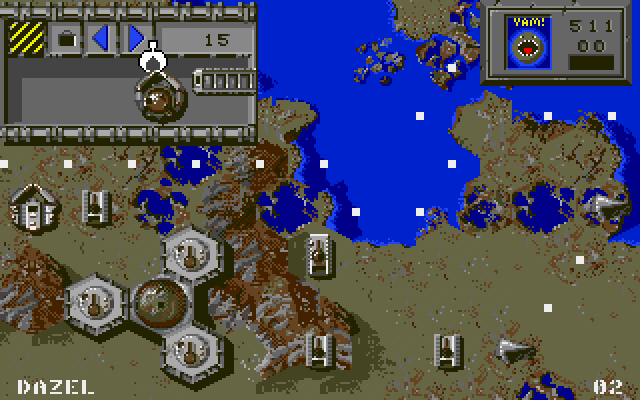
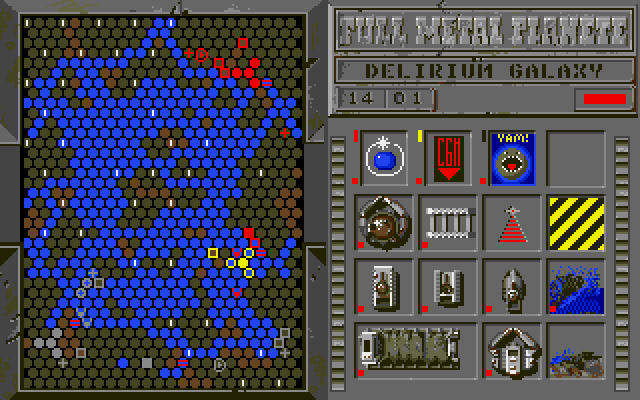
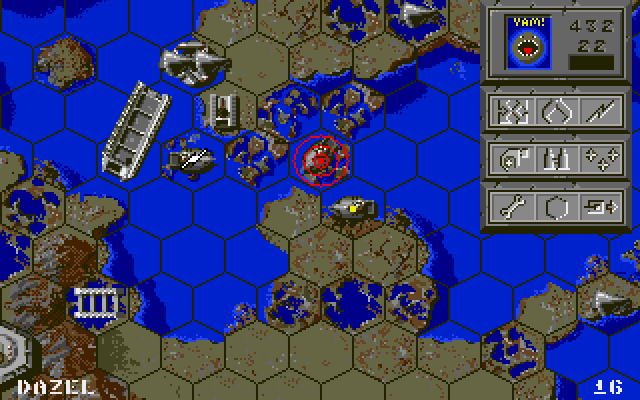
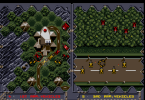
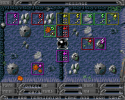
Visually, we’ve seen more colourful games … but in a strategy game, readability is what counts (if the display looks too dark in the WinUAE emulator, enable the Dark palette fix option, level 2 should be enough). The manual is still necessary to decipher the meaning of the icons and how the menus work. I struggled a great deal to adapt to certain counter-intuitive commands, so much so that I’m about to spill half a page on the subject… For example, when the game asks whether you want to format a save disk without displaying a button to answer, you have to type on the keyboard, not Y, nor O (in French) … but F! Afterwards, I kept mixing up the “save” and “load” icons, with the consequences you can imagine…
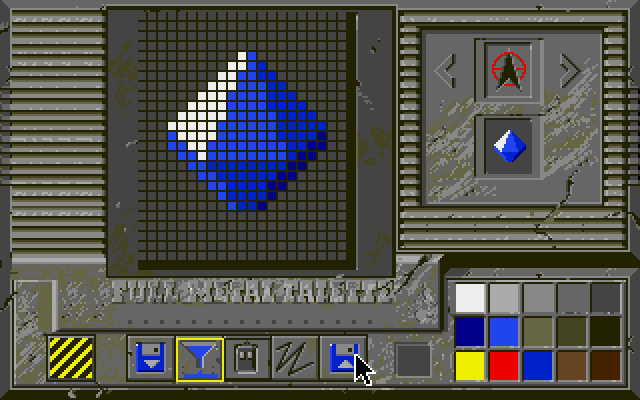
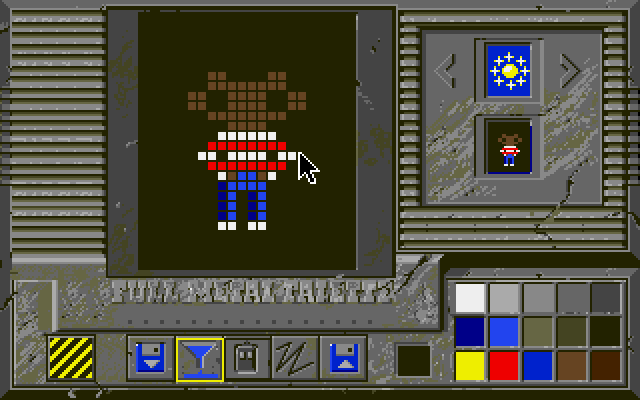
Along the same lines, there’s a module for drawing a personalised flag (I spent half my playing time on it). I managed to save my second drawing (I lost the first by clicking on “load”…), but it took me a good quarter of an hour to work out how to use it in a game! I’d click on the floppy disk, then on the name of my flag, and nothing… It drove me mad, until it dawned on me that you don’t confirm by clicking on the yellow and black button, but on the text next to it…
The most embarrassing part, and ultimately my greatest difficulty, was working out how to start a game while controlling the side of my choice. In my first ten or fifteen attempts, the computer controlled everyone, and I was tearing my hair out because, not knowing how to quit the current game, I was forced to restart the computer every time. I’m at a loss to explain how I eventually managed it, or to say whether the fault lies with a limitation of the program or with my declining faculties. Giving the former the benefit of the doubt, let’s move on…
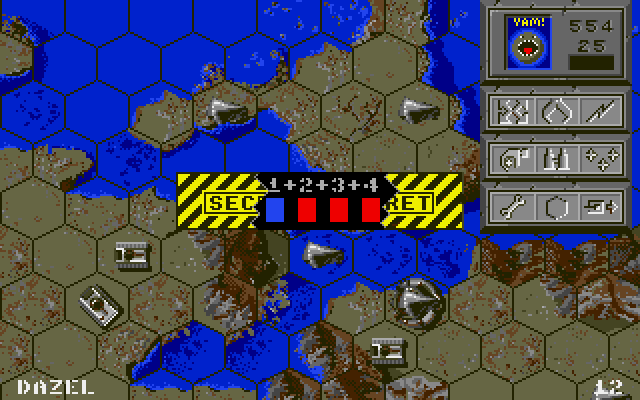
Once the game is under way, the interface gave me no further cause for complaint. The box at the top right (press “Left Alt” if it disappears) shows the important information: the countdown to the end of the turn, the number of action points available, and the rectangle indicating the colour of the faction(s) under your control. Click on the latter to display the secondary commands. In addition, there are a few shortcuts worth knowing, such as the M key (for Meteorology), which displays the tide forecast, to be consulted before planning your moves. I never used the second one, the D key for “diplomacy”…
All in all, I found the atmosphere original, and the mechanics both accessible and thoughtful. I expected nothing less from the adaptation of a board game reputed to be “quick to learn, long to master”, where strategy largely prevails over luck. On the other hand, the content is limited to a single map and six measly types of unit. A map or scenario editor would have added appreciable value compared with the “boxed” game. Hero Quest suffered from the same frugality.
A trivial detail: it made me happy to read terms in the manual taken from the tabletop version, such as “the weather hen” or “the heap”, which add to its character. One thing still nags at me, though: what’s with that title? The reference to Kubrick didn’t escape me, but why “Planete”, with two es and no accent? As I write these lines, the title at the top of this page uses the official spelling, but I’m suppressing my diacritic neurosis by biting a cushion, with no idea how long I’ll hold out…
[Less than two minutes. – Ed.]
As a bonus, for a quick presentation of the board game, watch this video; for a more complete review, this one. I was also pleased to share videos in French, for once! English-speaking readers will understand that the effort is more often made the other way round.
|