Gear Works
| Developer: N/A | Graphics: |
 | |
| Publisher: Hollyware | Sound: |
 | |
| Year: 1993 | Difficulty: |
| |
| Genre: Puzzle | Lastability: |
 | |
| Number of players: 1 | Rating: |
7/10 | |
Originally called Clik Clak, this Italian game came out in 1992 on the Amiga, Commodore 64 and PC-DOS. The Amiga version was afflicted by a bug that stopped you getting past level 7 (out of twelve). A fixed version appeared a year later under its international title, Gear Works, followed by Game Gear and Game Boy ports (the latter is the one I knew as a child).
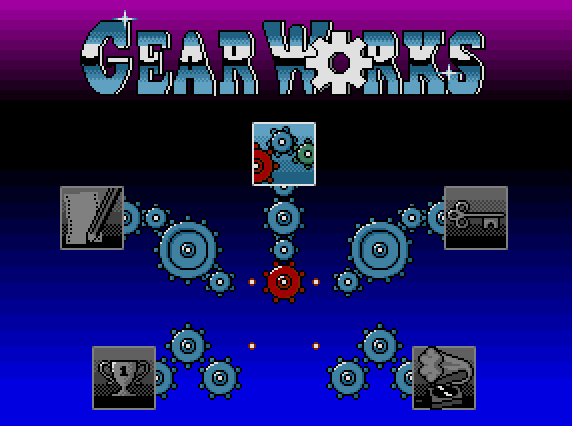
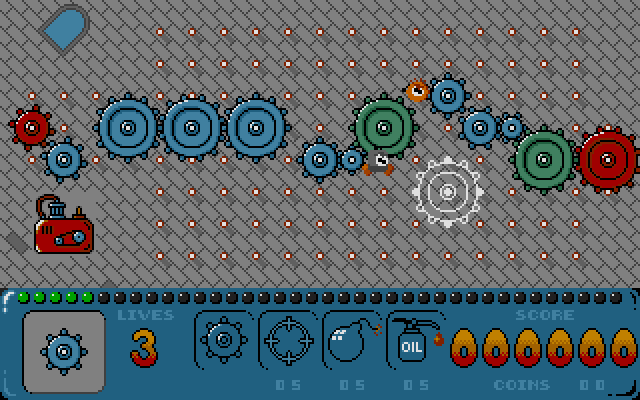
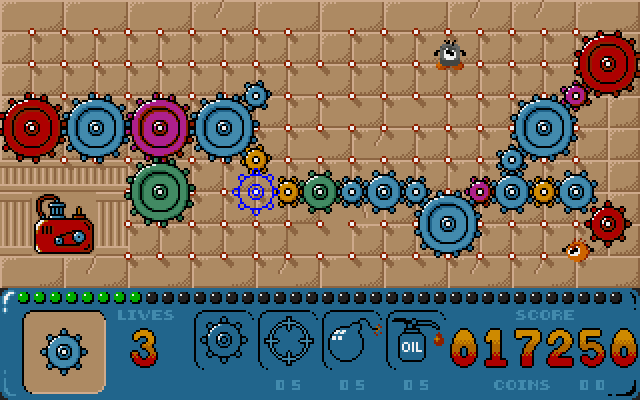
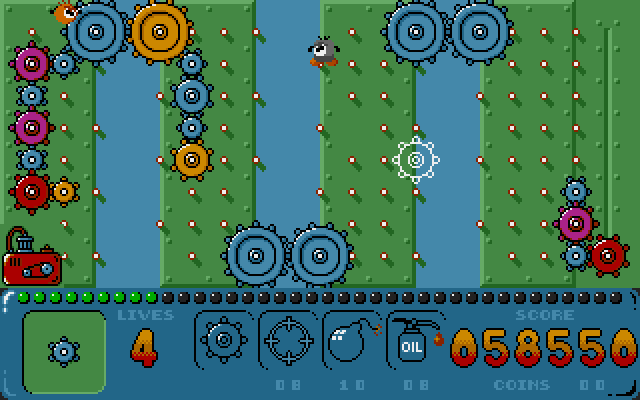
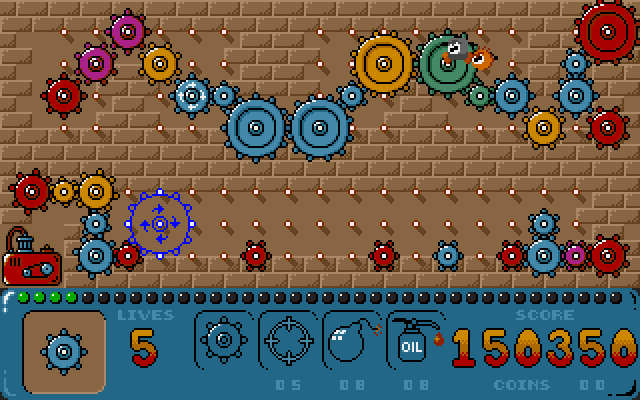
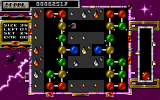
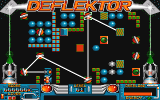
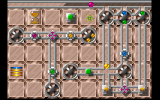
The aim of the game is to repair the clocks of famous monuments by assembling gear trains from cogwheels of various sizes. Once the job is done, you’ll be sent to a new capital, in the manner of Pang. While we’re making comparisons, building circuits from randomly drawn pieces recalls Pipe Mania, and the pests roaming the screen recall Deflektor.
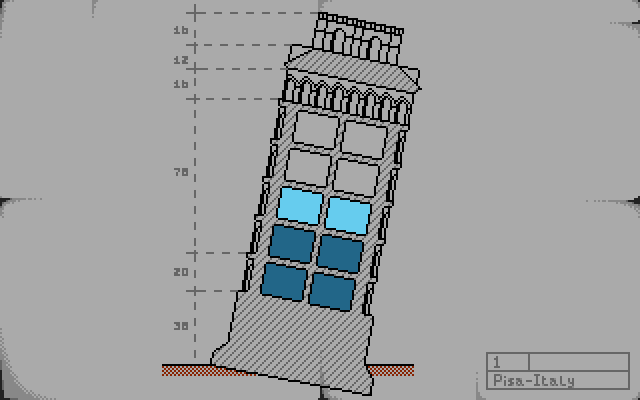
The plan of the building site is shown at the start of each round. The number of “pieces” in a storey determines how many successive screens you must complete within a shared time limit (which only resets when you move up to the next storey). The first monuments, tall and slender, pose no difficulty in that respect, but the last ones, squat and wide, require a strategy to manage the allotted time. I usually criticise timers in puzzle games, but here it’s particularly well implemented. Note, incidentally, that the game lets you pause (P key) without hiding the view, leaving you time to think about where to place your cogs.
Be that as it may, the element of chance and the apparent lack of depth (lots of repeated levels and only three types of cogwheel) earned it rather cool reviews in the magazines. But isn’t it the hallmark of a good puzzle game to run on simple ideas? I encourage you to reserve judgement until you’ve finished level 4 (the Statue of Liberty), where the difficulty starts to become satisfying, and good anticipation helps reduce the luck factor (prioritise placing the big cogs). Mind you, you won’t even be halfway through your troubles!
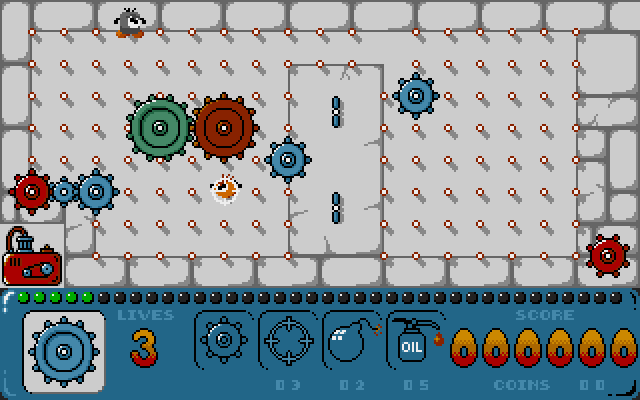
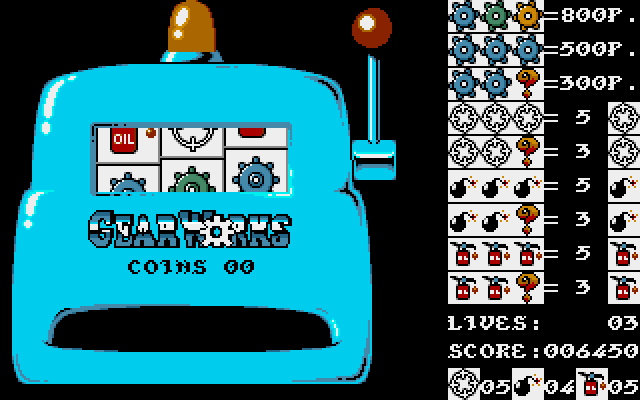
Things start to grind from level 8 onwards, though. Space shrinks, forcing you to use small cogs on the tightest sections, but if the game deals you nothing but medium and large ones, you’ll have to put them down anywhere, then blow them up with bombs to clear some room. And if you’re out of bombs, you lose a life and must restart the whole series of stages (the entire storey), hoping for better luck in the draw next time, with no guarantee! I suppose it’s to ease this problem that they slipped a slot-machine mini-game in between, to replenish your bombs. It’s boring, breaks the rhythm and harms the balance of the game. I didn’t like it any better in Donkey Kong (on the Game Boy). It isn’t even a lasting solution, since every time you lose a life, or resume a game via a password, the bomb stock drops back to five, and that isn’t always enough in the last levels.
I came away rather frustrated, which is a shame. The concept was interesting; it just lacks a distribution of cogs suited to the constraints of each screen. Remember those cardboard jigsaw puzzles, with interlocking pieces? You drew each piece at random, but you knew each one had its place on the table, that it was unique. Imagine being handed a box with the same number of pieces, but picked at random, without removing the duplicates and triplicates. You’d be livid, wouldn’t you?
Dear Santa, I hope you’re well and the elves too. Mum and Dad told me I’ve been very good. I’d like you to bring me a remake of Gear Works. I’ve prepared a little list of changes I’d like: a controlled draw of cogs; the removal of the three consumable items (crosshair, bomb, oil), which could be replaced by bonuses appearing occasionally in the play area, activated by placing a cog on them, for example; the removal of the slot-machine sequences; and finally, mouse control rather than a joystick. Kisses to your reindeer.
|