Into the Terrible Tunnels
| Developer: Elles & Victor | Graphics: |
 | |
| Publisher: Ruppelware | Sound: |
 | |
| Year: 1994 | Difficulty: |
 | |
| Genre: Boulder Dash | Lastability: |
 | |
| Number of players: 1 | Rating: |
6/10 | |
I’m not sure if you had noticed, I rather like Emerald Mine.
Evidently, I was not the only one, judging by the hundreds of amateur variants lovingly gathered and preserved on the Emerald Web site. These games were created by enthusiasts, first using the official level editor (built into Emerald Mine 2), which was quickly superseded by a more sophisticated programme, Emerald Mine Tools (1991), developed by the group No One Inc. (then, in its later versions, between 1994 and 1997, by the group Ruppelware). These floppy disks were exchanged within “clubs” (the famous Emerald Mine Club, established in Holland, England and Austria). I have unfortunately not found much information about these communities. How many of them were there, how were they organised, what were their relations with Kingsoft, or between these groups, which collections were the most popular? It goes without saying that I would be most interested in any sort of accounts that might surface on the net – old articles, excerpts from newsgroups, forums, anything at all.
What remains today is a vast quantity of games, readily accessible, but of uneven quality… It is difficult to find one’s bearings. I do nonetheless tip my hat to a useful initiative on the Rocks ‘n’ Diamonds forum, where one person took it upon themselves to undertake the Herculean task of testing and reviewing a portion of these titles. For me, it was an absolute treat. I used it to draw up my shopping list! I was nonetheless left rather baffled when they came to Into the Terrible Tunnels, employing jargon I had never encountered before. Warparound? Auto-pushing bombs? What, what, what? And there was I, fancying myself something of an expert… I simply had to give it a try!
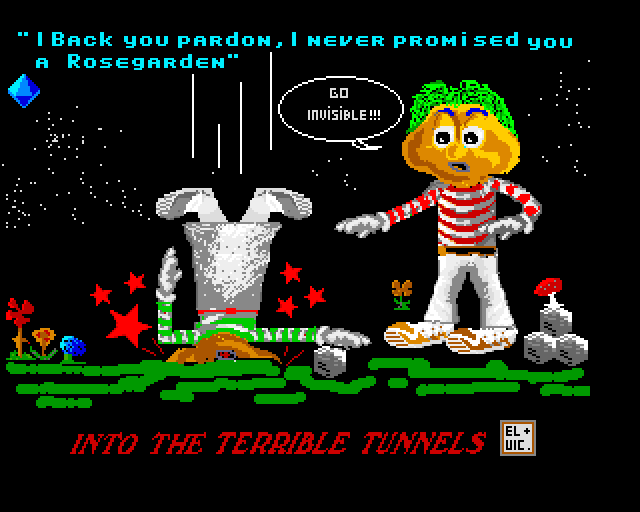
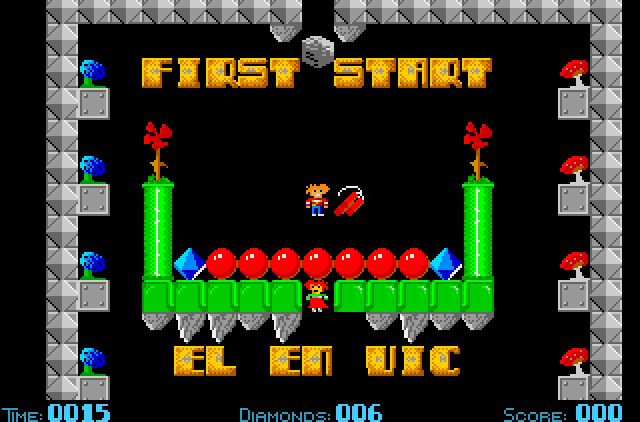
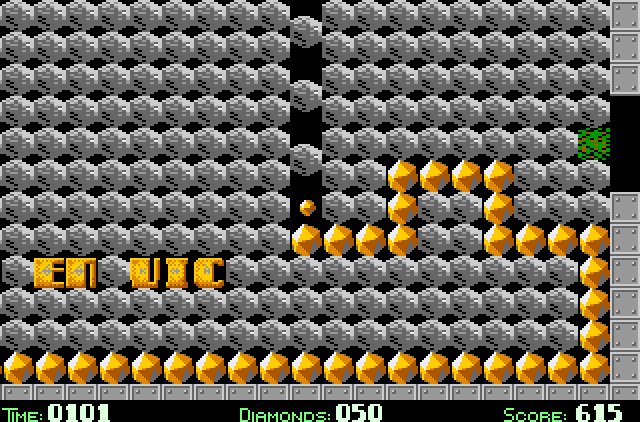
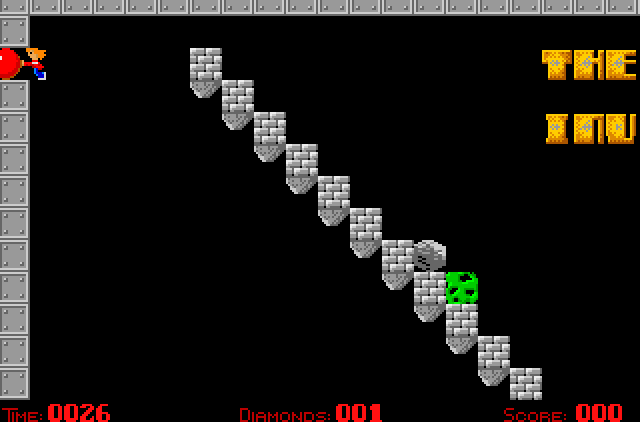
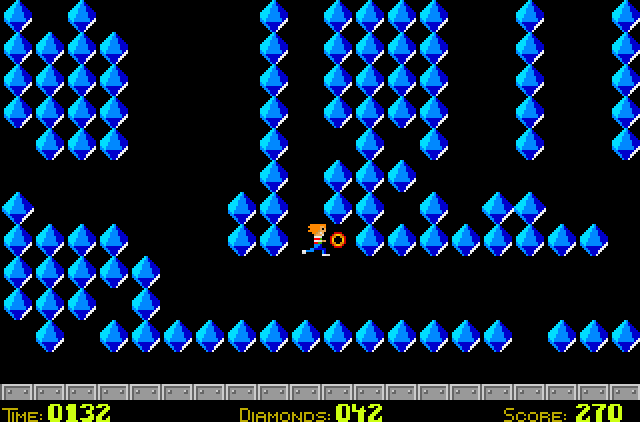
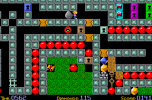
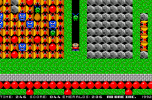
A word of warning beforehand: this game is not suited to beginners, but rather to “jaded veterans” such as myself, in search of something new. The levels are often designed around the exploitation of bugs or programming tricks. For instance, I have no idea how they managed to create gaps in the outer wall (the one that frames the levels), on the left or right, which teleport you from one end to the other whilst rendering you invisible (take a closer look at the third image…). There are also invisible elements (not walls) or objects taking on the appearance of other objects. I have seen “false sapphires” floating in mid-air that awarded no points, and as for the mysterious auto-pushing, head to level 29 for a rather brutal demonstration involving a boulder…
I discovered, reading a little further through the forum, that these peculiar techniques were in fact commonly used (notably present in No One Mine 18, Through The Chaos Caves 6, Nightmare on Emerald Street, Daddy Mine 9 and 10 … which go straight onto my shopping list).
Honestly, I found the levels original but rarely enjoyable (quite a few of them kill you within the first second). The difficulty varies wildly, there is a great deal of dross, but I will admit it was quite an experience … one that might give ideas to those who design levels (if any such people still exist). Only one level truly appealed to me, number 16. It affords room to move, and proves more subtle than it first appears. I felt a particular sense of satisfaction upon reaching the exit.
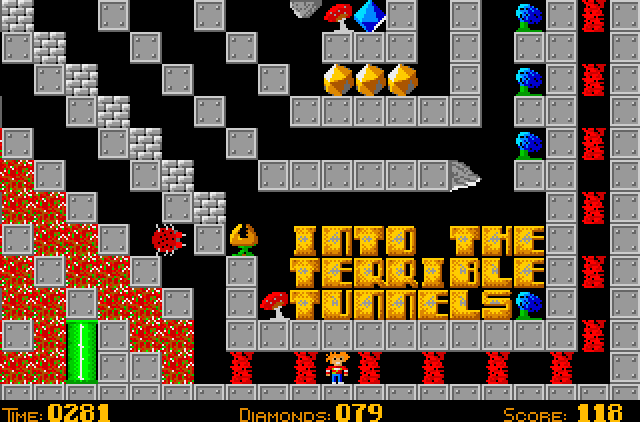
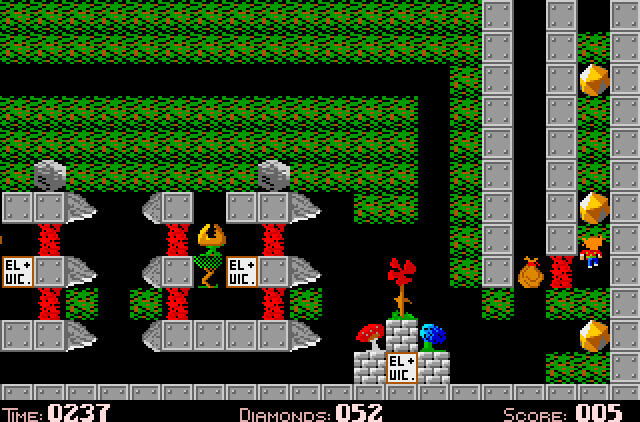
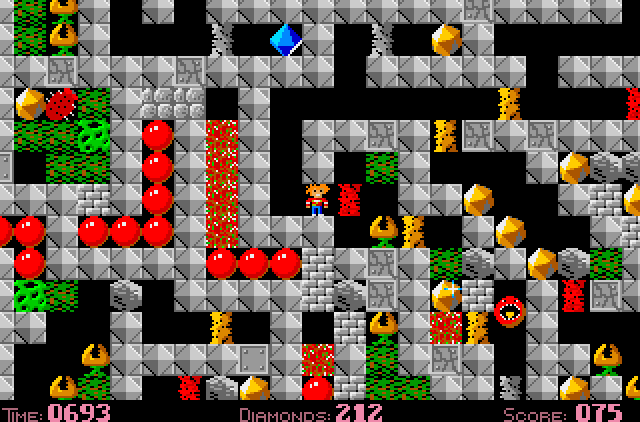
The predominant style is reminiscent of Forgotten Mine 2 (I imagine the creators were influencing one another), namely labyrinthine and very dense levels, made up of tiny rooms, numerous doors and “quicksand” blocks (allowing boulders to pass through), as well as acid pools without edges (enabling boulders or monsters to be destroyed by pushing them horizontally into the acid rather than dropping them in). This is the sort of game that takes a great deal of time (easily ten minutes per level), and affords very little freedom (level 71 is a prime illustration of this style taken to the extreme…).
There remains, however, a mystery I cannot quite fathom. I was treated to a sort of “crash” following a failure on level 20 – “Could not load HIS” (which occurs when it attempts to display the high scores), followed by a kind of cracktro animation reading "We hope you’ll play better next time"… Was that meant to be a joke? I restarted and was able to try again several times, before the error message changed to “could not load NAM” (the name screen, I presume). I was unable to get my floppy disk working again after that. Is it supposed to self-destruct after a certain number of attempts? I should point out that I made no use of save states.
A note for Rocks ‘n’ Diamonds users: the application can prove useful for visualising levels in the editor, or for watching how other players complete a level, but as the “engine” is not entirely compatible, it is preferable to play this particular game on an emulator.
|