Knightmare
| Developer: N/A | Graphics: |
 | |
| Publisher: Mindscape | Sound: |
 | |
| Year: 1991 | Difficulty: |
| |
| Genre: Role-playing game | Lastability: |
 | |
| Number of players: 1 | Rating: |
7/10 | |
I’ve learnt how to make rabbit pie. Want me to teach you?
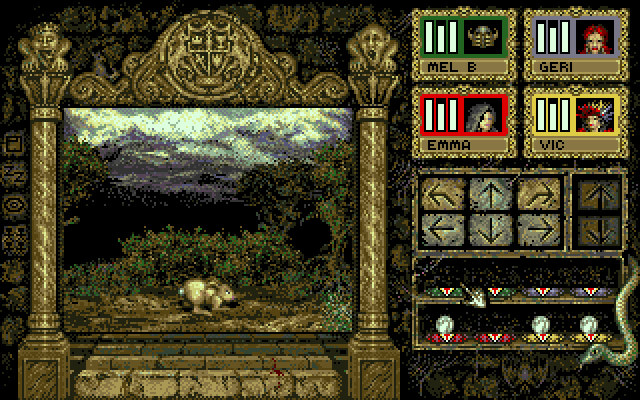
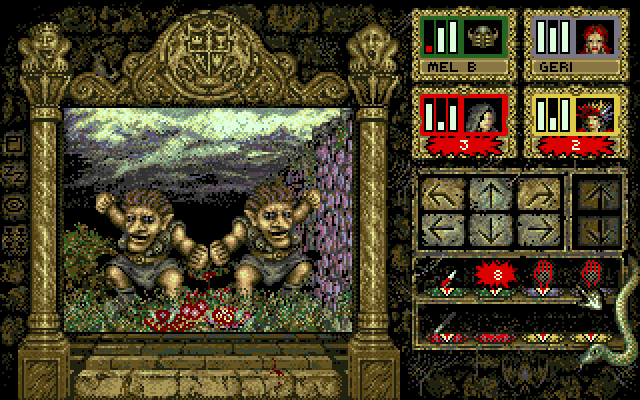
Gently place the rabbit in the middle. Arrange four famished adventurers around it. Pummel the animal until smoke starts rising. Scoop it up. Serve hot.
Thinking about it, I may already have seen this recipe in Parasol Stars…
Let’s leave that culinary preamble aside for a spot of culture. Knightmare was originally the name of a shoot’em up released on the Japanese MSX computer in 1986. A few years later came the TV show of the same name aimed at British children, broadcast between 1987 and 1994 (its French version, Le Chevalier du labyrinthe, was hosted by Georges Beller). It received a first video game adaptation in 1987 on 8-bit machines; a puzzle-based adventure game faithful to the spirit of the programme (non-violent).
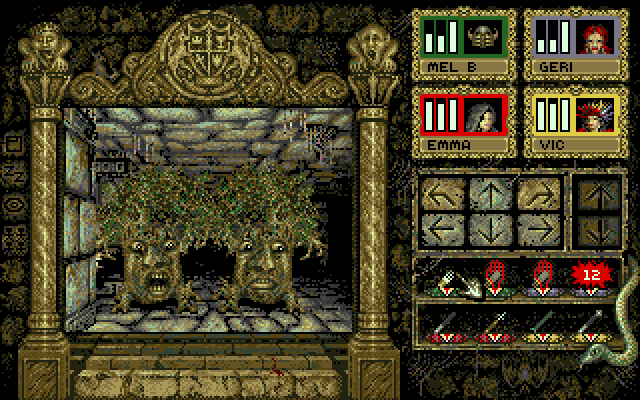
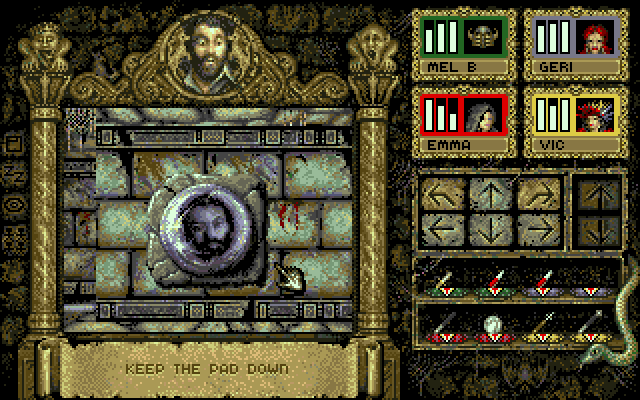
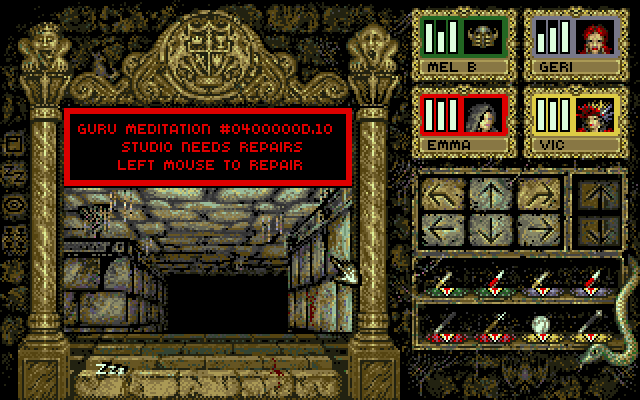
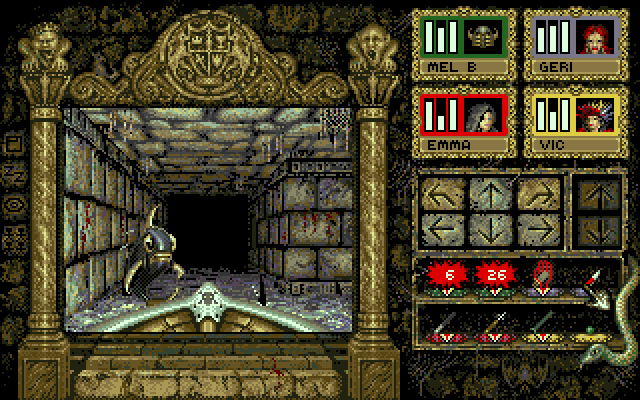
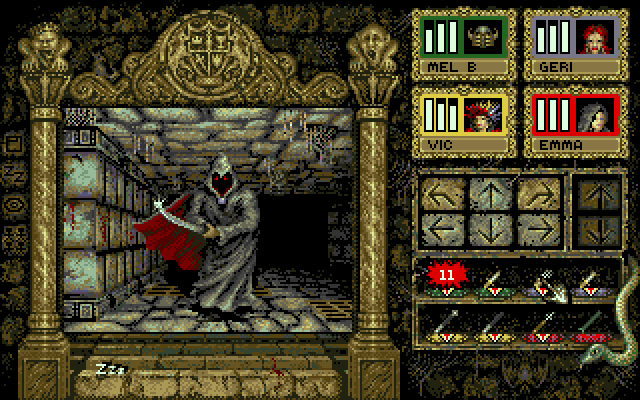
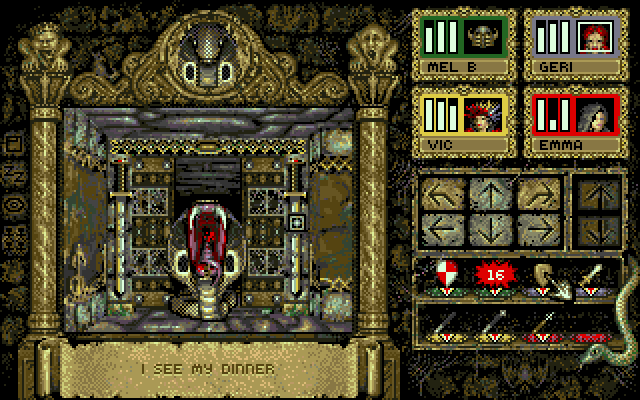
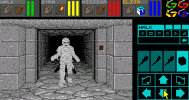
Here, we’ll be looking at the second “adaptation”, a genuine dungeon crawler that has little left in common with the children’s show, besides the host’s face popping up here and there to dish out cryptic clues. Designed by the team behind Captive, who set aside science fiction in favour of fantasy (ogres, haunted trees, gnomes, rabid rabbits…), the game shows clear similarities in how the interface works and how you interact with the surroundings. Prepare yourself to right-click that up arrow!
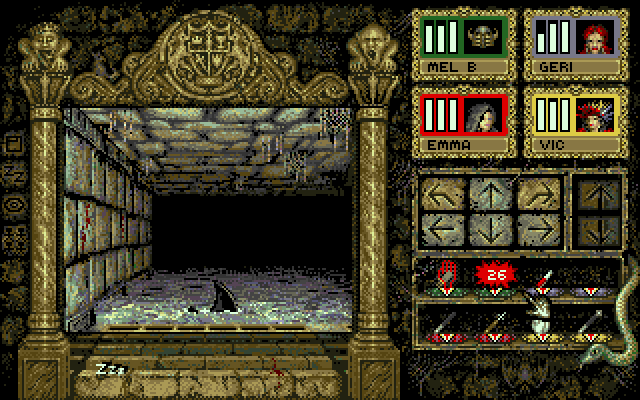
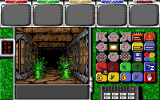
The interface looks simplified at first glance, but I think it lost something in usability along the way; more on that later. Dungeons are no longer randomly generated by the thousand. The whole adventure unfolds within a castle and its grounds, which lead into the game’s four dungeons, fitted out with the usual gadgets: switches, trapdoors, intangible or movable walls, retournacs, teleporters, projectile launchers … and if you behave, you might even get a ride on a wagon, or a boat.
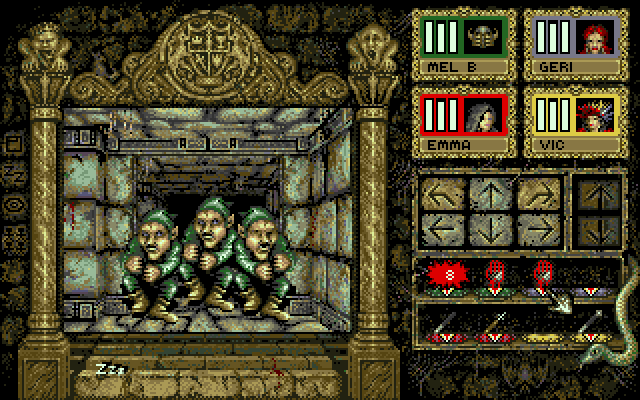
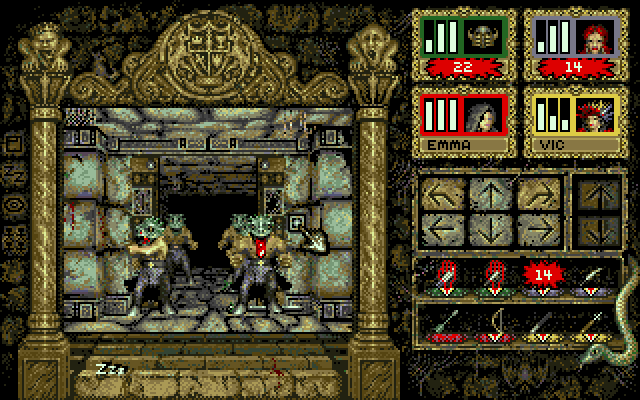
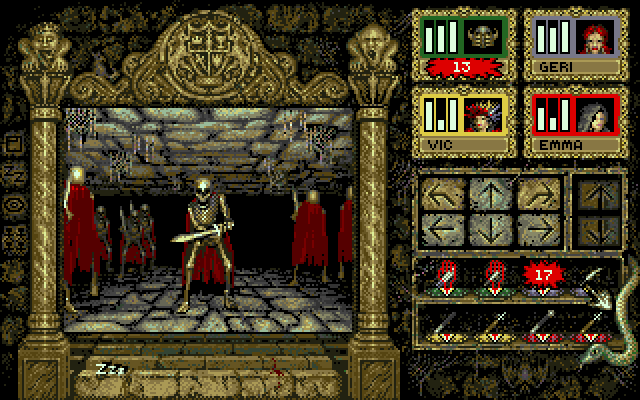
The least one can say is that our four wanderers don’t pack anywhere near the firepower of Captive’s androids. These fools turn up with no weapons and no armour, ready to fight bare-handed … against enemies that hit far harder and shrug off far more punishment, which makes combat particularly tense, forcing you to keep constantly on the move and juggle the numpad with the mouse in tight coordination. Get cornered against a wall by a pack of monsters, and it’s generally game over. And don’t even mention the joy of facing several groups at once, closing in from opposite directions, in cramped spaces…
What’s more, the gear you scavenge leaves something to be desired: a pea-shooter, a kitchen knife, a baseball cap… I didn’t find my first proper sword until the end of the second dungeon. Overall, the loot disappointed me, given how much of my motivation hinges on it. Even the ultimate weapons owe less to Dungeons and Dragons than to Evil Dead 2, as you’ll see…
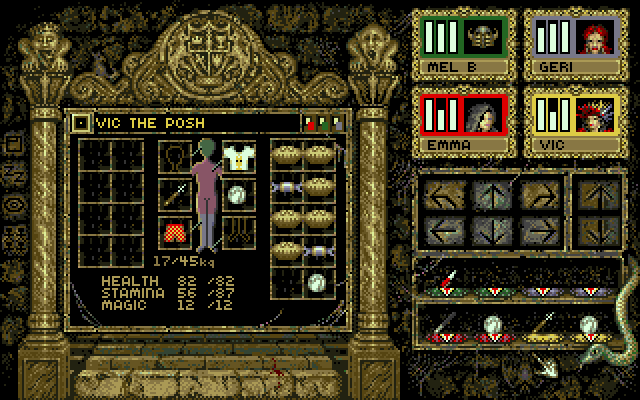
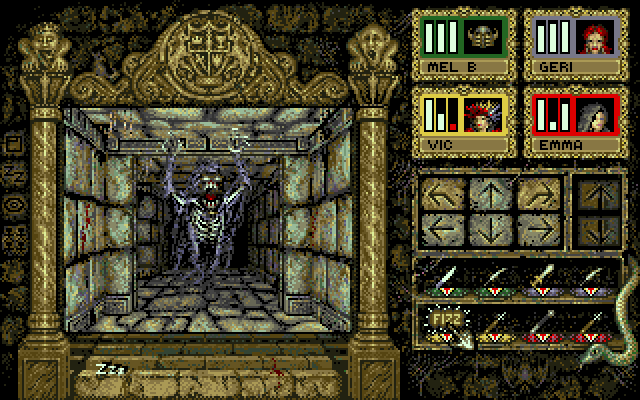
Graphically, Knightmare looks more elaborate than its predecessor, and it becomes harder to spot hidden buttons or small items lying on the ground, such as keys (a spell lets you make them glow, if need be). Inventories can be accessed with the mouse or via the F1 to F5 keys. The three white bars next to the portraits represent health, stamina and magic, respectively. The latter two regenerate while sleeping, more or less quickly depending on how well-fed you are. The basic functions are easy enough to pick up; the finer points, however, are poorly explained, if at all. So I’ll spend the rest of this page grumbling. It’s therapeutic…
To begin with, every time I dig up a new weapon, I can’t tell whether it’s better than the one I’m already carrying. The damage ranges vary enormously, depending on a luck factor, but also on the creature in front of you and how you strike (thrust, slash, headbutt…). It’s even harder with ranged weapons, whose damage is never shown at all. Either way, I soon grew tired of picking up my projectiles one by one after every volley.
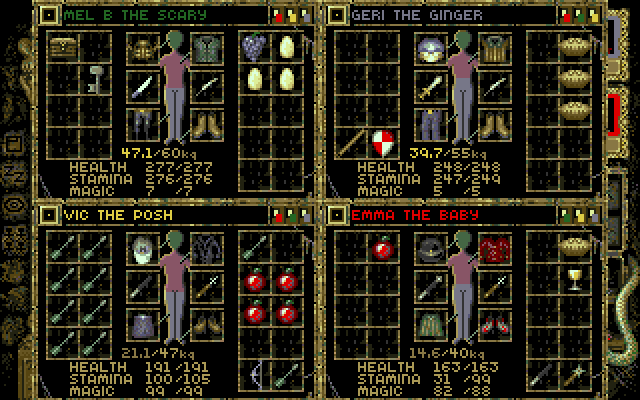
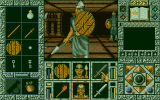
It then took me a long while to answer the age-old question: When’s dinner? Because I couldn’t work out which part of the interface represented the need for food. As it turns out, on the inventory screen, characters are shown in purple, with blue trousers … or blue boots … or blue shoes? Ah, that’s it, the gauge! Purple from head to feet? Time to eat!
Still on the inventory screen, it took me ages to twig that a red square indicated a wound, to be treated with the right spell, cast by whichever character stands directly behind. This means shuffling your companions’ positions about, or even bringing along a second healer if the first one is wounded too.
In my experience, healing spells (Aid for wounds, Cure for poison, with further afflictions added later on) need to be cast a good ten times or so before taking effect, whereas a single bite from a giant snake is enough to poison its victim. So once my priestess has burned through all her mana trying in vain to heal my warriors, I’ve no choice but to order camp so she can recharge, watching helplessly as the rest drop dead one by one…
I gathered that the chance of a spell succeeding rises with experience, but that just shifts the problem; if you’re forced to cast them into thin air for hours on end to “train”, that’s just as tedious. Perhaps it’s just me, since I only discovered (no earlier than the third dungeon…), while fiddling with a wand, that a number appeared at the top of the spell list, adjustable from 1 to 6. No explanation in the manual. My spells kept failing at every level. Maybe I’m a bit dim, but I wouldn’t call that user-friendly design.
Incidentally, I find it annoying that you can’t tell which spell is active without unequipping then re-equipping your wand. Even the simplest tasks, like swapping a piece of armour, require several trips back and forth between screens to compare the stat (singular, mind). I’d also have liked to be able to drop food straight onto the portraits with the mouse, rather than having to remove whatever item is held in hand, four times over, before putting it back, then clicking on it twice more to make it usable. As for the lack of an automatic map, fair enough, I don’t mind drawing my own, but really, no compass either?
A few tips to finish off:
- On emulator, set up a memory extension and two floppy disk drives.
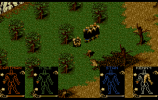
- Spend some time early on hunting rabbits to fill your food bags (and pick up a bit of combat experience). That way you’ll be able to sleep freely to recover.
- Always save before flicking a switch, pushing a wall, or setting up camp. You might end up raging less than I did…
- Doors are your best friends; slam them shut on monsters to crush them.
- One oddity worth remembering: if you strike in melee while moving forward, it’s your companions at the back of the line who take the hit in their teeth!
- If you’re stuck, throw any old item at anything that looks out of the ordinary.
- If you don’t know what an item is for, try eating it.
- Hidden in the gardens is a key that opens a certain door… I’d wait until I was genuinely well-armed before venturing there (after the third dungeon).
|