The Kristal
| Developer: Fissionchip | Graphics: |
 | |
| Publisher: Addictive* | Sound: |
 | |
| Year: 1989 | Difficulty: |
 | |
| Genre: Adventure/action | Lastability: |
| |
| Number of players: 1 | Rating: |
4/10 | |
(*) Published by Cinemaware in the United States.
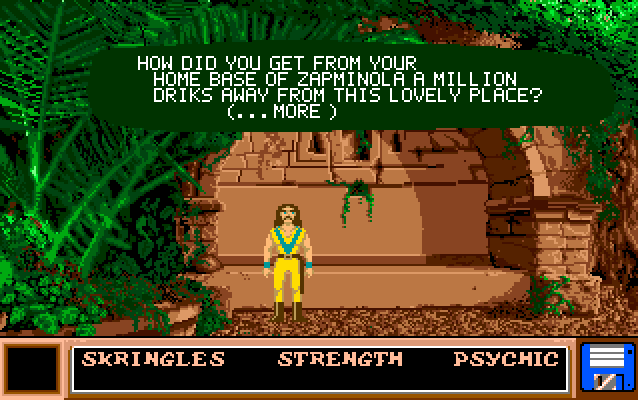
A moustachioed space pirate in Lycra is trying to recover from his hangover. Start by helping him track down his ride…
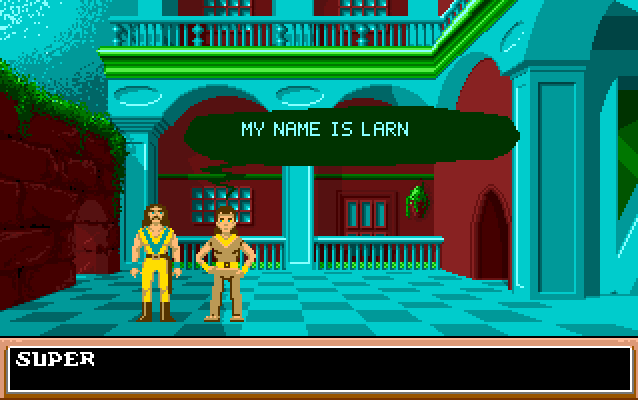
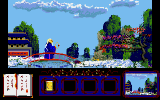
Once again, I overestimated my own abilities and set off on the adventure alone. I lasted ten metres before walking straight into a wall. After several fruitless attempts at going back and forth, I resigned myself to consulting a manual. Generational cognitive decline isn’t just a rumour.
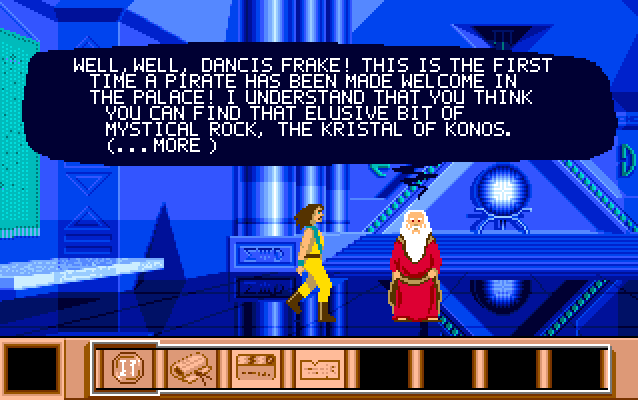
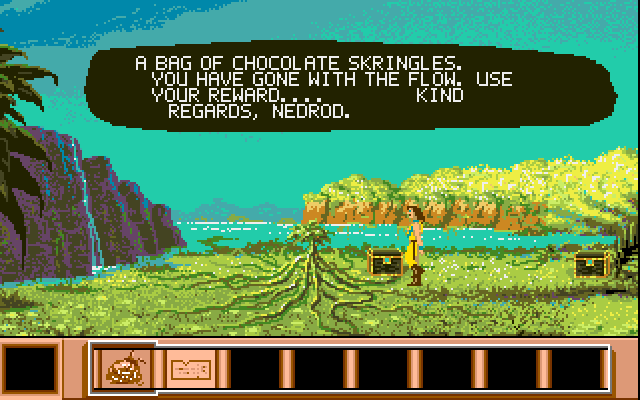
First revelation: to get through the door, set slightly back, you need to position yourself a few steps ahead, then push the joystick forward so as to face perpendicular to the depth-of-field axis. This let me advance a further thirty metres or so, pick up two items whose purpose escapes me, before going round in circles indefinitely, unable to get any useful information out of the passers-by braying as I went…
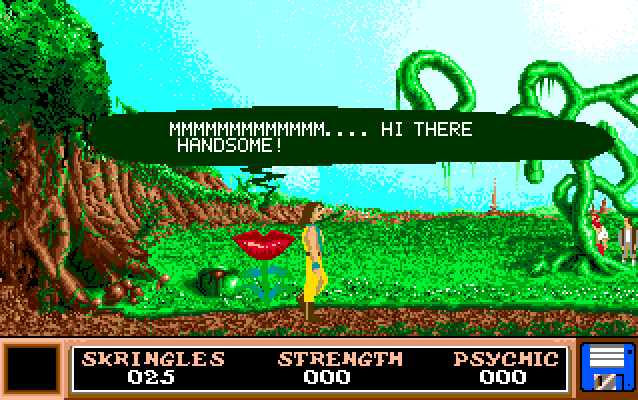
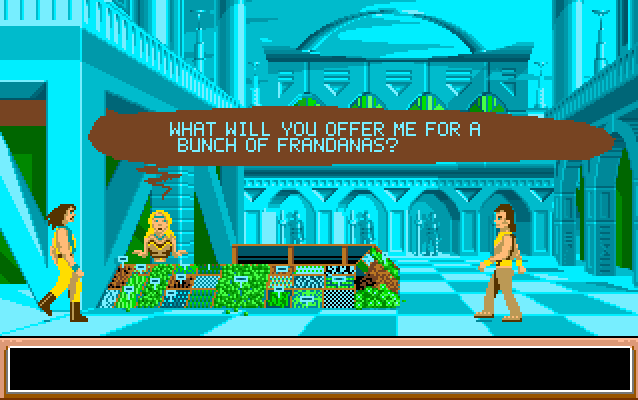
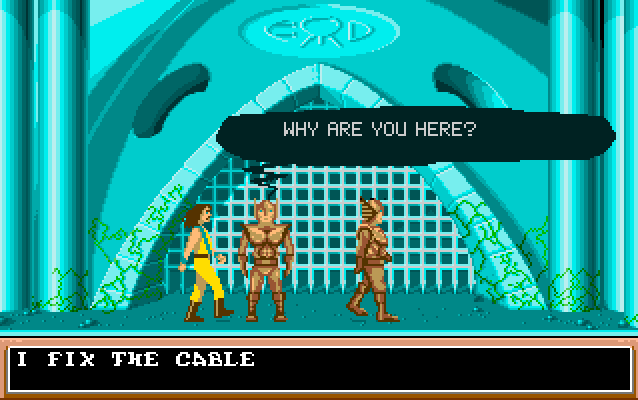
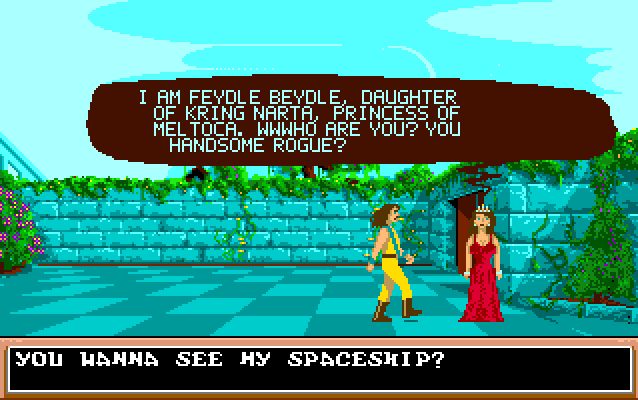
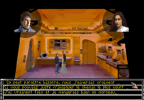
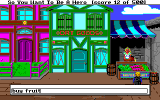
It’s not easy when your lines have to be typed in English on the keyboard, as in the old Sierra games. On top of that, the dialogue only runs one way: whoever you’re talking to gives you two or three tries to say what they want to hear (feed them the right keyword), before pointedly ignoring you. After that, there’s no resuming the conversation without leaving the area, coming back, and risking that they’ve vanished in the meantime.
So I had to get hold of a second manual, the one from the American version, which is more thorough and notably lists the essential questions to recite to anything that breathes: What is your name? What do you do? What is happening? (I’d suggest adding this one too, it costs nothing to ask). It’s worth taking notes, since these blighters won’t repeat themselves.
As for the story… No, I think I’ll just let the manual speak for itself. I can’t tell whether it’s actually meant to be taken seriously; either way, I certainly can’t manage it. The script is apparently adapted from a musical written by the programmer. Lovely, another auteur game! You’ll be amazed to learn it never found a producer.
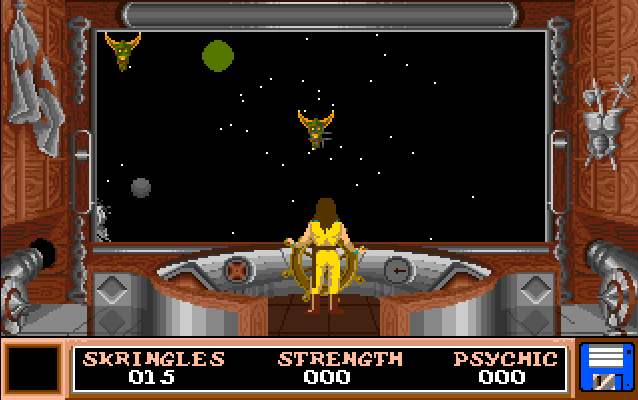
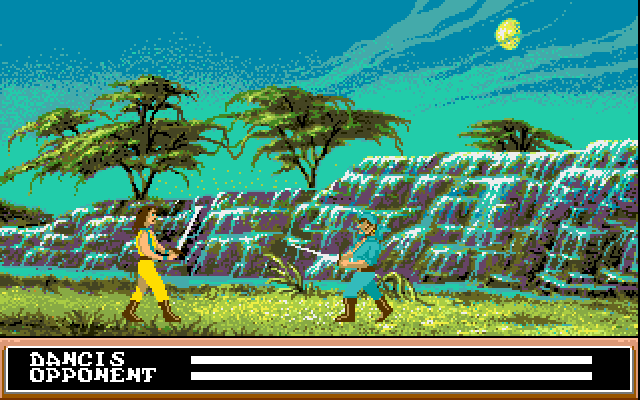
And what would a pre-point-and-click adventure game be without its haphazard interface (which pairs beautifully with the overload of sci-fi jargon: five skringles to a froodle…) and the inevitable, thoroughly awful “arcade” sequences, whose sole purpose is to delay your progress as much as possible: a shooting mini-game aboard the ship, and sword duels whose production values rival those of a Master Ninja. Tip: push the joystick forward while holding the button down, and don’t move a muscle until it’s over…
While we’re at it, here are the rest of the controls:
- F1: switches to dialogue mode (Esc to exit, or type “bye”)
- F2: picks up an item (only when the box bottom left is flashing)
- F3: teleports onto the ship (once you’ve found it)
- F5: describes a selected item
- F6/F7: cycles through items on the inventory screen
- F9: combat mode
- F10: uses an item
As for presentation, what stands out is the lovely introductory music, followed by narration spoken by Patrick Moore. The rest of the time: silence punctuated by the occasional shrill sound effect.
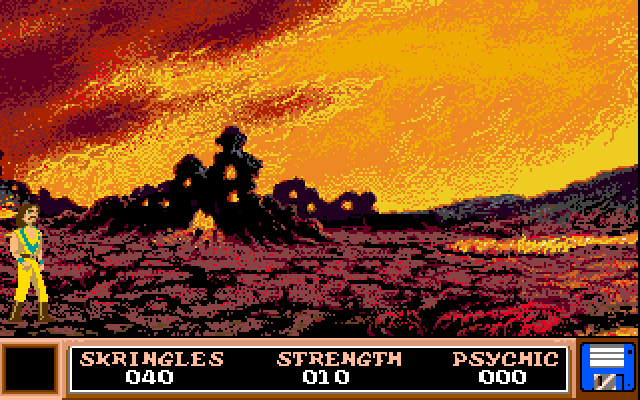
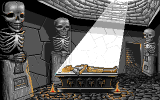
Anything good to say? Yes, provided you’re armed with patience, able to put up with the mini-games, the sudden deaths and the endless disk swapping; there’s potentially a thread to follow, planets to visit with complete freedom, and surreal conversations to hold with background characters who behave like “conversational agents” (a novel attraction at the time). But all of this will demand far more perseverance than seems reasonable, even with both manuals to hand… At the time of writing, only one video creator has actually finished this game: BillBull. Hats off! That said, before following in his footsteps, be aware that certain items and characters are placed at random, or sometimes don’t appear at all, which bodes for bottomless wells of frustration.
|