Supaplex
| Developer: Think!Ware | Graphics: |
 | |
| Publisher: Digital Integration | Sound: |
| |
| Year: 1991 | Difficulty: |
 | |
| Genre: Boulder Dash | Lastability: |
| |
| Number of players: 1 | Rating: |
7/10 | |
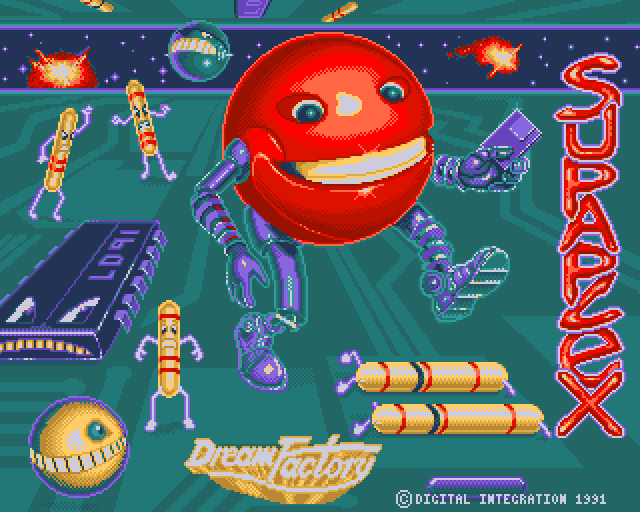
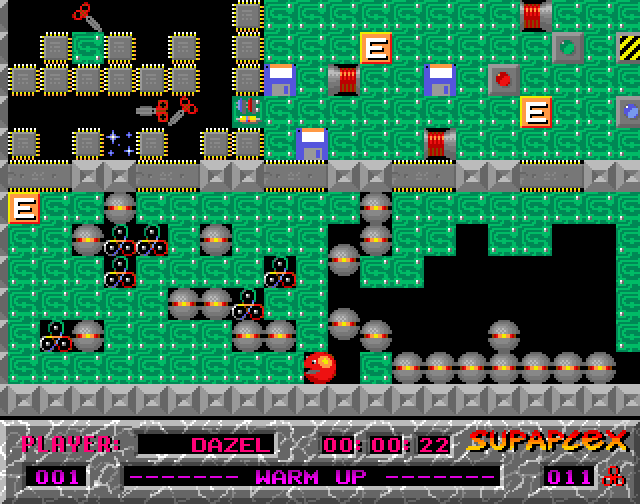
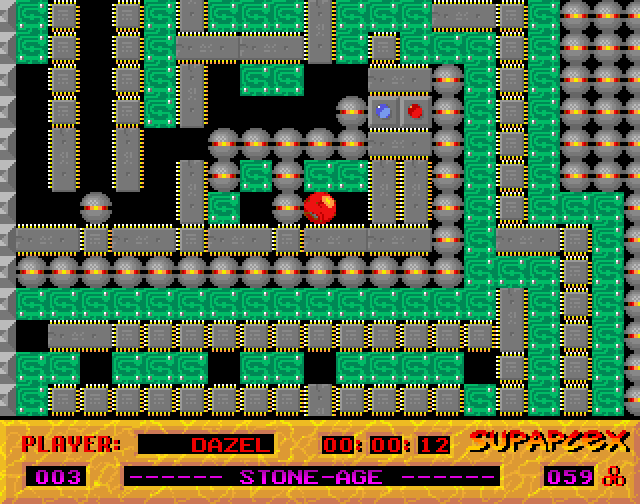
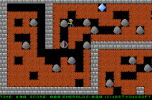
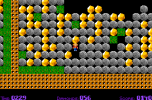
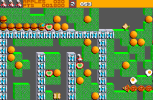
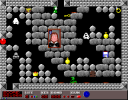
Supaplex is a clone of Boulder Dash with a computing theme, developed on the Amiga and subsequently ported to PC-DOS. Most of the game elements are shared but redesigned: the dirt (or sand, through which tunnels are dug) takes on the appearance of printed circuits, diamonds are replaced by atom-like objects (“infotrons”), and boulders by “zonks”. The two classic enemies also make an appearance: “snik snaks” (scissors) in place of fireflies, and “electrons” in place of butterflies. I almost forgot: the hero, the little red ball, is called Murphy.
Other elements bring it closer to Emerald Mine: orange floppy disks act as bombs (exploding upon hitting the ground), red floppy disks work like sticks of dynamite (collectible and usable wherever desired). There is a third variety, unique to this game: yellow floppy disks, which explode remotely when a terminal is activated. The distinctive keys and doors of Emerald Mine, meanwhile, are replaced by straight, cross-shaped, and one-way tubes. Finally, certain deadly tiles (“bugs”) emit sparks, and some passages feature modified gravity.
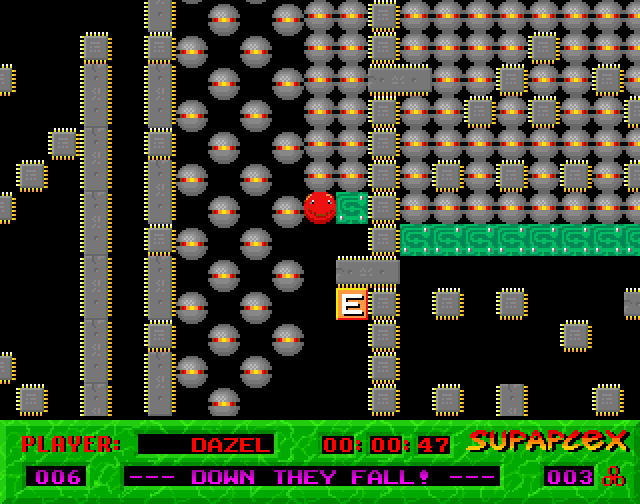
Graphically, I find it less polished than Emerald Mine. Beyond the slightly garish colour palette (a matter of taste), it lacks, for instance, a movement animation on the vertical axis (later corrected in the PC version). Moreover, I am particularly attached to the “dirt tiles” that display a jagged border when adjacent to an object. So attached to this detail, in fact, that I went to the trouble of reproducing it throughout my website. You will have noticed the fine black lacework bordering the walls, I trust? That is 4-pixel nested HTML tables, ladies and gentlemen! And that is why Emerald Mine is superior to Supaplex, but also to Boulder Dash, Rockford, Flaschbier, Sapphire Yours, and the rest… I remain utterly unyielding on the matter of my lacework.
There is something else that bothers me about Supaplex: it bores me. Too many boulder puzzles for my taste, not enough hunting! Level 7 is particularly tiresome, trapping you if the rooms are not visited in the expected order; and level 13, which asks you to collect 155 infotrons across a uniform landscape, with not a single enemy in sight…
Which brings me to my principal grievance, which forced me to throw in the towel at level 14: Supaplex’s physics differ just enough from Emerald Mine’s to kill me constantly near a falling object when moving sideways or downwards. After my hundreds (or indeed thousands) of hours playing the latter (and its variants), I have developed automatic reflexes that betray me in Supaplex – reflexes I am simply unable to shake. This is, once again, a personal criterion, but an absolutely insurmountable one.
Several fairly rare characteristics set Supaplex apart from the others:
- No time limit.
- A broadly increasing difficulty curve.
- Background music, pleasant enough in itself, but looped continuously with no other sound effects and no option to disable it (I could not find one on the Amiga version).
- A level editor, which accounts for the game’s success, particularly in its PC-DOS version.
- Objects and creatures are not entirely constrained to a “grid”. A detail which, according to Wikipedia, produces unintended effects that form the basis of advanced techniques exploited in user-made levels…
For a long time (2000–2010), Supaplex was notoriously difficult to run on the WinUAE Amiga emulator. The preferred alternative was WinFellow, configured as described here. I tried again in 2026: no problems whatsoever. You simply need to be patient at startup (around two minutes staring at an entirely yellow or black screen).
Although the game was never officially declared freeware, a huge community formed around it, and thousands of player-created levels have been exchanged freely for years. This has not stopped certain shrewd operators from commercially exploiting a barely retouched version on well-indexed websites (complete with uncredited fan contributions). I am no lawyer and cannot say whether this is legal or ethical; I shall therefore refrain from using stronger terms than “shrewd”, though you will no doubt gather my true feelings on the matter… The Supaplex trademark was apparently registered in 2018, the year a remake was released at an exorbitant price, sold on Steam and in the Nintendo Switch eShop, among other places.
In the meantime, other developers continue to nurture communities of enthusiasts in their own time, sharing everything freely (additional levels, new gameplay elements, and perhaps multiplayer someday). You see, that is what the Internet was for, once upon a time…
The simplest (and obviously free) way to try the game today is to head to Supaplex Online (apologies – trademarked, so it is now Megaplex Online), a browser-adapted version requiring no download, launched in 2020. Alternatively, you can always opt for Open Supaplex or Rocks ‘n’ Diamonds.
|