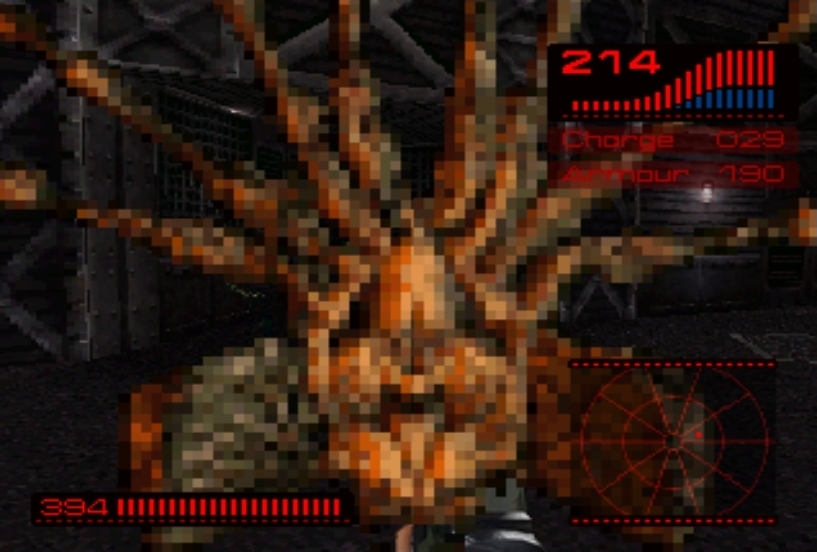
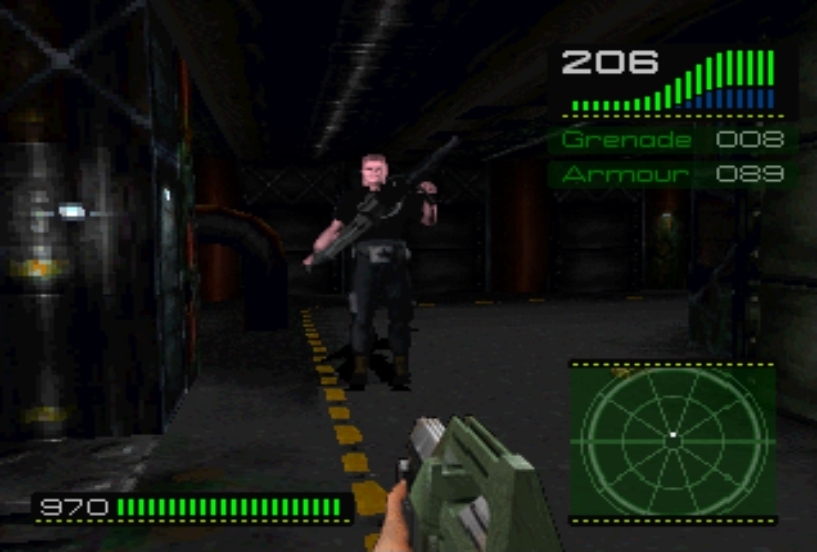
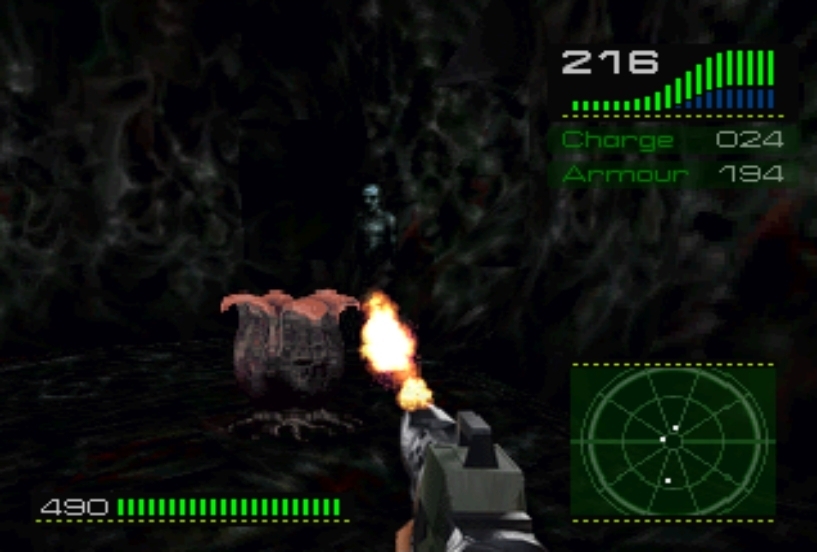
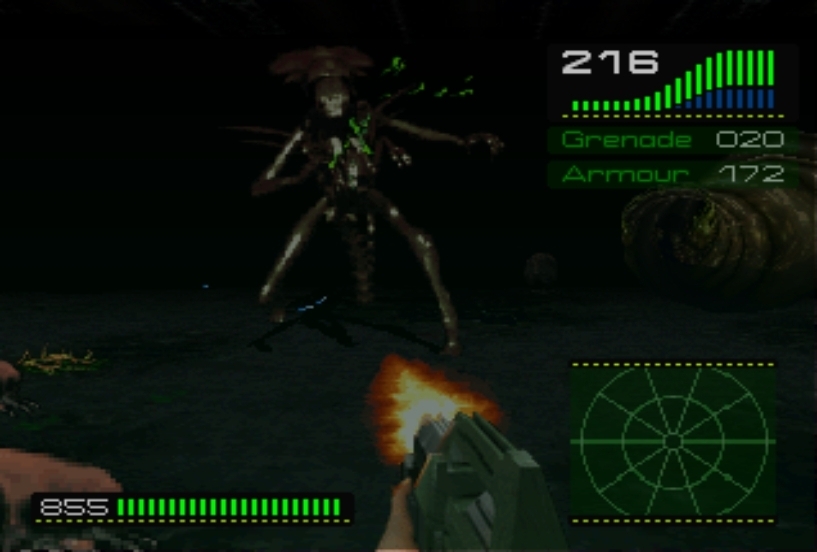
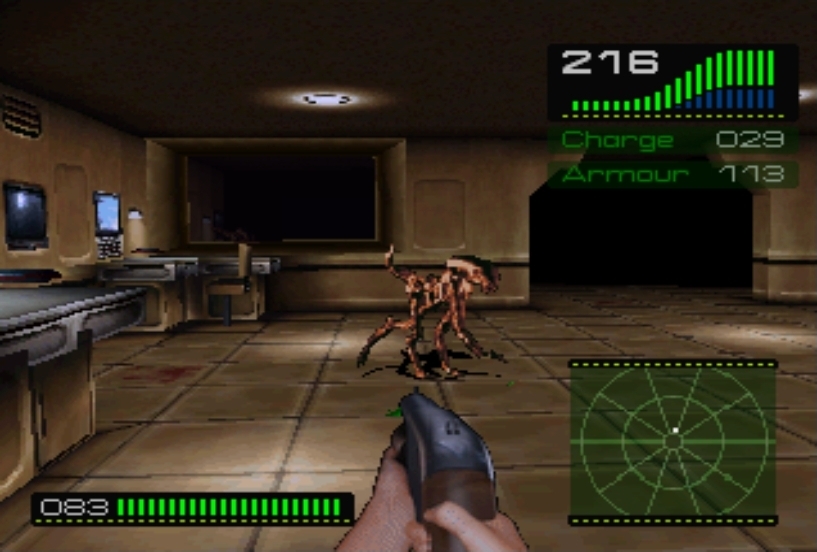
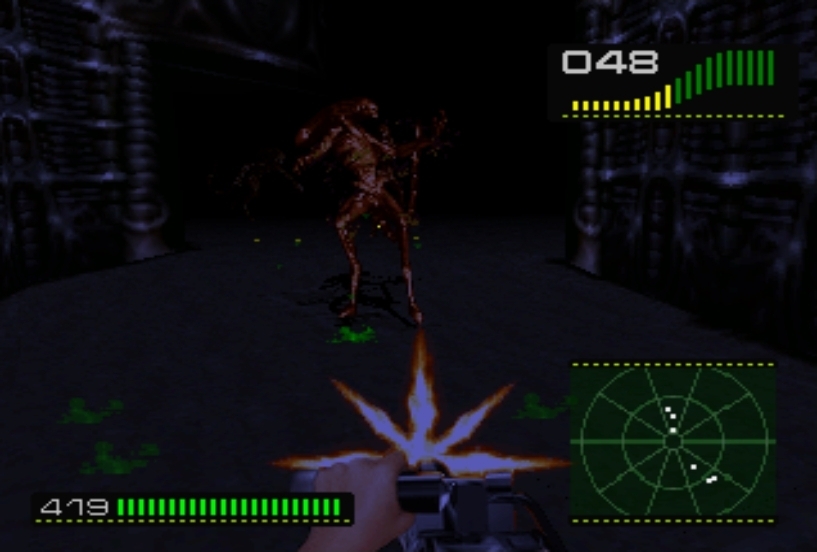
Alien Trilogy was released on PlayStation, Saturn and PC-DOS. The latter version is considered inferior despite supporting the mouse and featuring a multiplayer mode. The console versions are nearly identical. The Saturn has the edge on audio but struggles to handle transparent textures (smoke, flames, glass, liquid surfaces), which are rendered using dithering. The PlayStation offers more varied lighting effects, at the cost of an overall picture that is too dark for my taste. I played it on Saturn back in the day, but nowadays my choice falls on whichever emulator is the most stable and easiest to configure. DuckStation leaves the competition in the dust.
As its title suggests, the game adapts, with no shortage of creative liberties, the storyline of the first three films… I mean, the three films … with a heavy emphasis on the second (Aliens), which lends itself best to a video game adaptation. The first section follows its script more or less closely (provided one does not dwell on the immediate slaughter of the entire cast, save for Ripley and Bishop). The second takes place in a prison complex inspired by Alien 3 (but set on the same planet, and packed with firearms…), while the third leads you into the heart of the derelict vessel at the origin of the infestation.
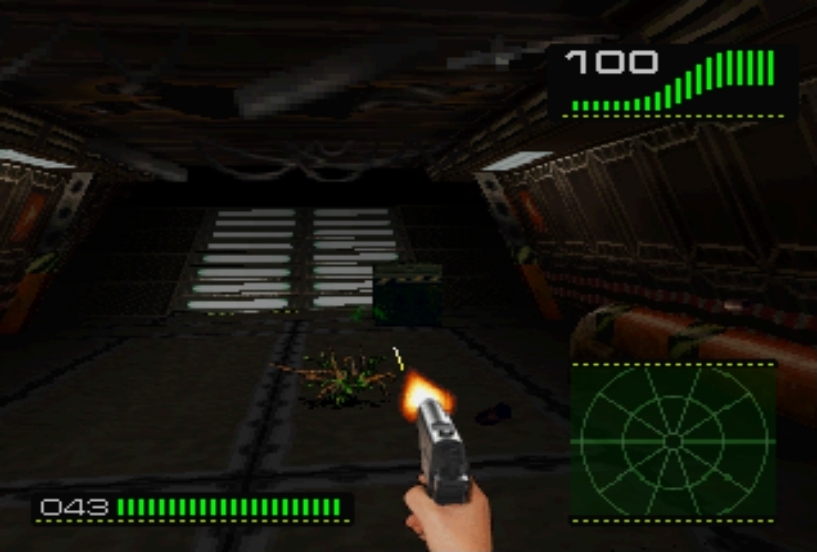
For me this is an example of a successful licenced game, given that I expected little of it: that the atmosphere be faithfully rendered and that it give me the creeps. The sparse environments (which yield rather hastily to Time to Crate) nonetheless allow a few iconic locations from the films to shine through (the colony control room, the prison infirmary, the mess hall…). You handle recognisable weapons: Gorman’s pistol, Hicks’s shotgun, Dietrich’s flamethrower, the pulse rifle wielded by practically everyone, Vasquez and Drake’s smart gun…
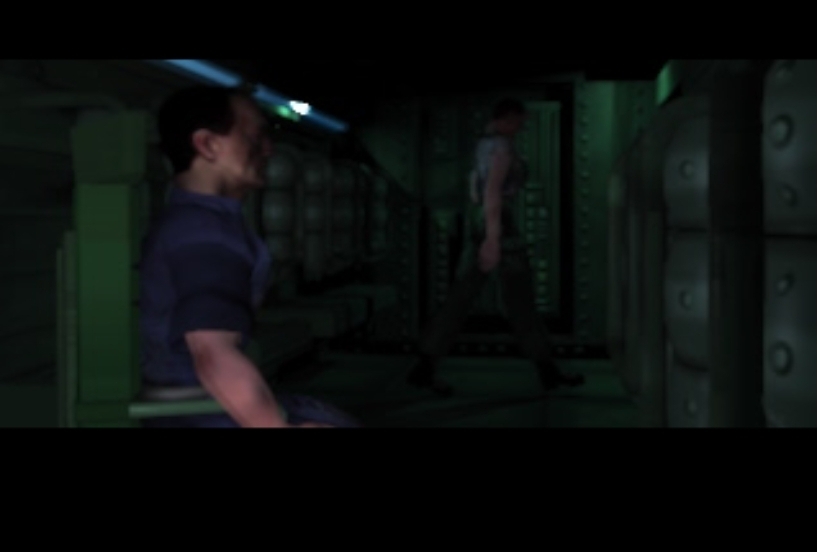
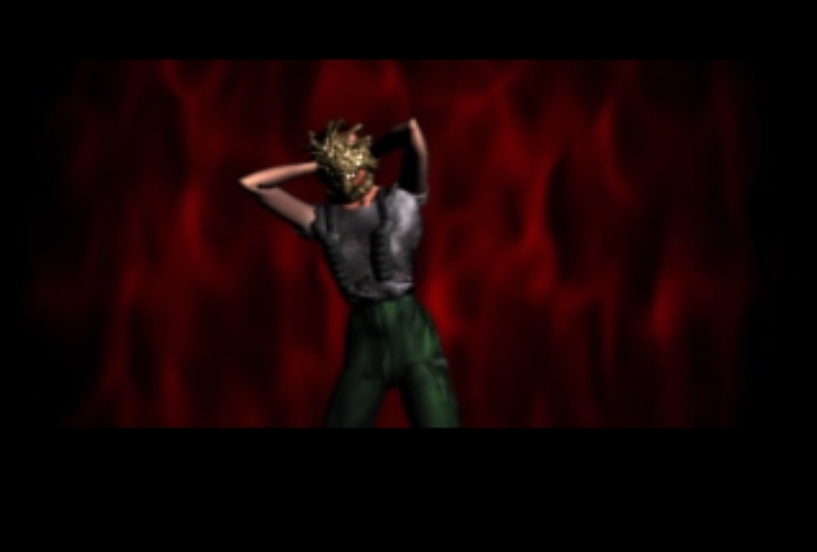
All these toys produce exactly the same sounds as in the cinema. The same holds true for all the sound effects, from the electronic doors to the iconic handheld motion tracker. It really is as straightforward as that to establish an atmosphere! The scarcity of light and ammunition contributes as well. Of course, the storyline has been reworked, and inconsistencies emerge between the mission briefings – which give the player the impression of working for the Company – and the (ghastly) cutscenes, which portray Ellen Ripley as a lone rebel. No cause for complaint in an action game.
I would have more to say about the controls and ergonomics. First, the rigid d-pad controls result in a longer time to turn (analogue sticks would not arrive until a year later). This was the norm on consoles, but combined with the single button for switching weapons (cycling through them in one direction only), it slows the pace (compared with Final Doom, for instance, which provided two buttons, usable even whilst paused). On the other hand, it heightens the anxiety. Every cloud.
However, one detail vexes me: the mini-map displays our position but not our orientation. One must zoom in to find out, but first wait several seconds for the menu animation to complete. This is an ill-judged aesthetic choice that needlessly undermines the player’s comfort, at a time when every other first-person shooter provided a full map instantaneously.
Regarding the level architecture, it is relatively conventional: doors, buttons, barrels, and the occasional weapon cache behind a destructible (or movable) wall – after firing into it some thirty times. There are a few sloped surfaces and multiple elevation levels, but these come with visibility issues. I frequently fumed over those infernal single-use lifts, having spotted a secret passage only to realise I had permanently cut off my access by jumping too soon. The later levels attempt to introduce some variety but prove frankly unpleasant, as illustrated by those “false walls” (the opposite of invisible walls).
To this must be added finishing flaws that betray a lack of testing (or time). The game features three bosses … all identical (the Queen), who freezes the moment you shoot at her, making the confrontation utterly trivial. I also encountered aliens hanging from the ceiling who followed me everywhere … without attacking! Finally, the mission objectives are not always clear, to the point where one is sometimes arbitrarily forced to replay a level one has just completed.
A few tips and tricks to finish: in DuckStation, I rigged myself an “always run” function. Go to “Settings> Controllers> Macros”, tick the run button (R2 in my case), and under “Trigger”, select for instance the L2 button, then tick “Press To Toggle”. To compensate for the lack of light, I suggest applying a filter under “Settings> Post-processing” (simple-gamma and simple-brightness). Also, do not forget that when you pick up a shoulder lamp or night-vision goggles, you must activate them via the menu screen – otherwise you will lose them at the next level.
The emulator allows for more advanced tweaking. I have seen that one fellow managed to play with a mouse (amongst other things), but I have neither reached that level of expertise nor judged it worth the effort.
The spiritual successor is called Alien Resurrection (PlayStation, 2000), an adaptation of the fourth film, notable both for having introduced the standard dual analogue stick control scheme and for its extreme difficulty…