Borderlands 2 (PC)
| Developer: Gearbox Software | Graphics: |
 | |
| Publisher: 2K | Sound: |
| |
| Year: 2012 | Difficulty: |
| |
| Genre: Rampage and fill the red bar! | Lastability: |
| |
| Number of players: 1 to 4 simultaneous | Rating: |
8/10 | |
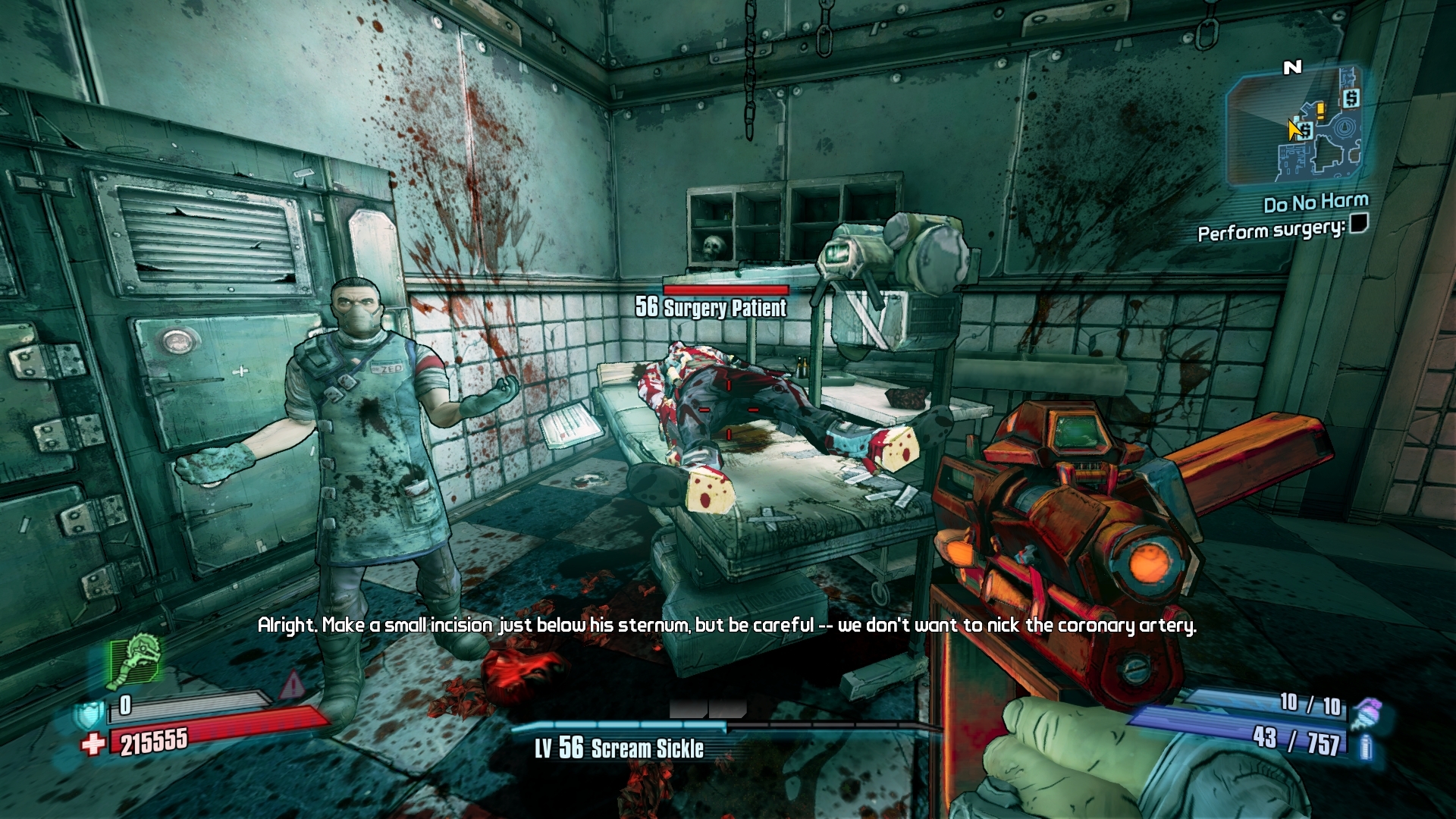
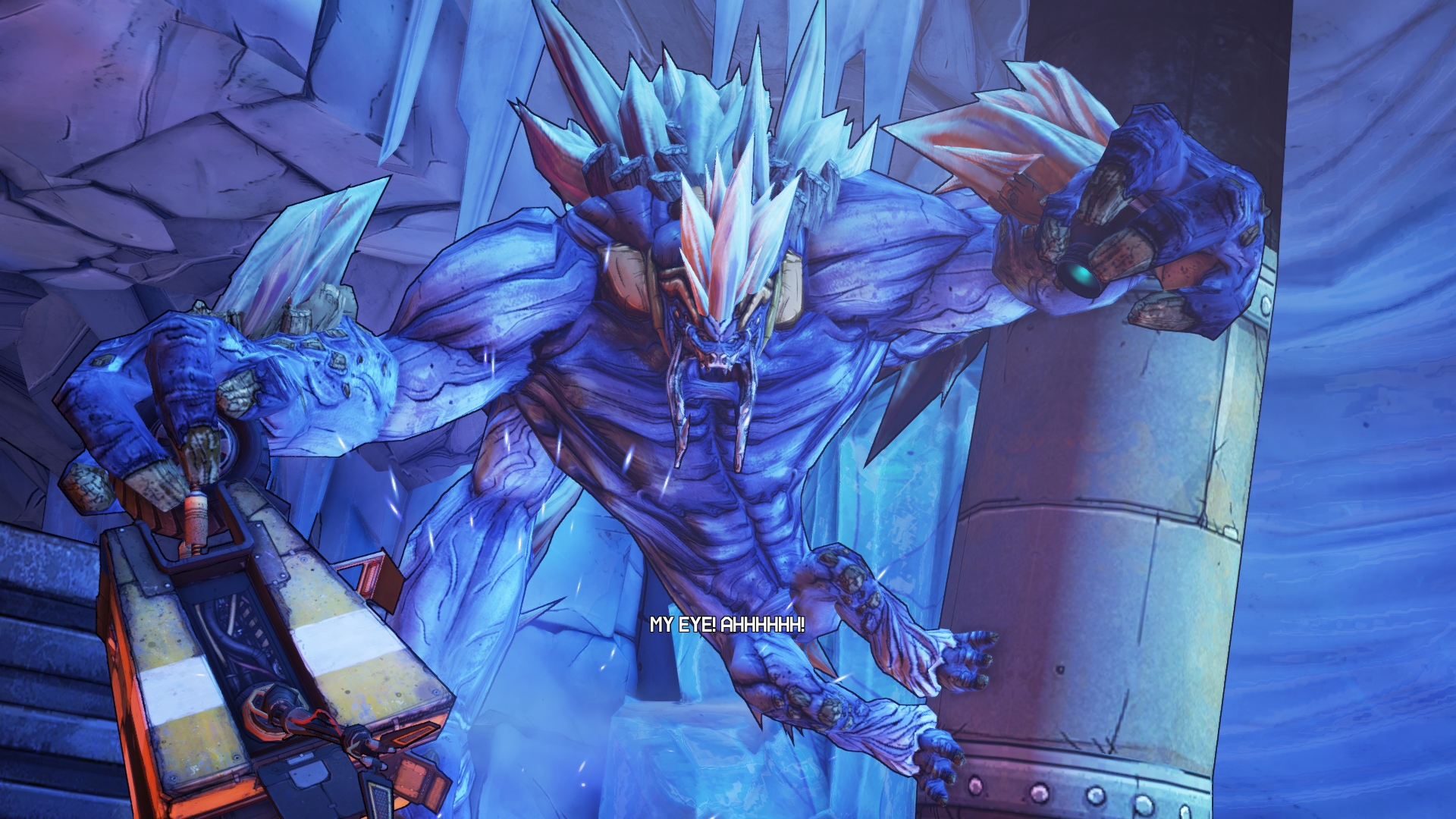
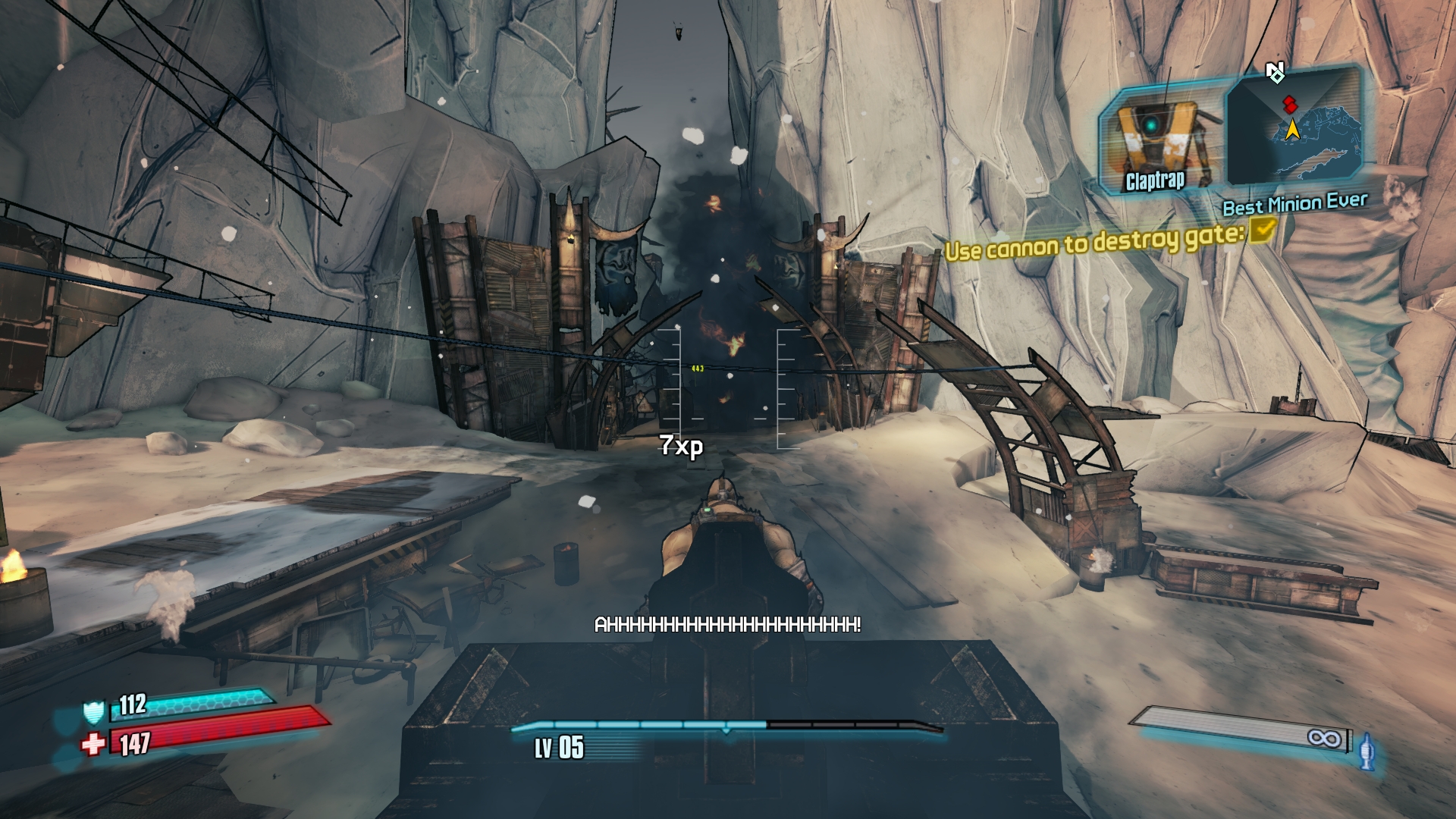
Apologies if the screenshots don’t reflect the game properly. I don’t think my playstyle does either.
Let’s recall the previous episode: four vault hunters had set off in search of … the vault, which they found at the end. It contained nothing other than tentacles and disappointment, to paraphrase the introduction sequence. Borderlands 2 starts with a dramatic twist, the existence of a second vault is revealed to us! This time, it’s certain, it holds a treasure…
The game scrupulously reproduces the formula of the first instalment, bigger, more exuberant and more polished. The fundamentals remain unchanged. One: shoot everything that moves. Two: collect new weapons of all shapes and colours, raining from the sky in absurd abundance. It nevertheless retains the same burdens: mechanical progression (accept a mission, accomplish it, return to the quest giver to obtain a new one) and the endless scrutiny of stat sheets buried in overflowing menus.
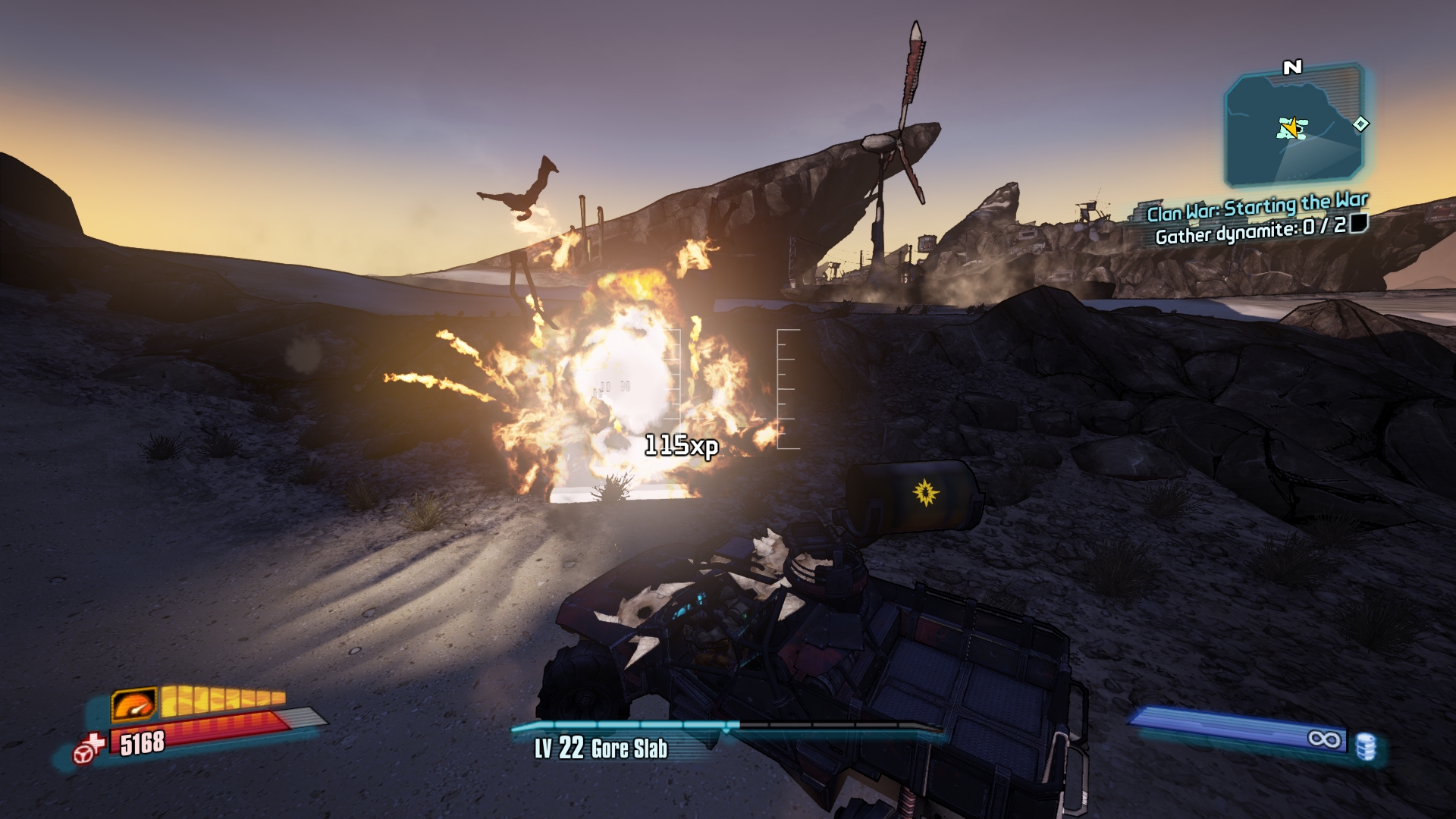
I’m perhaps going to deliver an atypical point of view on this one (for a change…), I’ve devoted hundreds of hours to it, finished it at least twenty times, but always with the same character, who doesn’t even appear in the initial selection. Do you know Krieg? this hero introduced by the Psycho Pack expansion in 2013. I had such a blast with him that I never felt the slightest desire to try the others, throughout all those years. I don’t play Borderlands 2, I play Krieg!
It’s worse than that. Among the three specialisations offered, I invariably choose the same one: Mania, which takes up the berserker archetype from traditional role-playing games. This close combat class rewards aggression and risk taking. The principle is simple, grant life recovery (here 100%) for each enemy eliminated, encouraging a headlong rush towards the next one, rather than a tactical withdrawal to heal oneself. The second component is tenfold strength when his health level is low (Krieg then metamorphoses into a bloodthirsty mutant, and carnage ensues).
The first Borderlands already offered a melee class with Brick, but it didn’t work as well. I spent most of my time hidden behind a wall, waiting for my shield or special ability to recharge. Faced with enemies positioned at the other end of open ground (notably at the end of the campaign), I had no means of closing the distance. Krieg can’t either, but he has a chainsaw-axe that he can throw indefinitely at his adversaries (don’t ask me how, but it’s quite entertaining!). He also has the less amusing propensity to turn the weapon against himself. The poor fellow suffers from identity dissociation which contributes to his “charm”. He counts among the most tortured and offbeat characters in the game’s universe, in addition to being the most original to play. Not the most powerful, admittedly; his function in the team consists of decimating hordes of ordinary enemies (mobbing). On the other hand, he proves more delicate to handle against bosses, because he needs to kill constantly to raise his health gauge. And let’s not speak of the ordeal of trying to hit a flying target with his axes … which is akin to wanting to wipe a mammoth’s bottom with a piece of confetti folded in four.
A few years later, I found that style of gameplay again through the “Zealot” specialisation of Victor Saltzpyre in Vermintide 2 (2018). Replace the axe throwing with the ability to quickly project oneself towards a distant enemy, and the transformation into a mutant with a progressive increase in power and resistance, proportional to the loss of health points. Curiously, I enjoyed less playing the bona fide berserker embodied by the dwarf, Bardin Goreksson. Perhaps I should name this archetype differently.
Despite my preliminary mockery, the storyline, simple though it may be, benefits from particularly thoughtful crafting. The developers have totally abandoned the melancholic atmosphere of the first title to favour a burlesque register stuffed with references to popular culture. This style of humour was relatively innovative in 2012, but it has since been debased, notably in cinema (Marvel and Disney at the forefront), to the point of becoming perfectly unbearable for many of us today. I won’t reproach Borderlands 2 for this, I have another scapegoat in mind…
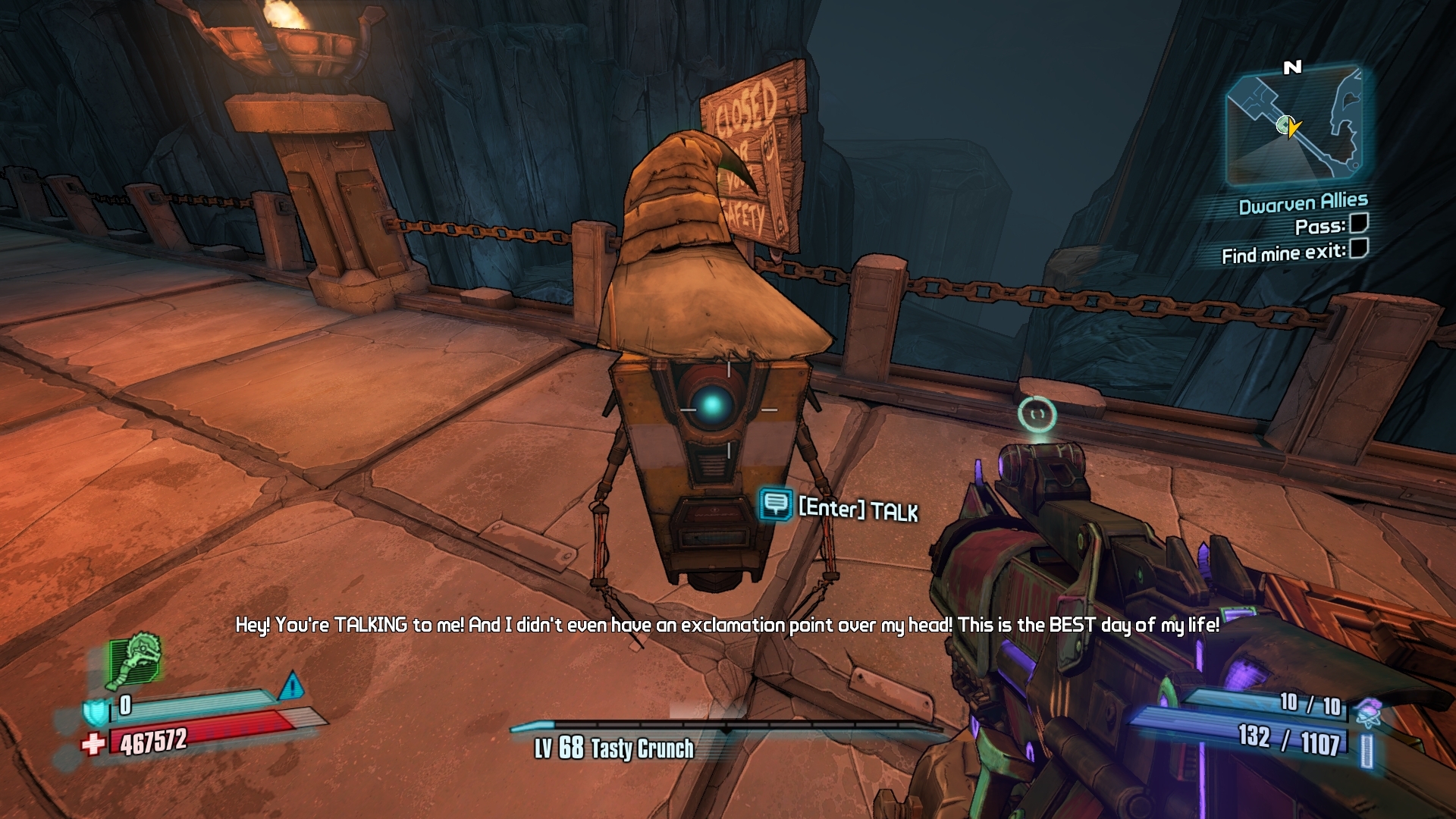
Be that as it may, we discover a gallery of new eccentric and talkative characters (Sir Hammerlock, Tiny Tina, Mr Torgue…), whom I would dare to describe as endearing (I would be less lenient towards Brick and Mordecai, whom I greatly preferred in the first game, when they were mute). The game also treats us to a charismatic and memorable antagonist in the person of Handsome Jack, well written and remarkably voiced. The humour certainly doesn’t soar high, but it made me laugh, the first time. I admit, however, that I was laughing less at the third viewing. I’ll come back to this.
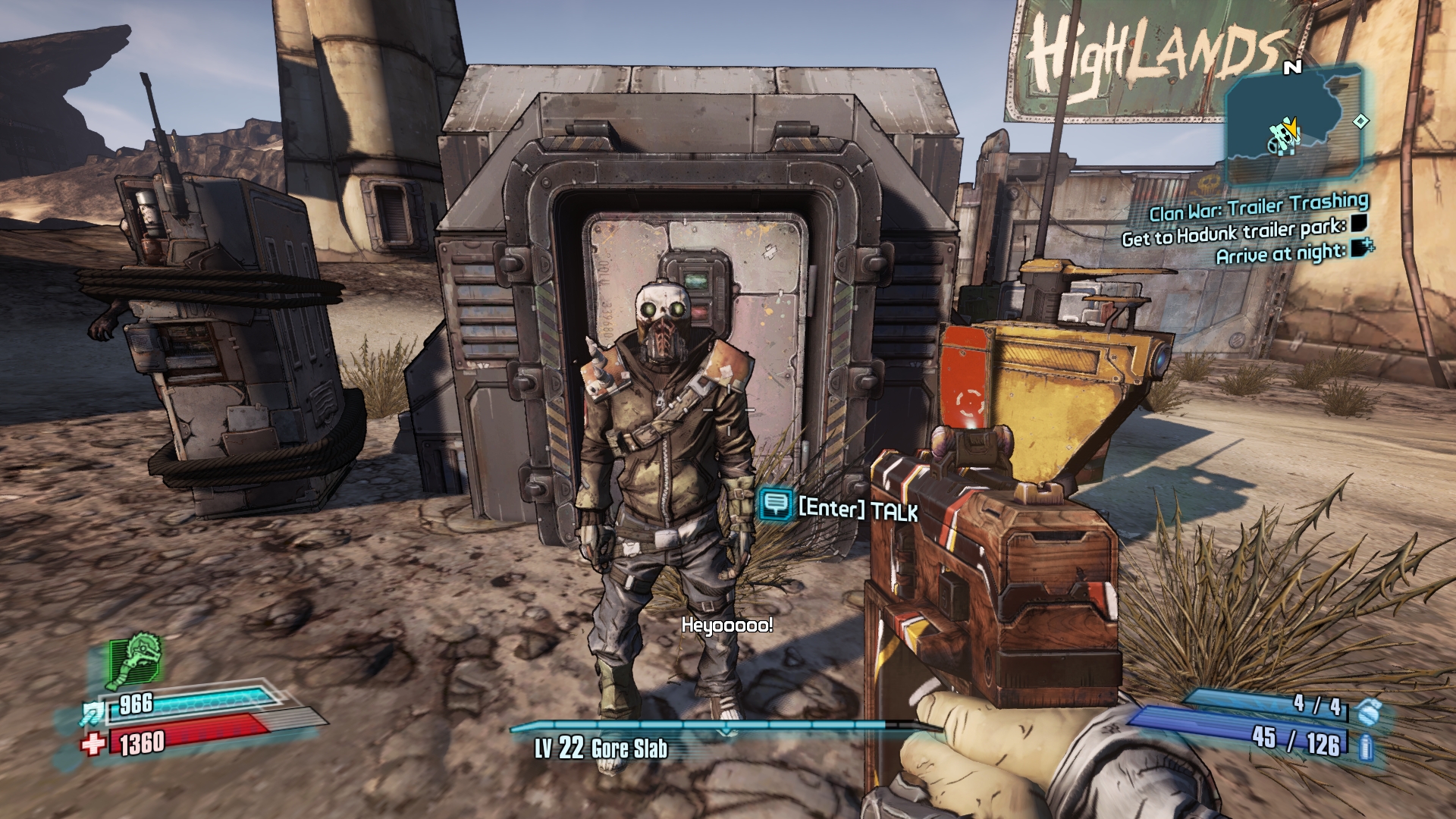
By the way, I have yet another atypical opinion to share: I hate the French version, which I find approximate, even inconsistent. For example, when a conflict between two groups of bandits is presented to us, the Slabs against the Sawtooths in the original version; the former become “Mastocs” whilst the latter keep their English name, pronounced with a Frenchified accent. “The Mastocs against the Sotouss”. Ridiculous.
Yet they took the trouble to fully dub the French version. I find it abysmal (sorry Christophe Lemoine)! That said, as we’re forced to restart the adventure three times, changing the language will at least have brought me a semblance of variety.
I would mention in passing that the sound mixing is poorly adjusted. It has to be said that I embody the most vociferous character in the game. His screams during combat being categorised as “dialogue”, I was forced to reduce the volume of all dialogue…
But what matters most in a shooting game is the sensation provided by the guns, isn’t it? The big question remains: in this domain, does Borderlands 2 surpass its predecessor? Do you want to know my expert opinion?
Well, I haven’t got a bloody clue! I spent 500 hours throwing axes at people’s heads.
The other complaints I have about Borderlands 2 roughly match those of the previous game. Let’s go through them quickly:
- Many side missions unlock too late, when we’ve already scoured the region and exceeded the minimum level to gain experience.
- I still don’t like manipulating elements, particularly the new one, called “Slag”, which I spoke about in my review of Lichdom: Battlemage (read it, it’s a game that would deserve more recognition).
- The 3D engine remains imperfect, the character frequently finds himself blocked by the slightest terrain relief or in front of doorway embrasures.
- The menus are heavy and the map lacks precision. Often, I go round in circles searching for a mission marker, only to discover that my objective is one floor below or above. This problem worsens further in Borderlands: The Pre-Sequel (2014).
- Occasional bugs remain in the “scripts”: objects or enemies that don’t appear as expected and prevent the accomplishment of a mission. This is generally resolved by quitting then relaunching the game, after having wasted time looking for a solution on the Internet.
- The lack of balancing persists: weapon power not always in relation to their rarity, excessive variance in scaling at high difficulty levels (notably Eridium weapons, less effective in Ultimate Vault Hunter Mode), certain talents useless or bugged, and of course, the damage sponge syndrome (it took me more than an hour to overcome Jackenstein at level 54).
For me, the main black spot lies in the obligation to restart the campaign three times before reaching the maximum level. It’s one time too many, and it detracts negatively from the overall impression. The fact remains that particular care has been given to the endgame; not the epilogue, but what happens afterwards. These are optional activities (borrowed from MMOs) aimed at pursuing the perpetual quest for new weapons, ever more powerful, by bumping off rare monsters or bosses repeatedly. This phase was present in Borderlands, but it consisted less of “hunting” than of restarting the game in a loop to reset the vendors’ stock.
I would nevertheless have wished for better balancing of bosses (too easy or too tough depending on the level at which one encounters them). Furthermore, the time-consuming activity of “farming” or “grinding” very quickly loses its appeal. I remember for example that the shotgun of my dreams (Casual Carnage), can only be obtained by killing insignificant creatures, which appear rarely, with a probability of desired loot of less than 1%. The tedious exercise wouldn’t bother me if it were accompanied by a stimulating challenge (exploring a difficult dungeon or defeating a dangerous boss). But here, the task proves totally trivial: walk a hundred metres and reload the game, for dozens of hours! I wasted several evenings without obtaining what I coveted, before downloading a save editor to force fate. Naturally, as soon as the legendary weapon was in my possession, I lost all desire to continue…
Along the same lines, I didn’t enjoy the “OP levels”. They’re the final layer of additional difficulty, an optional challenge that pushes the player to run the same dungeon multiple times, only to replace all their gear with identical items marked by an incremented number. At that point, it becomes necessary to optimize one’s build according to the current meta and to make use of the Slag element; in other words, to standardise the playstyle. Above all, it’s so repetitive that I never stuck with it for very long.
Despite its imperfections, Borderlands 2 brings interesting customisation options, and the complex synergies via the talent trees will delight statistics enthusiasts. It marks for me the golden age of the series, before the external setbacks that I’m going to detail further on, and the scriptwriting bankruptcy of the third episode…
I’ll finish with a dark anecdote. I have memories of one of the first YouTubers to have covered this game, Yoteslaya, who notably offered guides on weapons. He died in a car accident with two other people, while racing a train under the influence of alcohol. The irony is stark.
* * *
The review of Borderlands 2 stops here. I’m now going to address a long tangent on other pernicious trends in the video game industry, because this panorama is inseparable, in my view, from the series.
The growing influence of communication: Borderlands was released at the height of the social media boom, and Gearbox studio cleverly took advantage of it. It all started with trailers broadcast on YouTube, Facebook, Twitter (and later, Twitch), which players shared and relayed (viral marketing). Social networks then made it possible to measure engagement and retain the audience. Let’s take the example of golden keys, introduced with Borderlands 2; they were used to open a special chest, prominently displayed in the centre of Sanctuary (the base town), which contained guaranteed legendary loot. These keys could only be obtained with a promotional code (Shift Code) distributed by Gearbox (often directly by Randy Pitchford, the studio’s president, on his Twitter account). You can see where I’m going with this, can’t you? This powerful communication tool is a double-edged sword, or a Pandora’s box… It didn’t take long for their well-oiled communication to be parasitised by recurring controversies: accusations of embezzlement, alleged assault of Claptrap’s voice actor, sabotage of Aliens: Colonial Marines. Obviously, this kind of controversy existed well before social networks (just ask Peter Molyneux), but their frequency and repercussions have increased tenfold since the 2010s, leading to ruining carefully prepared launch campaigns.
This uncontrolled communication has the indirect consequence of revealing to the world the unhealthy corporate culture of large video game companies, usually so discreet. Let’s mention in no particular order: the sexual harassment affairs at Blizzard and Ubisoft, complacency towards Chinese censorship (the Blitzchung affair), crunch, greenwashing (Ubisoft boasts about its Play Green initiative, all while promoting NFTs), or indeed, assumed activism (culture war) which fractures the public (Avowed and its pronouns).
Pricing policy and contractualisation:
Amongst the marvellous inventions of the 2010s is the idea of making people pay for games a second time to access their online content. EA’s Online Pass, followed by Ubisoft’s VIP Pass, paved the way. Gearbox, always quick to follow the example of industry heavyweights, drew inspiration from this for Borderlands 2 by launching the Premier Club: an optional paid code giving access to exclusive bonuses. And if you had bought the game second-hand, you had to pay again!
Better still, you had the possibility of acquiring a Season Pass with Borderlands 2, giving you access to all the DLC (downloadable content) … at a preferential rate! All these pricing innovations prefigured the logic of microtransactions, loot boxes, live services, battle passes that we cherish so much today.
I associate another creative business tactic with this developer: the practice of selling their games piecemeal (chopping them up and selling them slice by slice). I’m not just talking about expansions, but the slightest cosmetic trinket, sold separately or in packs. These packs were frequently reorganised and redistributed under other names, sometimes leading to buying the same thing several times.
A concrete example? I bought the game again in 2023 on the occasion of a promotion. The pack in question was called The Handsome Collection and included more or less all the DLC, thankfully for a game released in 2012. Cost: €18.88. What was my surprise to discover that the Commander Lilith and the Fight for Sanctuary DLC (2019) was missing, which is poor, but essential to unlock character progression from level 72 to 80. And as luck would have it, said DLC was sold at full price (€14.99).
Several months later, I noticed the presence of another compilation, Borderlands Collection: Pandora’s Box, including Borderlands 1 to 3, plus Tales from the Borderlands, New Tales from the Borderlands and all the DLC (61 items!), sold between €146.74 and €27.24 according to promotions. That inspires confidence, doesn’t it?
And what would a modern franchise be without its obligatory DRM, accompanied by its evolving terms of use, and its liberal management of personal data? Under the guise of fighting piracy and cheating, this digital additive degrades performance and “spies” on you. Players’ mistrust has grown since Gearbox’s acquisition by Take-Two in 2024 and the revision of the end-user licence agreement in 2025, which was enough to trigger a flood of negative reviews on Steam. It should be noted that these outbursts, quick to blow rumours out of proportion, ought to inspire the same mistrust.
Shall I stop there? Hell no! I’d like to take the opportunity to salute this brilliant idea of plastering a disgusting advertising banner over the character selection screen. It’s the kind of trivial detail for some that completely riles me. There’s a way to remove it by deleting a file, but with Steam forcing game updates, it reappears regularly. I can’t see a better incentive for piracy than sticking an advertisement on the product I’ve paid for.
I’ll close with another delightful innovation: the beginnings of “always online”. Officially, it’s not compulsory in Borderlands 2. I nevertheless had the unpleasant surprise of receiving a notification in the game during a disconnection, followed by a systematic crash when I tried to restart it offline (general protection fault). I’ll give them the benefit of the doubt and consider that it wasn’t intentional, but I suggest you remain vigilant regarding this oft-criticised company.
The financialisation of the sector: It’s obvious, 3D games cost more and more, and the search for funding has become developers’ main preoccupation. Is this rise in budgets in such proportions justified, however?
- Borderlands: $10 million, 50 to 80 people in the development team
- Borderlands 2: $35 million, 200 people
- Borderlands 3: $95 million, 400 people
- Borderlands 4: $280 million, 800 people
It’s to increase the quality of games, we’re told. I’ll let you judge the quality of a Diablo 4, developed by more than 9,000 people.
Beyond the sarcasm (and these impossible-to-verify figures), this budgetary inflation leads to direct consequences: besides the increase in retail price, products that are more difficult to make profitable, diminished artistic coherence (I’m not going to repeat the spiel about standardisation), a release requirement aligned with the fiscal calendar without worrying whether the games are finished or merely playable. Add to that dysfunctional management, through replacing technicians with financiers, disconnected from reality, favouring a policy of compromise at the origin of recent industrial catastrophes such as Redfall (2023) and Concord (2024).
This scaling up also leads to: perpetual restructuring, studio closures, mass redundancies, and naturally, job insecurity. My point isn’t to drone on with a trade unionist discourse, but to denounce the continual degradation of game quality even as their budgets continue to grow.
It should be noted that a community patch is available on PC, the Unofficial Community Patch, which fixes a certain number of bugs, rebalances certain talents and modifies the behaviour of certain weapons. If, like me, you have trouble getting it to work, you need to activate it from the character selection screen.
Unlike the previous game, the DLC are of uneven quality. I recommend Psycho Pack, Mr. Torgue’s Campaign of Carnage and Tiny Tina’s Assault on Dragon Keep, not to be confused with Tiny Tina’s Wonderlands (2022) which is a separate game that I haven’t tried.
Borderlands: The Pre-Sequel (2014)
In this pseudo-sequel, which takes place chronologically before Borderlands 2, the player accompanies Handsome Jack in his rise to power. This game was criticised for its lack of innovation. The passages on the surface of Pandora’s moon, under reduced gravity, cause some irritation, but I liked the story and the characters. Amusing anecdote: I preferred playing with Aurelia, who nevertheless represents the exact opposite of Krieg in every respect (woman, black, frail, rich and sophisticated, ice element, specialised in ranged combat).
I also recommend the Claptastic Voyage expansion (2015).
Tales from the Borderlands (2014)
An episodic adventure game reputed to be well written, but which resembles an interactive film.
Battleborn (2016)
A hero shooter (the term would have been used for the first time by Gearbox), a genre neighbouring the looter shooter, focused on competitive multiplayer, riding the wave of the live services fashion and the success of Team Fortress 2 (2007). It couldn’t compete with Overwatch (2016).
Borderlands 3 (2019)
… exists.
You know what? I was planning to leave it at that, but inspiration flows naturally when it comes to spouting nastiness, so here we go!
Let’s start with the positive, the weapons, particularly the double-barreled shotgun inspired by Doom 2!
Graphically, the game is more appealing, that was expected, but the interface remains as badly designed as a sprained ankle (that unfixed map, what an aberration!).
And behind the facade, it’s narrative shipwreck. The collapse of writing quality in Borderlands 3, symptomatic of the modern entertainment industry, is very well described in this video and in that one.
If you want a summary, all the characters have become unbearable through their talkative narcissism, their pretentious mannerisms (accompanied by an excess of references to the real world), through their obsessive need to shoehorn jokes (not funny ones) into every line, like a Marvel film, and through their propensity to constantly shout. As a bonus, the general tone, excessively vulgar, cynical, even nihilistic, which was already present in previous episodes, but ends up tiring everyone and finishes making the characters unlikeable. Even the villains manage the feat of being exasperating while remaining fiercely politically correct. The contrast is striking with Handsome Jack’s flamboyant and disturbing presence.
Another problem, I wasn’t yet hearing talk of “wokism” at the time (and I won’t pretend to have understood what this word means), but we’re witnessing in any case the first signs of perverted feminism. The female characters become overpowered, authoritarian and condescending, while the male characters are rendered incompetent, immature and cowardly. Let’s not forget the obligatory homosexual couple of characters, who have no other narrative function than to remind you at every moment of their orientation!
John Carmack, one of the programmers of Doom, asserted that the storyline in a shooting game was as important as in a porno. I would propose the following corollary: from the moment you sell us a story, that you impose it on the player through cinematics suspending the action for long minutes, and if this story proves to be so wretched, then it takes precedence over everything else. Because of it, Borderlands 3 has killed all the interest I had in this series (much in the same way as Dragon Age Inquisition).
One last notable point, linked to the writing, concerns the assassination of beloved characters, whether literal (Maya, Aurelia) or figurative (Rhys, Vaughn, Tannis). For a franchise to endure over time, it’s important to respect it. I could digress about Star Wars, but I think that’ll suffice for today.
Alright…
|