The Killing Cloud
| Developer: Vektor Grafix | Graphics: |
 | |
| Publisher: Image Works | Sound: |
 | |
| Year: 1991 | Difficulty: |
| |
| Genre: Action | Lastability: |
| |
| Number of players: 1 | Rating: |
6/10 | |
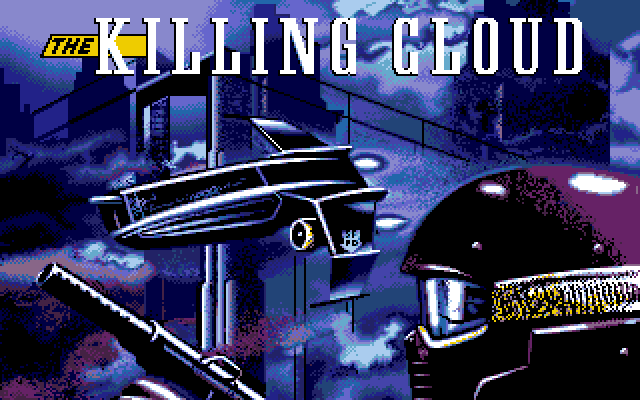
San Francisco, 1997, in an increasingly less near future … a deadly cloud has blanketed the city. Survivors fled to the upper floors of the tall buildings and adapted. “Walkways” were built linking the tops of the towers, and the manual also mentions a suspended tramway, though neither of these structures appears in the game. The setting is fleshed out by a short story some fifteen pages long (accompanied by a comic book, at least in the American version), which offers little beyond run-of-the-mill noir scenes scattered with futuristic jargon. I’d rather have learnt how these people eat. How are the residents at the top of the towers resupplied, given that the airspace is contested by an ultra-violent gang?
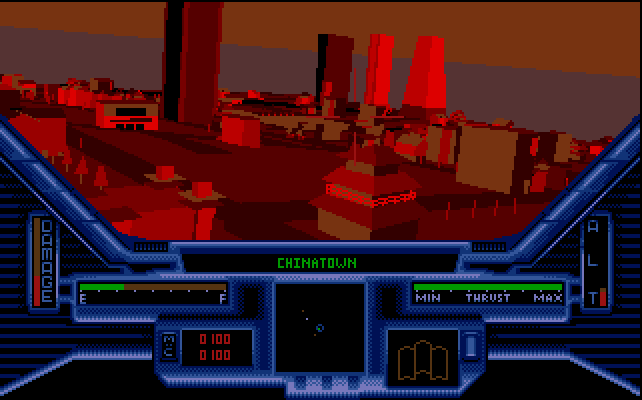
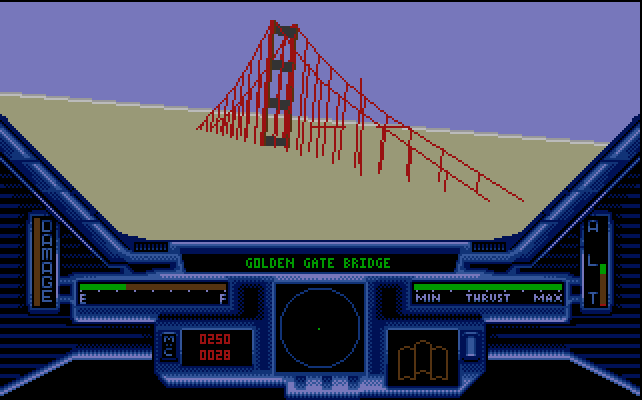
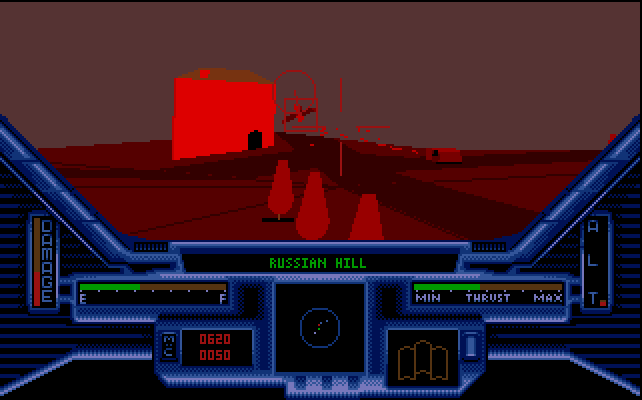
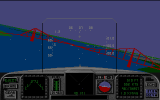
With no explanation given, I came up with my own theory: having modelled a 3D city without skimping on the number of buildings or the level of detail (just look at the pagoda-style houses typical of Chinatown, for instance), the developers must have found that their 3D engine couldn’t handle so many polygons without dreadful slowdowns. So they cut the draw distance and justified the decision after the fact with this cloudy, post-apocalyptic premise. I don’t hold it against them, since it’s a nice change from the usual flat, chequerboard terrain. Call it a forerunner of Turok (Nintendo 64, 1997) and Silent Hill (PlayStation, 1999), which would likewise use fog to mask their technical shortcomings.
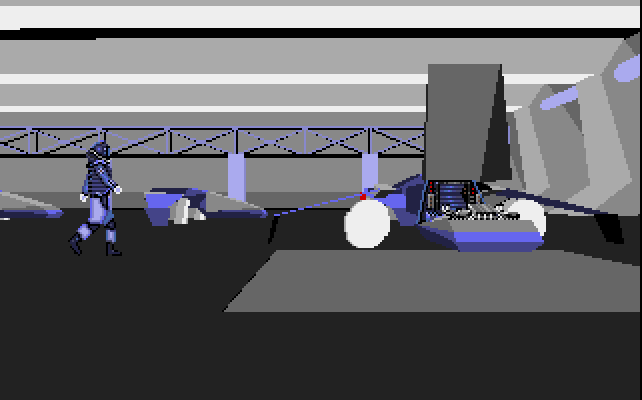
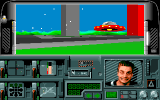
Be that as it may, the player takes on the role of a cop stationed at a police precinct perched atop a skyscraper, locked in conflict with a gang ravaging the city. Both sides pilot flying shuttles, heavily armed and with handling that defies gravity: you can slow right down to zero, hold a stationary hover, or even reverse like some floating car. It’s even possible to land anywhere and explore the city on foot (wearing a protective suit). The appeal stays limited, though, given there’s no interaction with the scenery, that getting around takes ages, and that the camera lurches about as if you were drunk. The developers nonetheless seem keen for this feature to be used on every mission.
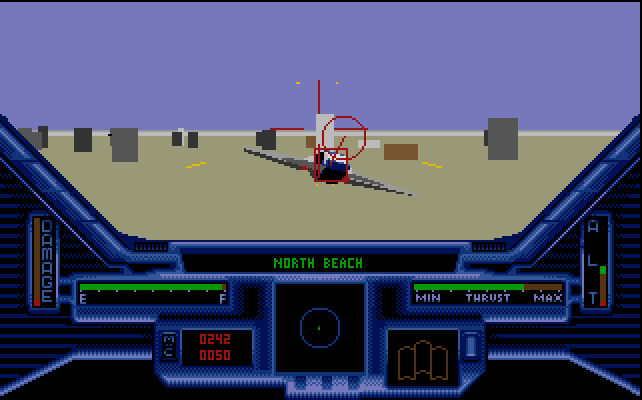
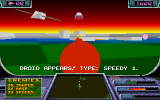
Aerial combat proves more convincing. A lead-angle reticle shows where to fire ahead of the enemy ship, factoring in its speed and trajectory. Engagements against several targets, weaving between buildings, are spectacular, but sadly make up only a fraction of the game, swamped beneath a pile of side activities that are tedious and largely pointless, which I’ll now run through.
Missions most often consist of locating and then apprehending suspects for questioning. In practice, that means capturing targets alive with a net launcher, landing nearby, getting out of the shuttle to read them their rights, then calling in a remote-controlled flying pod (PUP) tasked with ferrying them back to the precinct. The whole procedure rests on a string of poorly conceived game systems.
To begin with, the net launcher and the PUP have to be parachuted into the city before the mission, then retrieved on site. Yet the game lets you skip this essential step and head off on a mission with no way of actually completing it. It even lets you take off without ammunition or air reserves, should you fancy it. Next, the PUP becomes useless if you drop it too far from the arrest site, which you’re supposed to know in advance. What’s more, this equipment is limited in number across the whole campaign. Use too much of it, and you’ll find yourself stuck several missions down the line. Drop just one net and miss your target, and there’s no choice but to restart the mission. Once the target is caught, you still have to manage a swift landing; the engine-off and shuttle-exit controls only respond about half the time. Dawdle for a moment and the suspect gets away. Suppose everything goes off without a hitch, you then have to wait several long minutes for the PUP to load the suspect and deliver them to the precinct, that’s when it doesn’t simply stop dead halfway there for no reason. Why all this fuss?
The lack of information doesn’t help matters. The city map, for instance, can no longer be checked outside headquarters. In mission 2, two targets are flagged; one to capture, the other to shoot down, with no on-screen indication to tell them apart. The only advice worth following is to wait until they fire at you, return fire, then save the net for whichever vehicle is the last left standing.
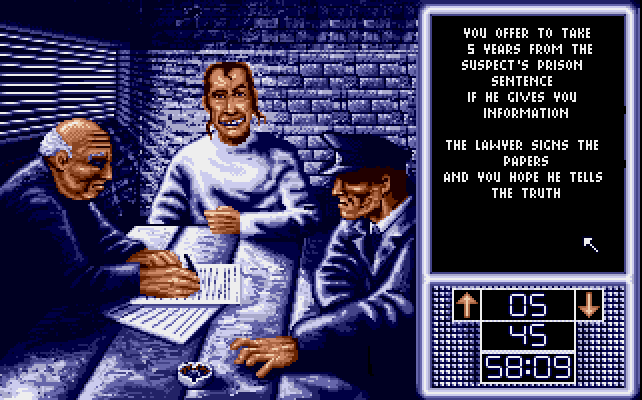
The missions are interspersed with an interrogation mini-game similar to APB. According to magazines of the time, the original plan was to rough up the suspect physically to make them talk, but Amnesty International apparently put pressure on the developers to change this. Instead, you “negotiate” by knocking years off their sentence. If they agree, you move to the next question. If they refuse, you get nothing, but they keep their reduced sentence! Once it’s whittled down to zero, the suspect walks free and the round ends. It’s slow, illogical, and hollow; one more layer of flashiness at the expense of substance.
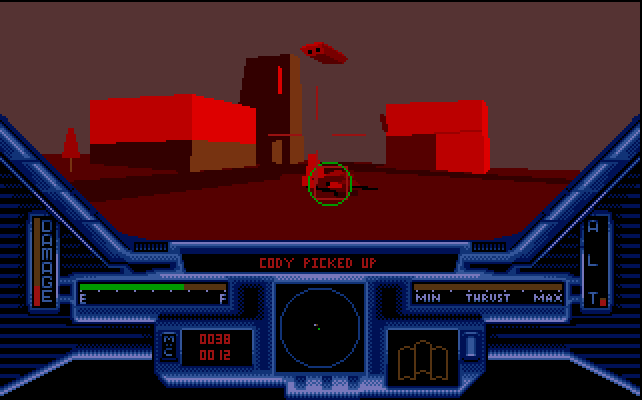
My opinion was set in stone by mission 5, which gives you two minutes to find a bomb, pick it up, and drop it over the sea. Two minutes is precious little, especially when you don’t know what you’re looking for. What does a bomb even look like in this game? A red cube lost among dozens of other red cubes? I have no desire to wrestle with the landing controls and stretch my legs. Why not simply let me shoot at everything that moves in the sky? Why does the game insist on making my life so difficult? And once again, I suspect this draconian time limit betrays the designers’ own lack of confidence in their creation.
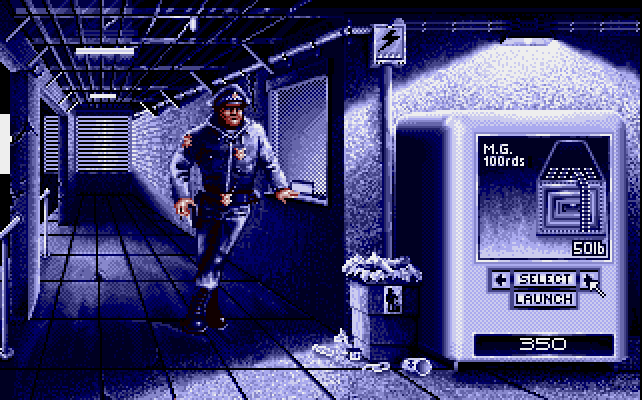
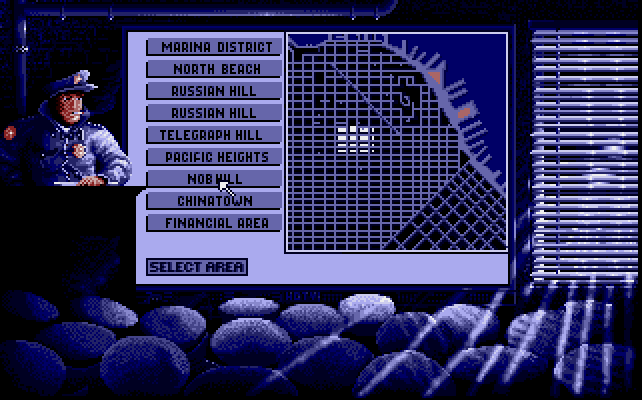
Another artificial mechanic: loading up equipment just before missions (survival suit, fuel, ammunition). What’s the point of this illusion of choice if you’re forced to take everything anyway? For the sake of atmosphere? It’s all very well polishing the mood, but I felt cheated by these stylish screens, which seemed to promise an evolving arsenal in later stages, paired with a genuine decision on my part. Not a chance! They might just as well have scrapped this screen entirely and handed out a standard kit, as in any other game.
To my mind, The Killing Cloud would have benefited from focusing on its strengths, namely flying and combat, and cutting everything else: equipment drops via the tactical map, the interrogation mini-game, the bomb hunts. Besides, the 3D world, more detailed than average, remains static and underused. Its intricate geography seemed well suited to exploration missions in the style of Damocles, provided they were woven in smoothly, without the player ever feeling them as a chore.
On Amiga emulator, the game has a habit of stubbornly demanding you insert the second floppy disk even when it’s already in the drive (the second drive doesn’t seem to be recognised). Go along with it, press Space as many times as needed, and it will eventually give in. There’s no fathoming Amiga games sometimes… Another typical oddity: the language choice is only available on the copy-protection screen!
The PC-DOS version runs more smoothly, but is weaker on the sound side. The best option, reserved for the more seasoned among you, would be to use the WHDLoad patch and install it on an Amiga hard drive. Personally, I manage to muddle through as far as the first error message (“object not found”, in this case), without being able to fix it.
Here are the main keyboard controls (used alongsid the mouse for turning and firing):
- E: turn the engine on/off.
- T/R: zoom out/zoom in on the radar.
- B/V: increase/decrease speed.
- M/C/N: arm the machine gun, the cannon, or the net launcher.
- F/H: flight mode (default) or glider mode.
- S: apprehend the suspect (on the ground, on foot).
- I: end the mission (on the ground, on foot, on the roof of the precinct, and crucially once the PUP has finished its routine. If it refuses to land, the F6 key seems to rouse it).
- W: refuel.
- G/D/A: pick up/release/trigger a bomb (missions 5 and 10 only).
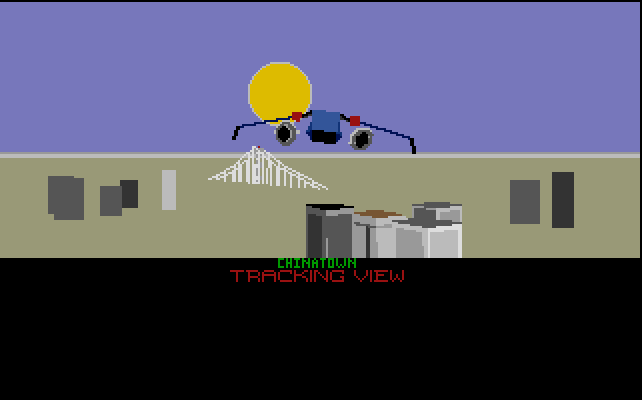
F1 to F6 and the number keys offer various camera and display options. The “6” key, in particular, strips away the fog and reveals what the 3D engine is really capable of, but only in the first mission.
Its spiritual successor: G-Police (PlayStation, 1997).
|