Albert Odyssey: Legend of Eldean
(Saturn)
| Developer: Sunsoft | Graphics: |
 | |
| Publisher: Working Designs | Sound: |
 | |
| Year: 1996 (Japan), 1997 (USA) | Difficulty: |
 | |
| Genre: Role-playing game | Lastability: |
| |
| Number of players: 1 | Rating: |
4/10 | |
I shall call it Albert Odyssey, though its original title is Albert Odyssey Gaiden in Japan, to distinguish it from the main series (two tactical role-playing games of the same name, unknown in the West, released in 1993 and 1994 on the Super Famicom). The title in question was initially intended for the same console (the Super Nintendo in our part of the world), before migrating to the Saturn partway through development.
Let us recall that Japanese role-playing games (and their animes) have a remarkable propensity to irritate me, notably through the impulsiveness and irrational behaviour of their protagonists. I retain a vague memory, for instance, of Final Fantasy 8: in the middle of an important mission, during which we were supposed to stand guard, one member of my party abruptly decides to abandon her post for an absurd reason. She tells me to stay put and walks off… I wanted to carry on with the mission, so I did not move. Yet the game clearly expected me to desert alongside her. Time had frozen, leaving me no other option. The episode put me off so thoroughly that I stopped playing on the spot (at this very moment). I rather like to imagine that, 27 years on, my character is still standing guard, suspended in wait for a signal that will never come…
The phenomenon is not exclusive to Japanese productions, in fact. I had the same reaction watching the series Banshee. Despite two attempts, I could not get past the first episode, so strongly did I disagree with the hero and his convoluted scheme to steal the identity of the local sheriff, fresh out of prison and on probation…
Albert Odyssey irritated me for similar reasons, and others besides. I feel I have wasted the better part of twenty hours on it and feel compelled to write a piece about it. Blame the sunk cost fallacy. I shall never get those twenty hours of my life back; this game has stolen them from me. More than that, in fact, since I had already completed it when I was at secondary school (without being able to explain how), before revisiting it in 2016, only to abandon it halfway through. The story is divided into two acts, and one companion is replaced by another at the start of the second; unable to stand her, I brought the relationship to an end. My most recent attempt (in 2026) did not last nearly as long, as I no longer possessed the mental fortitude to endure those wretched random encounters…
Let us set aside that thorny subject for the moment. I find that the intro sets the tone perfectly: over a static, brownish-sepia image (ugly), a gravelly-voiced old narrator drones on with platitudes, slowly, barely articulating. It drags on and on, one can barely make it out … sorcerers … dragons … magic sword… Right, then.
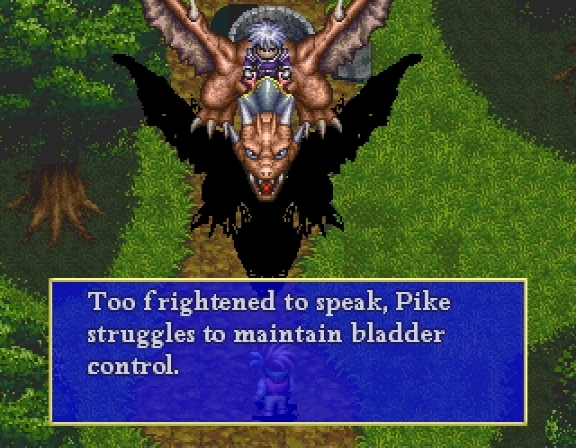
The adventure then begins, and one must concede that the presentation exudes an undeniable charm. The backdrops are detailed and colourful, the animations carefully crafted, the music … tolerable. It is no coincidence that I returned to it twice. The game is visually engaging; except perhaps for the world map, empty and flat, betraying in passing its design origins (the famous “Mode 7” of the Super Famicom, a somewhat dated 3D effect by 1996, achieved through the rotation of a horizontal plane).
The story follows Pike, a young orphan raised by a pair of harpies (winged beings living in the treetops). Suddenly, an evil sorcerer attacks the village, steals a sacred crystal, and turns his adoptive elder sister to stone (a strangely familiar feeling…). He sets off in pursuit, companions join him along the way, and he soon finds himself swept up in a quest to save the world, threatened by … sorcerers … dragons … armed with a magic sword … and the power of love. Any further questions?
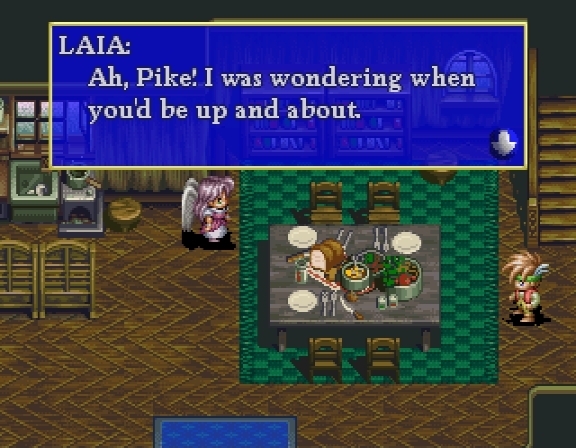
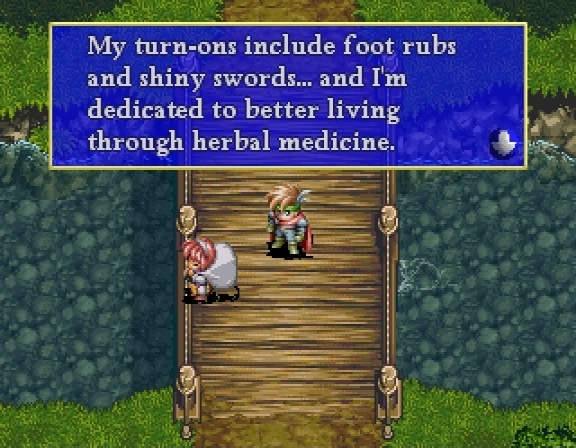
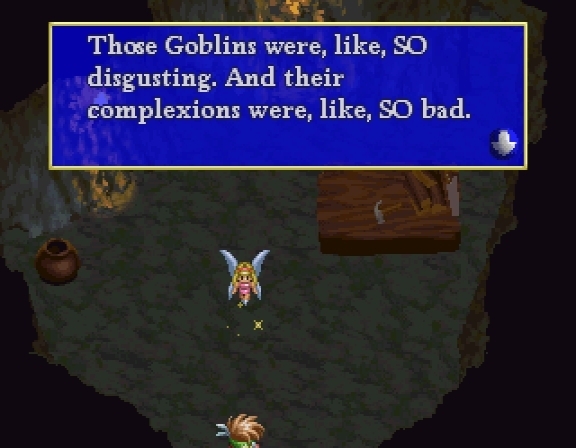
Conventional? Undoubtedly. Soppy? Yes and no… The studio “Working Designs”, responsible for the localisation for the American market, was renowned for its “liberal” translations of Japanese role-playing games, packed with anachronistic jokes, occasionally risqué, and in frank dissonance with the original work. In principle, I prefer a faithful translation; but given the atrociously generic nature of this title, I do not think much is lost. The French dub of Fist of the North Star had given me the same sense of unease, until I discovered the original Japanese. One need not understand Japanese to realise that two thirds of the dialogue consists of nothing more than characters repeating each other’s names on screen, staring into one another’s eyes with a constipated expression:
Ken: Toki!
Toki: Ken!
Raoh: Toki!
Toki: Raoh!
Lin: Keeeeeeen!!!
Ken: Nani?!
Apparently, Working Designs did not merely rewrite the dialogue – they had a habit of tinkering with the code to fix whatever they took a dislike to. In the case of Albert Odyssey, they reportedly increased experience point distribution, reduced loading times, and lowered the frequency of battles. I find it hard to believe… The original version was even worse?
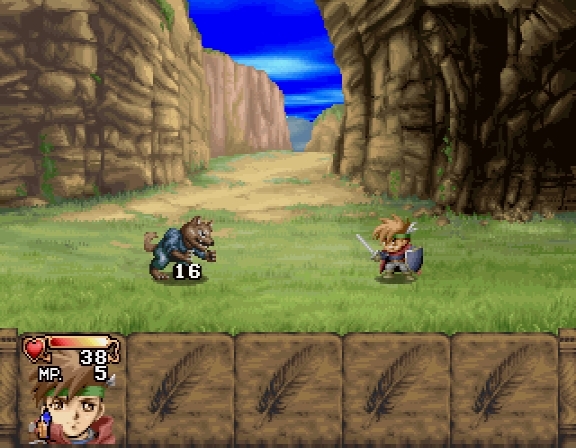
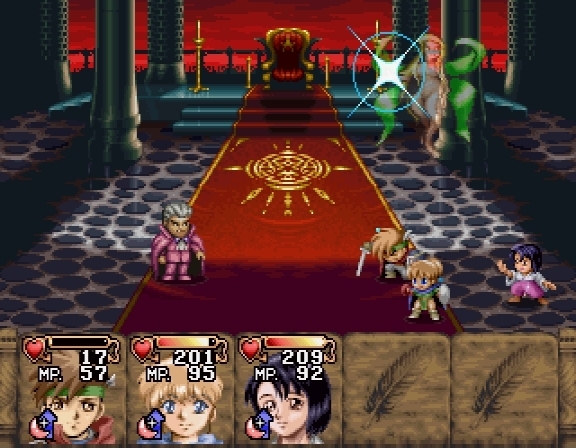
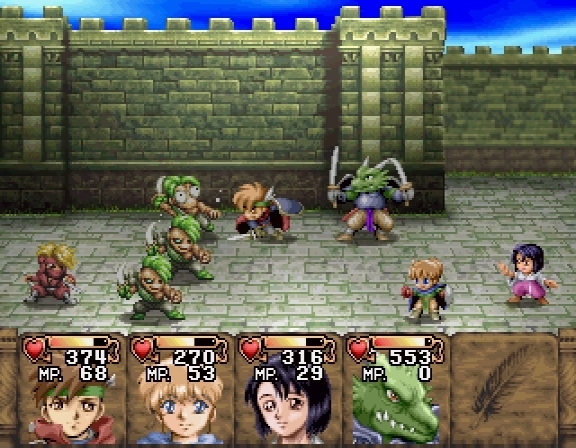
The combat … is mind-numbingly repetitive, dumb as a post, and incredibly intrusive. I timed it: an interruption every … one to ten seconds. Yes, one second! Add five seconds of loading, before and after. The enforced procedure boils down to hammering the “attack” button while throwing in the occasional heal. As usual, status spells are utterly useless, and so are items. I never quite grasped how to use half of them, in any case (perpetually greyed out in the inventory).
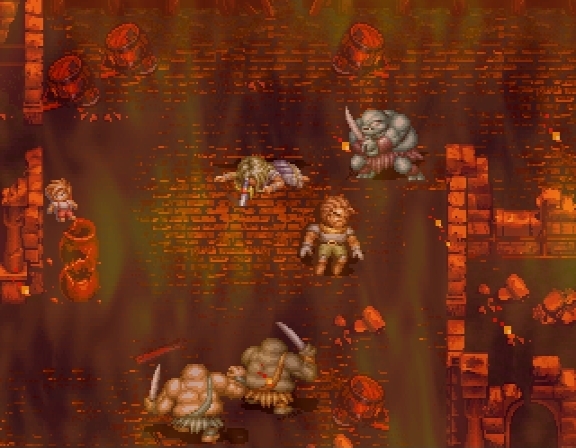
Moreover, these incessant interruptions caused me to lose my bearings in the dungeons (which were hardly complex to begin with). I would advance three steps: random encounter. I would emerge from the battle and turn around: random encounter… Balan’s Fortress in particular, roughly a third of the way through the game, frayed my nerves to breaking point. After hours of wandering (chopped to pieces by random encounters with the same two types of enemies), I finally stood before a large door … locked. It appeared I had neglected to visit one room. I therefore retraced my steps and combed the dungeon from top to bottom, harried relentlessly by battles. I was at my wit’s end! I eventually found the room, before laboriously making my way back towards the large door … in the wrong direction. I ended up at the entrance. I could have thrown myself out of a window! The game (and I along with it) suffers enormously from the absence of an auto-map. And that is merely a taster compared to the final dungeon…
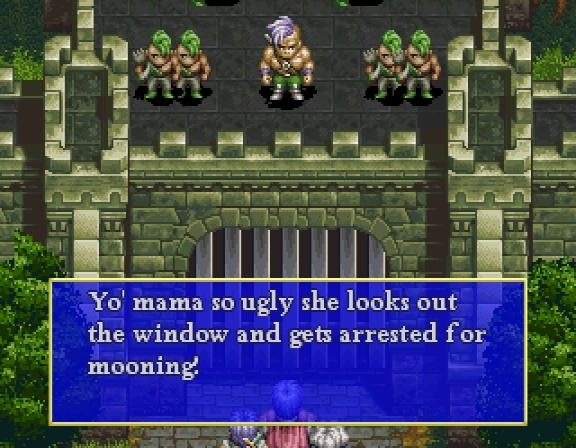
The crowning absurdity is that after all these tribulations, I had gained so many levels that the battles, even against bosses, no longer presented the slightest challenge, making the game even more tedious. And outside of combat? No puzzles, no customisation, no engaging plot. There are a few villages to visit, all identical; copy-pasted house interiors, and the clichés come thick and fast: the audience with the king, elderly and bearded, glued to his throne in his square castle, asking a 10-year-old child for help whilst his bumbling army is fit for nothing more than standing to attention on either side of the doors. I had the distinct feeling of living through this scene for the thousandth time. I should add that one is obliged to speak to absolutely everyone, in order to trigger the scripts that open up a new path (or a large door…). The more the game wears me down, the more I feel the urge to skip sections, and the more I end up kicking myself when I reach a dead end.
I shall close with a true anecdote: Albert Odyssey bored me so thoroughly that I muted the sound and opened YouTube. Providence (or the algorithm) presented me with this video by Yahtzee Croshaw, on the theme of: “If you’re not having fun, you can stop”. Just what I needed to extricate myself from this ordeal! Without the slightest hesitation, I therefore crown this game the most insufferable of all time, across all platforms. Let us be charitable, though … joint first with Hawkeye! Even if the latter could not have stolen more than two hours of my life.
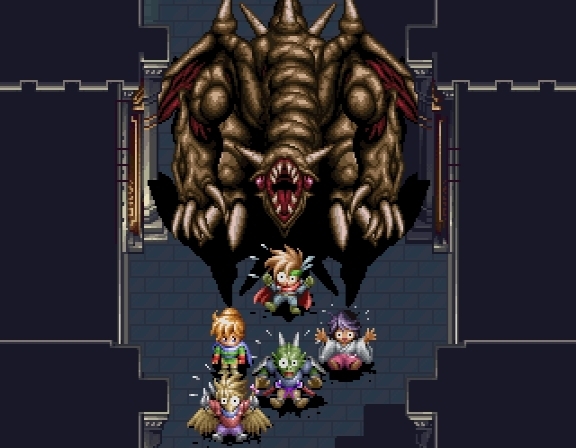
A cultural footnote: the first boss lets out a “Howie” scream. No, that one.
|