Heroes of Might and Magic (PC)
| Developer: New World Computing | Graphics: |
 | |
| Publisher: The 3DO Company | Sound: |
 | |
| Year: 1995 | Difficulty: |
| |
| Genre: Strategy | Lastability: |
| |
| Number of players: 1 to 4* | Rating: |
7/10 | |
(*) The “campaign” mode is played solo, while the “Scenario” mode offers 18 maps (34 in the version currently available) for 1 to 4 players.
Heroes of Might and Magic (which I shall refer to by its shortened name, Heroes) inaugurates a long series of turn-based strategy games set in a heroic fantasy universe. For reasons that I suspect are purely commercial, it was tied to the famous Might and Magic franchise, a lineage of traditional first-person role-playing games; though a more natural ancestry traces back to King’s Bounty (PC-DOS, 1990).
I had intended to pay tribute to Heroes 3, the series’ flagship title, still played online in 2026 by a vast community of enthusiasts. Then I remembered that this was the Eldorado of forgotten games, not iconic ones. What better candidate than the very first entry, overshadowed by all its successors? I confess to a rather mischievous ulterior motive, having observed among devotees of the third instalment a certain disdain for the later entries – particularly the fifth, accused of betraying the “canon” with its naff storyline and cartoon 3D aesthetic (reminiscent of Warcraft 3). Personally, I find Heroes 3 a touch dreary, and I rather wanted to confront those purists with the opening of the very first opus, so that they might steep themselves in the authentic original spirit: light-hearted and exuberant. We may return to this on the page for the fifth entry, should my ramblings spiral into a full retrospective… I shall, however, pass over episodes 6 and 7 in silence, unanimously decried for their excessive simplification and the obligation to use Ubisoft’s online platform (which acquired the licence in 2003, following the bankruptcy of the original publisher).
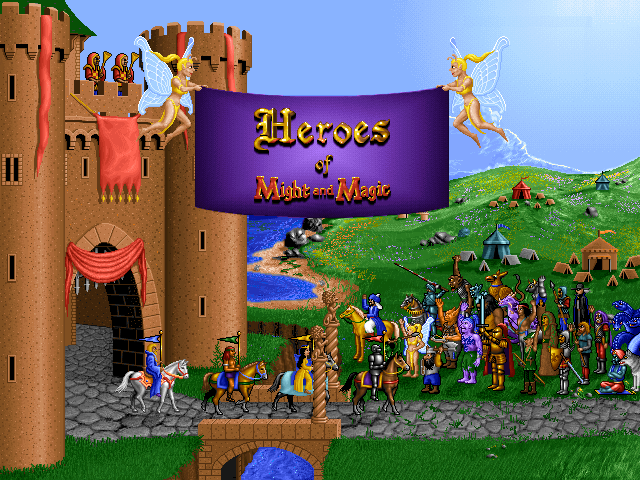
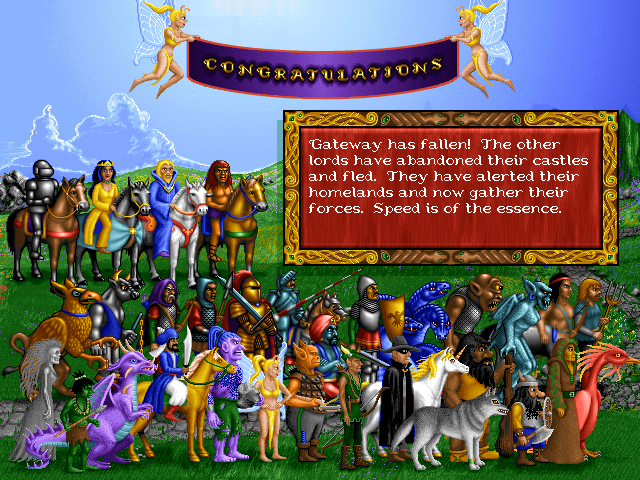
Heroes opens on a medieval scene that appears lifted from a children’s picture book. In the background, you can make out the sea, bordered by a reef, then rolling green hills dotted with tiny colourful tents. To the left stands a castle. Its portcullis rises and the four rival sovereigns ride out, processing along the road on horseback. To the right, a motley crowd cheers them on, gathering together every creature in the game (24 of them!). The charmingly simple animation heralds a naïve and delightful universe – while, from the perspective of a modest strategy enthusiast, the campaign is relentlessly brutal!
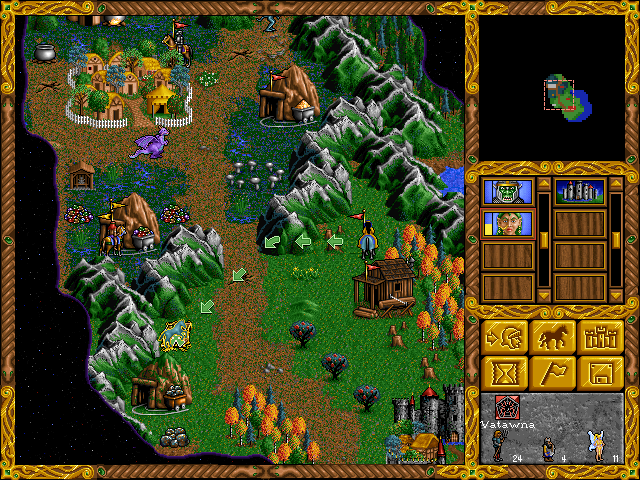
Another surprise: I have rarely encountered an interface so readable and ergonomic (left-click to interact, right-click for information). I found my bearings immediately, a sign that the presentation and mechanics have scarcely evolved since 1995. An apt moment, then, to describe the foundations that would be refined in subsequent titles.
You guide one (and later several) mounted heroes across a map, as in a board game, spending the movement points allocated each turn. Unlike its predecessor, King’s Bounty, the neutral creatures on the map never move. They simply block the road or guard an item, rendering a portion of the combat optional. One difference from that model: the colourful, attractive maps are crammed with things that glitter – piles of gold coins, treasure chests, gems, magical monuments, all manner of lairs… They are everywhere, and one feels compelled to collect everything, to visit every corner. It is eminently addictive, calling to mind the tidying neurosis mentioned on the Boulder Dash page (did you really think you would escape without a reference to Boulder Dash?).
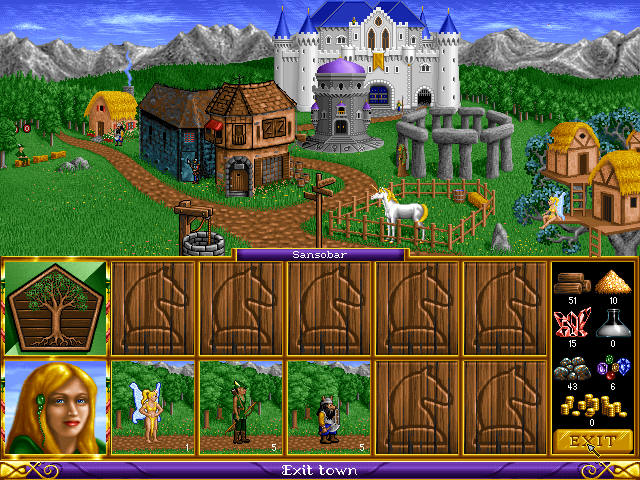
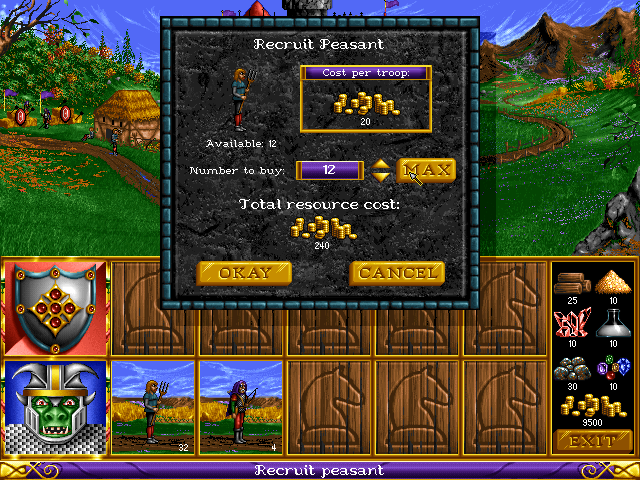
However, the density of objects somewhat diminishes the sense of journeying or losing yourself in unknown territory. The scale feels reduced, and there is less freedom to explore the world in the face of rival heroes, ever ready to descend upon your stronghold in your absence. Optimising your movements becomes the primary concern. A race unfolds to accumulate the resources needed to develop your towns and recruit an army, composed of human soldiers alongside mythical and fantastical creatures (cyclopes, minotaurs, unicorns, dragons…). Town management proves more involved than in its predecessor, whilst remaining very accessible for a game of this type. Each turn represents a day, during which you may erect a single building per settlement (subject to your finances and the six types of resources at your disposal). Certain structures produce new units each week, while others improve your defences or confer various advantages.
To this board game-like framework, they incorporated various elements drawn from role-playing games: heroes accumulate experience, gain levels and improve their statistics, conferring attack and defence bonuses upon their army or bolstering the effectiveness of the spells they are able to cast during battle. Further improvements are provided by artefacts scattered across the region (or plundered from defeated heroes).
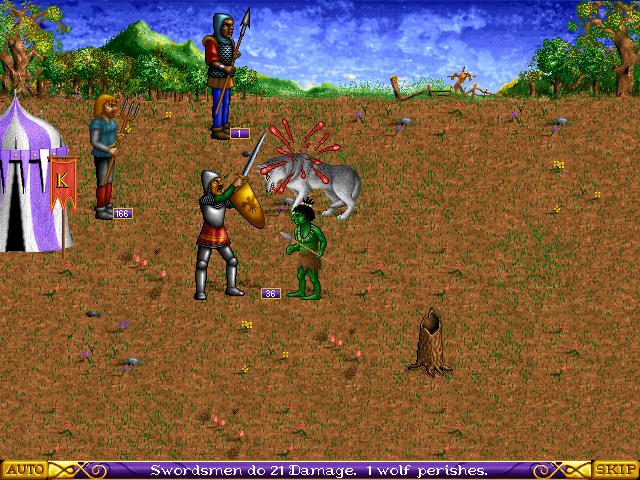
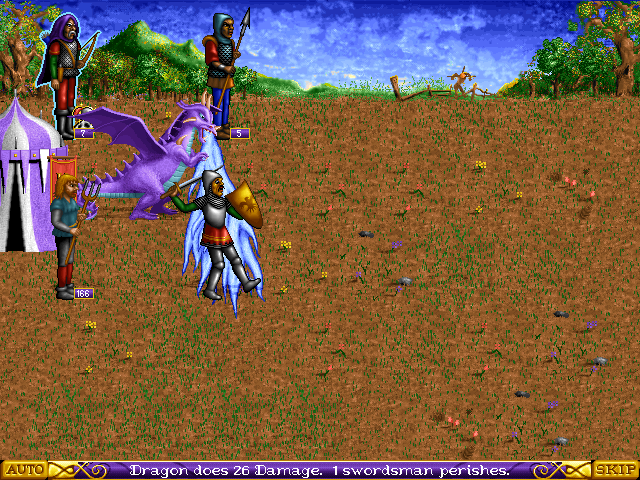
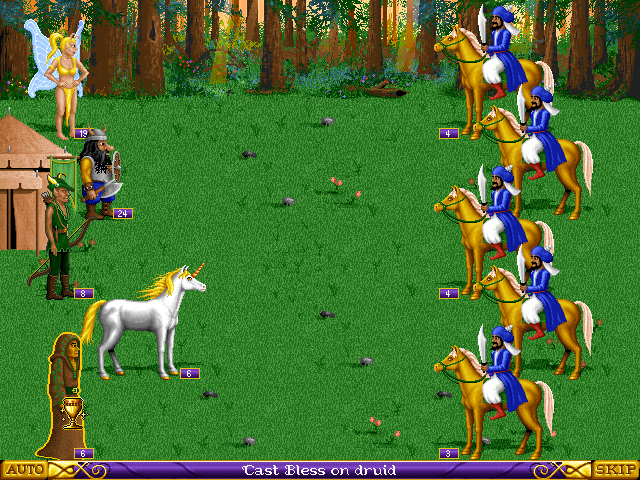
When a hero encounters a group of creatures, a rival, or one of his towns, a battle commences on a grid-based (hexagonal) terrain, in the manner of King’s Bounty. Imagine a game of chess viewed from the side, where each group of creatures is represented by a piece, adorned with a number indicating its strength. Each piece moves in turn, potentially dealing damage to an opposing piece, until the enemy army is destroyed or its general flees (not before craftily casting a “lightning” spell upon your most valuable unit…). Note that morale and luck factors are already present (influencing the frequency of action and damage dealt, respectively).
Although exploration occupies a less prominent role than in King’s Bounty, the notion of treasure hunting returns periodically. Inspecting various obelisks, scattered to the four corners of the region, gradually reveals the fragments of a treasure map. Careful exploration and a keen eye sometimes allow you to identify the area depicted without even completing the puzzle. All that remains is to make your way to the spot marked with an X and sacrifice a turn to dig (while hoping that a rival has not beaten you to it). It is a game within the game that provides a gratifying element of risk – and a powerful artefact into the bargain.
What makes the campaign particularly taxing against the computer, beyond our numerical inferiority and fewer resources, is unfamiliarity with the terrain. I shall take this opportunity to grumble once more about the obscuring of the map – not the “fog of war” concealing enemy positions, which is realistic (but absent here). I find it quite absurd to have the location of neighbouring towns and the layout of roads hidden from me when I am supposedly defending my own territory! This makes sense in a game such as Colonization, where one is setting foot on a new continent for the first time, but certainly not here. My “strategy” therefore amounts to restarting each mission at least once, having first identified the shortest route to the important resources and the next town to conquer. A considerable element of luck also comes into play, particularly in the initial selection of spells.
Since we are on the subject of unpleasant aspects, let’s enumerate the principal differences from the subsequent titles:
- The game features five factions, but the campaigns are identical (same maps), which amplifies the feeling of repetitiveness.
- It is impossible to split a unit stack using the Shift key (except on the troop-sharing screen between two heroes, or between a hero’s army and a garrison).
- There are no mana points as yet. Each spell has a set number of uses, as in Dungeons & Dragons. I do not normally care for this system, but it suits the game well here, as it encourages you to experiment with the variety of spells available and the tactics that go with them.
- The traditional grid-based battlefield is relatively cramped, which particularly favours flying creatures, capable of striking from the very first turn (archers and mages take a dreadful beating!).
- No marketplace for trading surplus resources (introduced in Heroes 2).
- No carry-over of hero statistics from one mission to the next (added in Heroes 3).
- No advanced options during battles, such as delaying one’s turn or defending (introduced in Heroes 3).
To conclude, Heroes represents a piece of history, worth discovering for its cultural significance (or out of fondness for its childlike aesthetic), but entirely surpassed by its immediate sequel, which remains faithful to its spirit (vivid and colourful) and is so magnificently enhanced. I’ll come back to it in a few months…
In my capacity as a conscientious curator of forgotten games, I feel compelled to point out that while Heroes, and above all its sequels, popularised the genre, they by no means invented it. Among its precursors: Civilization (PC-DOS, 1991), Warlords (Amiga, 1991), Realms (Amiga, 1991), Master of Magic (PC-DOS, 1994), Hammer of the Gods (PC-DOS, 1994).
… Not forgetting Castle Quest!
Where to buy it?
It is frequently on sale for under 5 euros.
 GOG
|
|