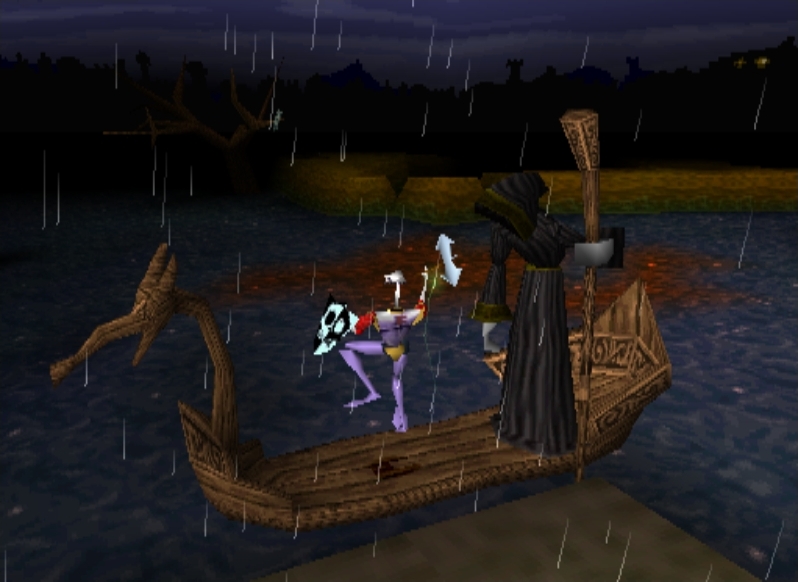
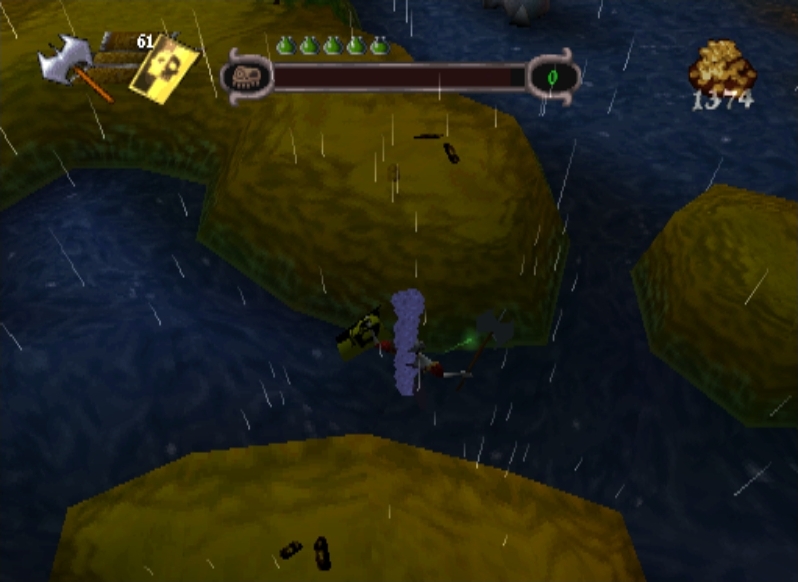
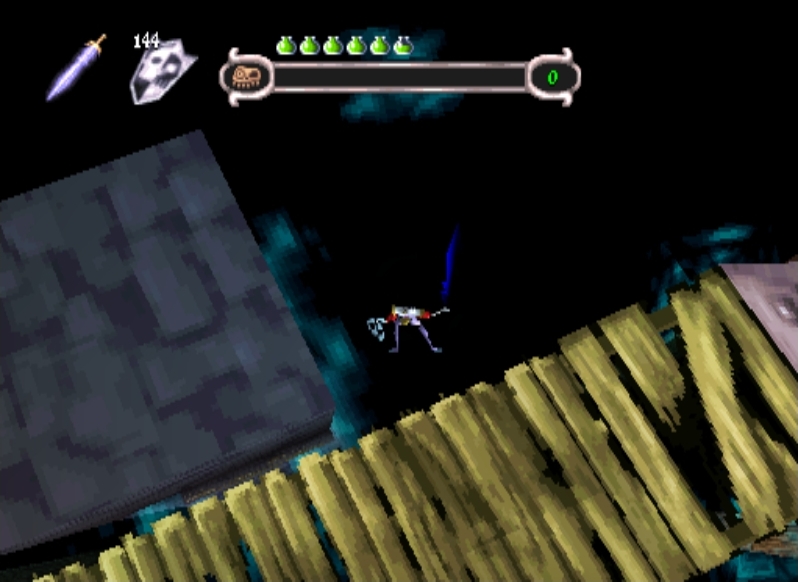
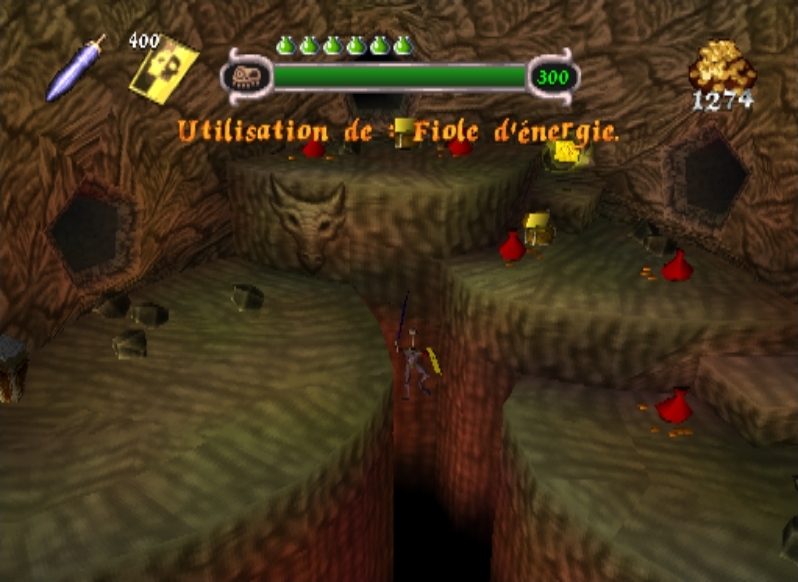
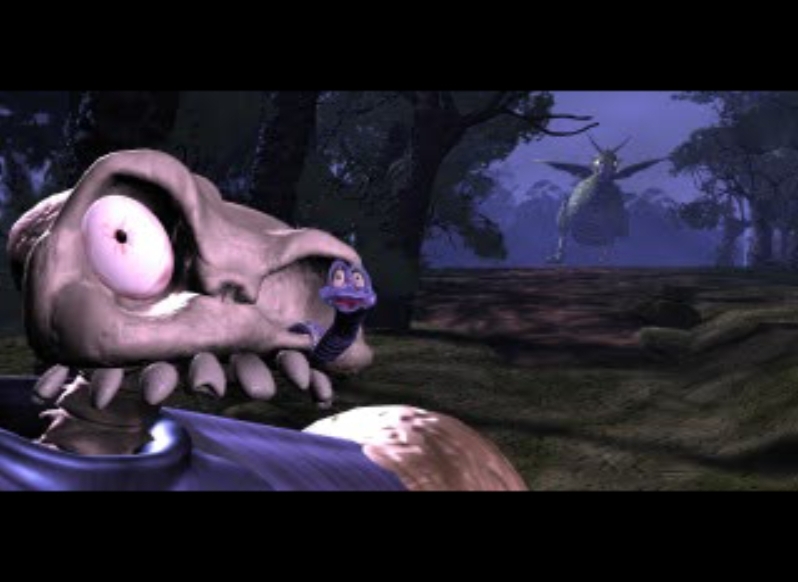
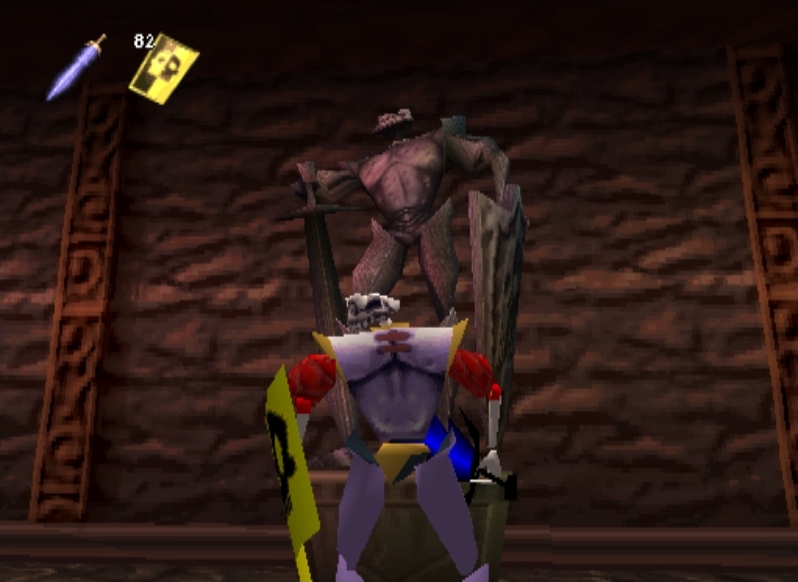
Legend has it that the fantastical land of Gallowmere was once saved by a hero, Sir Daniel Fortesque, who at the end of a glorious battle slew an evil sorcerer, instigator of a demon invasion. The reality is less flattering. The knight fell during the very first charge, victim of an arrow in the eye. A hundred years later, the evil sorcerer returned, cast a spell on the local cemetery to raise an army of the undead from the ground, and Fortesque was reanimated at the same time. He is now the kingdom’s last defender. A chance for him to rise to the height of his usurped legend, and earn his place in the “Hall of Heroes”, where fallen warriors feast for eternity…
MediEvil was reportedly conceptualised as a 3D Ghosts ‘n’ Goblins. Over the course of development, the arcade aspirations faded, perhaps due to technical limitations, resulting in a hybrid of puzzle-adventure game, interspersed with combat and platforming sections. It won’t surprise you, I think that none of these three elements is sufficiently polished, but that’s not really what matters to me… It’s time for my digression!
What? Not happy?
To begin with, I owe a great deal to this game – it’s one of those that motivated me to create my website back in 2000! It’s the archetype of the “recent” title I wanted to turn away from: in 3D, and propelled by insane media hype. I heard so much about it that I came to adopt the same incorrect pronunciation as everyone else (in France), to my great shame: “meh-dee-eh-veel”. Ugh! That said, I’ll never bring myself to pronounce “for-tes-kyoo” like you guys…
At that time, I still read the gaming press. It must be acknowledged that it exerted a strong influence on my purchases. Even today, its influence weighs on the questionable manner in which I evaluate games, through that little summary table that probably makes you roll your eyes. But unlike at my place, their (glowing) reviews were often accompanied by full-page advertisements, which testified to these magazines’ financial dependence on the good relations they could maintain with studios, foremost among which… Sony. The situation has obviously not changed today.
Now, I remember feeling particularly annoyed, in 1998, by the promotional din surrounding MediEvil in particular. We were fortunate to be living through a period when technology was progressing rapidly, and when technical novelties (3D notably) were being highlighted at the expense of everything else. People were shouting to the Moon because a 3D game seemed to be reinventing the wheel, by implementing puzzles, dialogues or pre-rendered cutscenes, without questioning what they fundamentally brought, compared to the classics of the past. I imagine the previous generation experienced the same phenomenon when the first platformers arrived on Amiga, with great fanfare, whilst they merely clumsily copied the proven mechanics of 8-bit games, with more colours.
And you won’t believe it, but the coverage of MediEvil in the specialist magazines was unanimous and effusive. Some praised “the graphic magnificence” (Console +), others lauded the camera that “twirls in harmony with your movements” (PlayStation Magazine), “a real delight […] it will hardly ever bother you” (Consoles News); or again, “its wealth of adventures” with puzzles “worthy of a Father Fouras in top form” (Joypad). Needless to say, I didn’t quite share this enthusiasm…
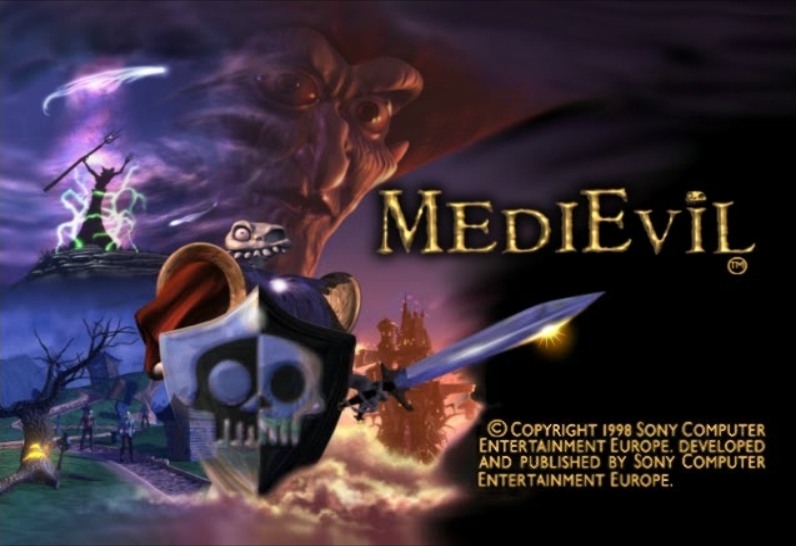
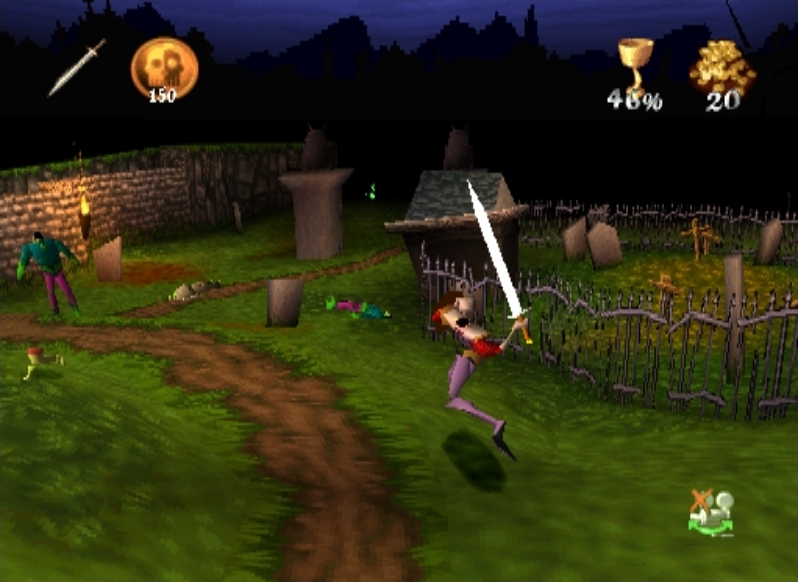
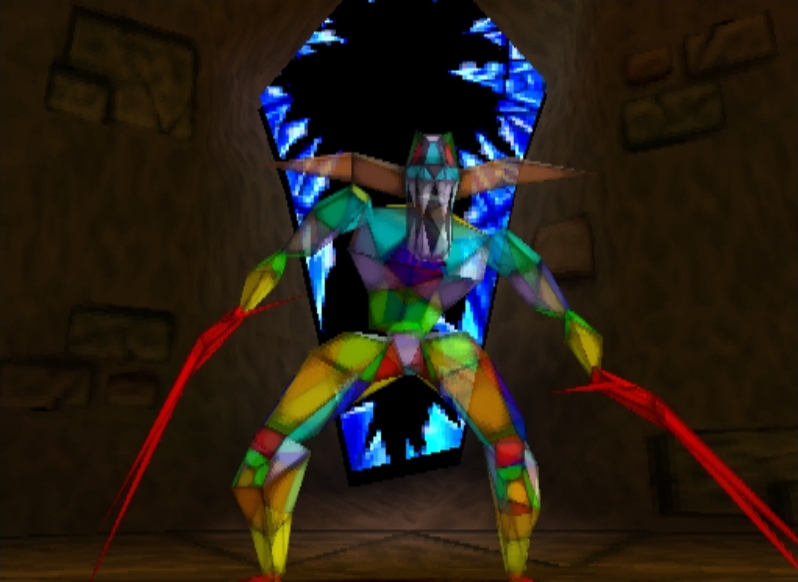
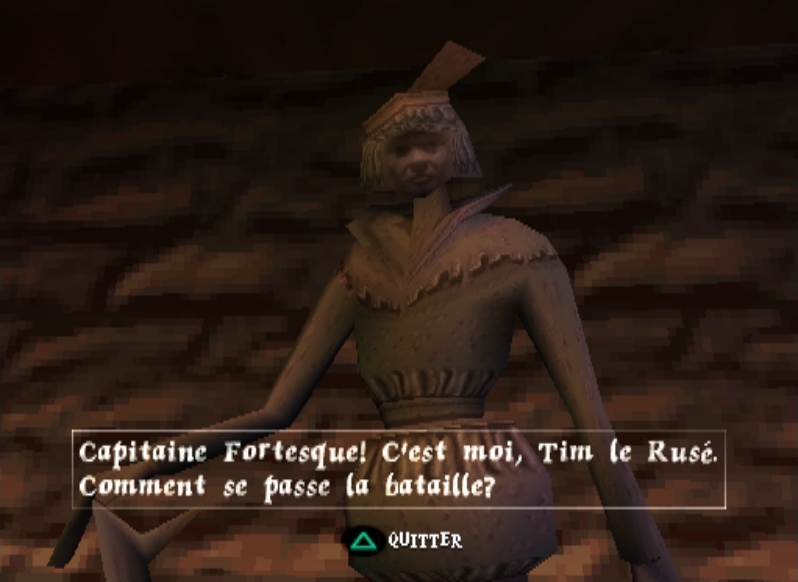
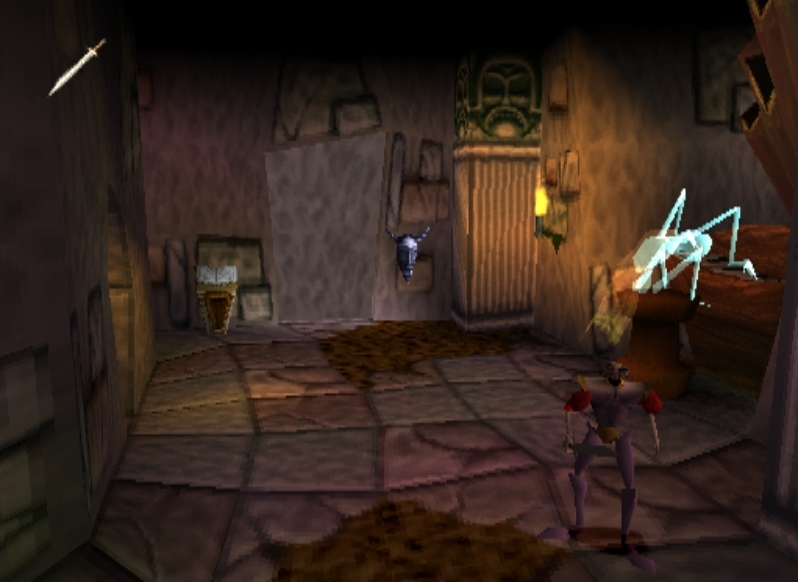
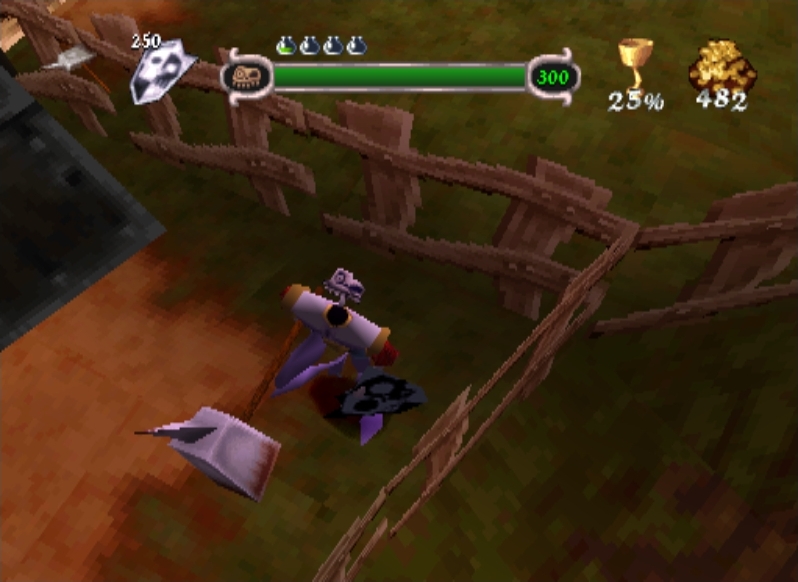
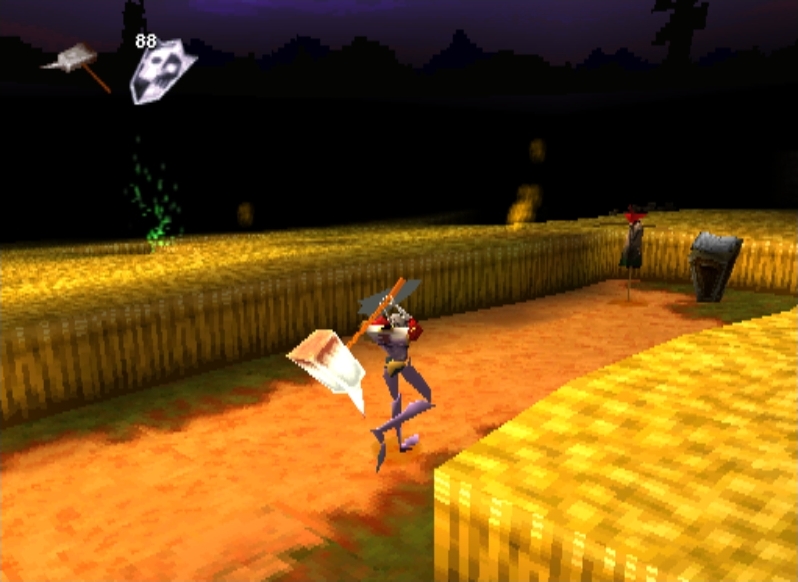
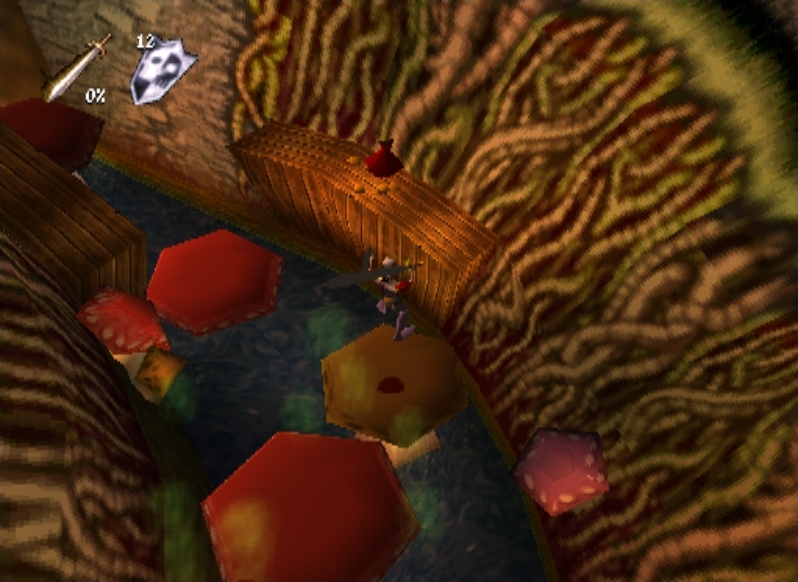
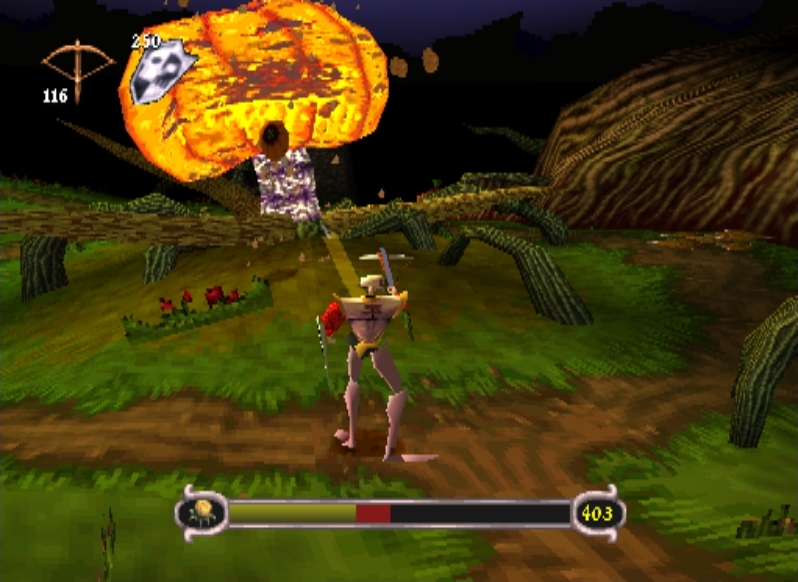
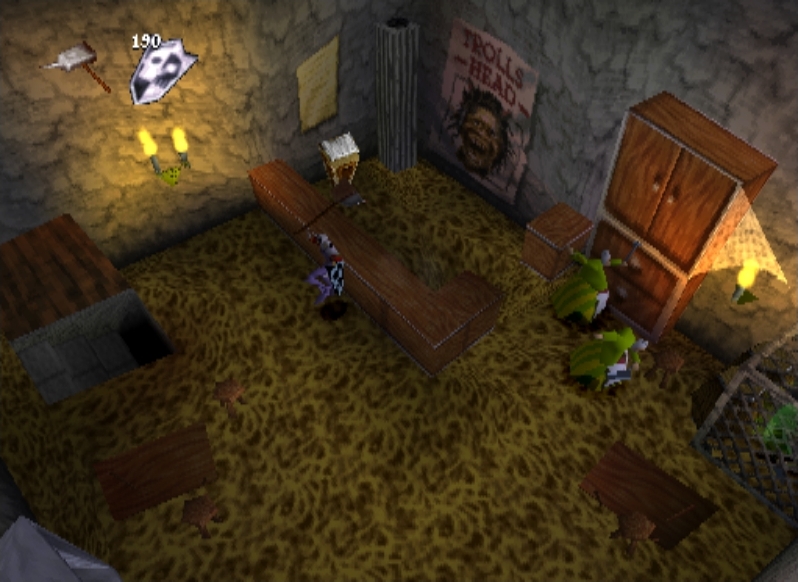
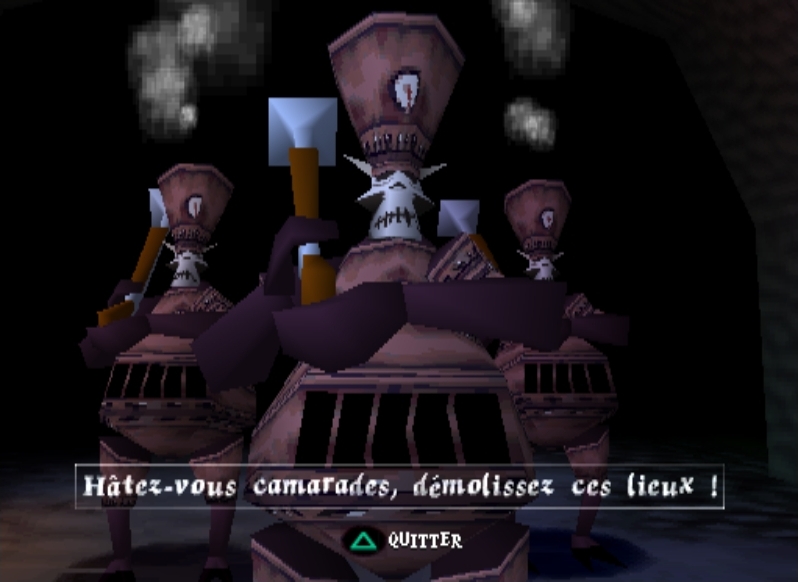
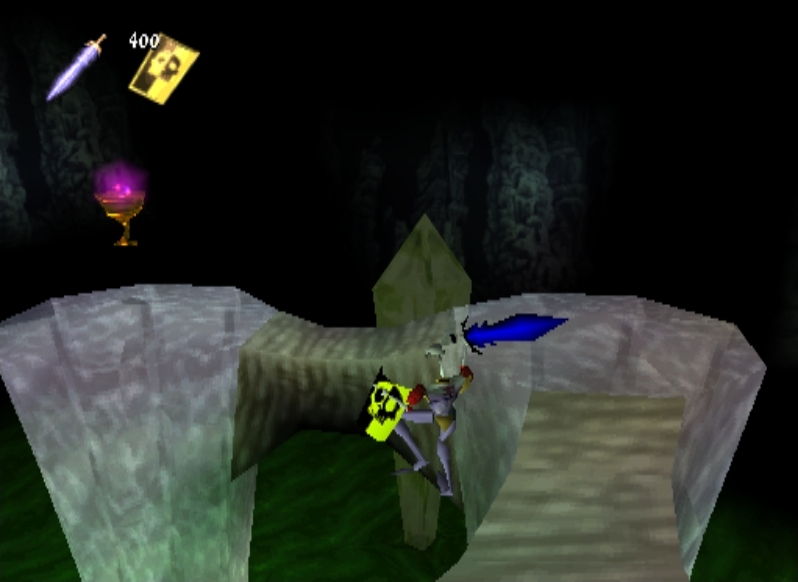
You’ll notice from the opening scene that MediEvil’s “art direction” draws heavily on Henry Selick’s The Nightmare Before Christmas; an opportunity to mention that I’m not sensitive to Tim Burton’s universe, but my problem lies elsewhere: the ugly 3D of the ’90s, which I already found ugly in the ’90s… In the game’s defence, the images shown here were captured with an emulator, without applying any filter. On a CRT screen, the rendering wasn’t as pixelated.
The fact remains that 3D platformers, or 2.5D ones (those that maintain movement on a single plane, like Pandemonium) have long suffered from a number of disadvantages. Firstly, the perspective effect, detrimental to visibility. Secondly, whatever one might say, a necessarily reduced level of detail (compare Rayman and Rayman 2). The loss wasn’t merely aesthetic, as the limit on the number of polygons displayed (notoriously on PlayStation) imposed compromises in the complexity of levels, which became either cramped (Crash Bandicoot), or conversely, leaving much room for emptiness (Mario 64).
This period certainly marked an important stage that allowed us to evolve towards today’s photorealistic games, but I was surprised that these degradations were presented to us as progress. One notable exception for me: Tomb Raider (1996). Lara Croft handled like a lorry, but diving from the top of a cliff gave me vertigo. It was the first time I felt the added value of a third-person 3D view, because the level design cleverly exploited height and space. Ironically, the “ugly 3D” style came back into fashion in the indie sphere in the 2020s. It’s probably a generational thing, like the mullet, the bum bag, wearing a moustache, or the first name Augustin. Appreciation is often binary and dependent on our age…
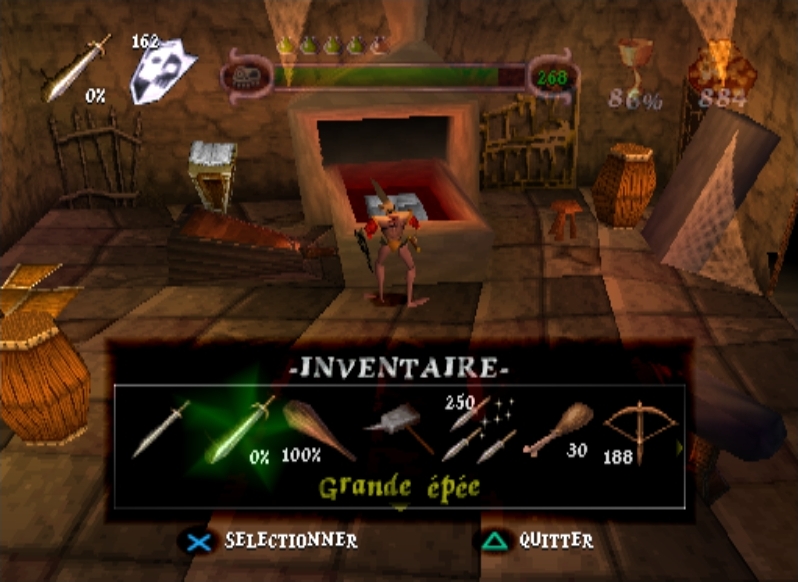
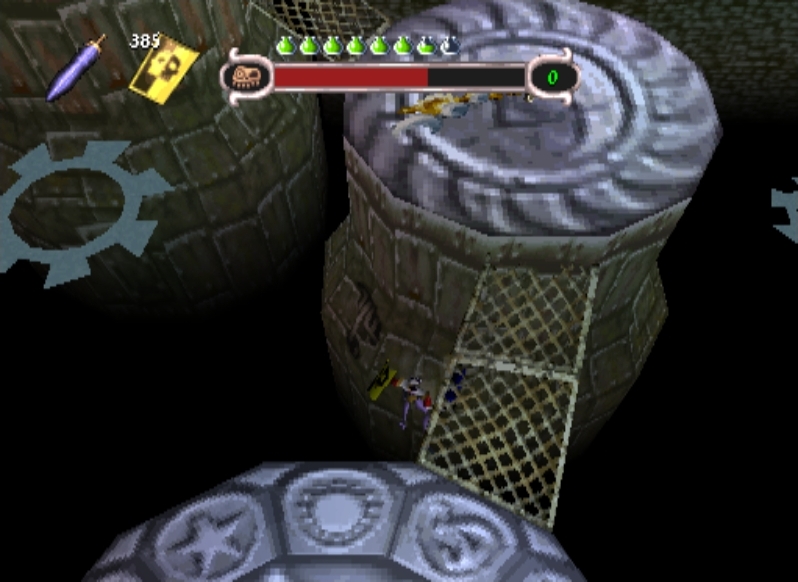
One positive point I nonetheless grant to old 3D games: they knew how to differentiate themselves (for better and especially for worse). 3D engines were almost always custom-made; the controls, specific to each game, and another rarely noted detail: the stylised interface contributed to their visual identity. I’m saddened by the uniformisation of menus or health bars in today’s games (these minimalist rectangles depress me).
MediEvil interests me for another reason. It represents that wave of 3D titles that preceded the modern standards we’re accustomed to. One immediately realises the progress made, controller in hand, in 2025; whereas at the time, not a soul was troubled by the button configuration. Reviews in magazines didn’t even mention it. As an anecdote, one of the games that introduced the current control system (left stick: movement, right stick: camera) was slated in the press for this very reason!
Here, one is allowed to choose amongst three configurations, but none provides the “cross” button for jumping – I had great difficulty getting used to it (the emulator can reprogram the buttons, but I was in a masochistic approach). Furthermore, the first time the world map opened, upon leaving the crypt, it took me several minutes to understand that the game was expecting a diagonal movement with the directional pad (it took me even longer to configure the emulator to activate the analogue stick). MediEvil takes advantage of the DualShock controller, strongly recommended for directing the character with the stick, in “always run” mode. Otherwise, running is triggered by pressing twice in a direction, which isn’t at all practical.
This brings me to combat, which is imprecise and confusing. The lack of ergonomics doesn’t help matters, such as using the triangle button to block with the shield, combined with the cross button to attack. And if you have the misfortune of trying to block whilst moving, it’s the forward charge that triggers! After a few clumsy attempts, I preferred to rush into the fray, accepting to take damage rather than fall into water or into a hole, and lose a life immediately. In any case, the shield deteriorates quickly, then breaks, which further discourages using it.
With the sword, half the time, the blow goes over the enemies’ heads. I found the character even more clumsy than Chauncey, I tell you! At a distance, it’s even worse. The auto-aim can’t keep up with moving targets, and projectiles being limited and costly, I ended up doing without them. For your information, the game’s most powerful ranged weapon is disposable. Impossible to reload it!
Moreover, the camera direction proves particularly laborious. At certain moments, it decrees that you don’t have the right to see in front of you, and at others, it refuses to rotate around the character (particularly when he’s moving!). Under these conditions, it’s difficult to avoid blows (or falls). The developers surely became aware of this, and compensated by granting the player a gigantic health bar, with its retinue of healing potions, transportable and automatically usable. For me, it’s an admission of weakness. On top of that, health doesn’t recharge between levels, so we must regularly return to an earlier ones to restock on potions. This tedious procedure only seems justified to mask the game’s short lifespan (or to annoy me, that’s not ruled out).
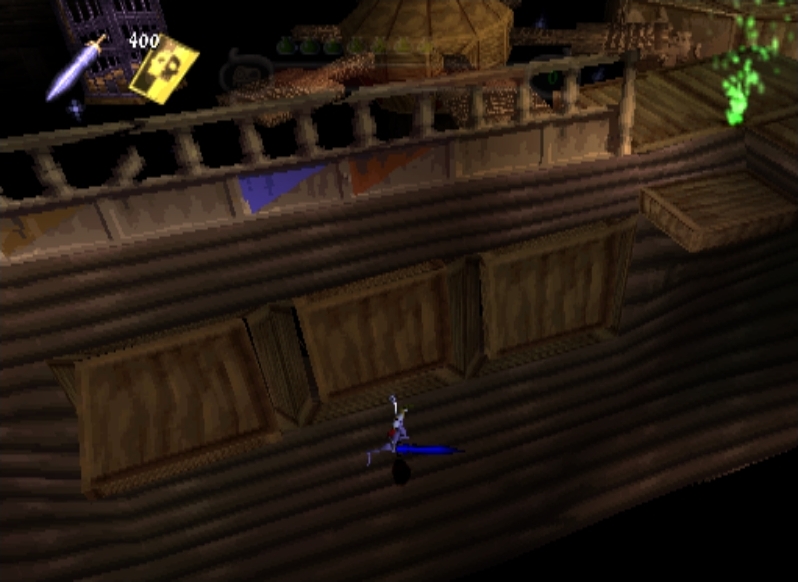
As for the environments, they seemed poor and compartmentalised to me; the platforming sections, few in number, basic, and obviously unpleasant because of that camera. The pirate ship level, at the end, is the only one to make use of moving platforms (a fond memory for you?). Generally speaking, I found the game’s mechanics excessively standardised. I was bored, to the point of not lasting more than two levels in a row.
If there’s one episode I enjoyed in this game (and which I remembered), it was the all-too-brief nod to Smash TV in the asylum level. The “brute force” approach seemed more suited to the approximate controls. It’s also one of the rare places where the camera remains fixed.
Our nag’s arsenal comprises some fifteen weapons, most of them redundant, which are obtained in exchange for chalices, optional objects, lazily hidden, constituting the only incentive to explore. One nonetheless remains very far from the rewarding secrets of The Legend of Zelda: A Link to the Past (Super Nintendo, 1991).
I’ll finish with the aspect that disappointed me most. How can one praise a game to the skies for its technical performance (delicate to appreciate) without reporting the obvious worthlessness of the “puzzles”? At best: pick up an obvious object, use the object ten metres further on, open a door. A glimmer of hope crossed my mind when I discovered a giant chessboard where haunted pieces moved by themselves. It was intriguing. I move closer, it was simply a matter of hitting them to push them towards a matching colour square… Another example: the puzzle with buttons symbolising the four elements. The riddle consisted of pressing all four, in the expected order … after having tried all the combinations, one by one! Do you find that stimulating? Amusing? Worthy of a Father Fouras in top form? Or worthy of a Father Coffe?
Some will advance the argument that MediEvil was aimed at children. I indeed think that the majority of its admirers played it very young, or allowed themselves to be conditioned by marketing. From my recollection, it wasn’t promoted towards children, and even if that had been the case, it wouldn’t excuse its shortcomings. Mario 64 and Spyro the Dragon were intended for children, and are both easily superior on all fronts (handling, camera control, level design).
It’s a personal opinion, perhaps harsh, but I think MediEvil is a three-legged consensual product, vastly overrated in its time. It left me with the same impression as the console version of Mr Nutz. Yes, yes, once again, my opinion is in the minority. I’m offering it to you anyway.
MediEvil had a sequel, MediEvil 2 (PlayStation, 2000), then two remakes: MediEvil: Resurrection (PSP, 2005) and MediEvil (PS4, 2019). A chance for it to rise to the height of its usurped legend? No, I’m joking.