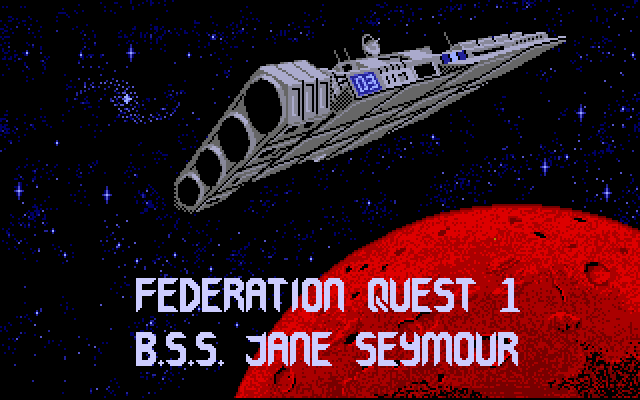
How was your weekend? Mine was spent on level 1… Some games make me work harder than others, and some show their colours from the outset. Federation Quest 1 can boast three release dates under three different names. The American version, distributed by Konami in 1991, is called Spacewrecked: 14 Billion Light Years from Earth. The European one is called BSS Jane Seymour: Federation Quest 1. If only all three began with the same letter, I’d spare myself updating three pages and shifting all the thumbnails. Double that since my mad idea of translating the site into English: six thumbnail-alignment chores…
The plot follows the misadventures of a space castaway who has just picked up a prerecorded distress message from a fleet of research vessels in peril. The maintenance systems have gone haywire and released dangerous specimens, which roam the corridors alongside crew members who have gone bonkers after five years in the freezer.
These deplorable circumstances have the merit of simplifying your rescue mission: save your own skin only by seizing a shuttle. Carrying it out is more convoluted: board each of the twenty spacecraft, repair them one by one, finishing with the one that you need, the only one with enough fuel to get back to Earth, 14 light years from here (14 billion for the unlucky souls living in the United States).
As usual, reading the manual (European) will enlighten you on the motives. I applaud the contortions the sci-fi plot goes through to justify the game’s mechanics. Why cross twenty ships if I only need the last one? Why repair them all? Why not siphon off some fuel and make a quick getaway? For a laugh, take a look at its French version. Judging by the number of typos, I suspect the translator gave up on page 21. Typical!
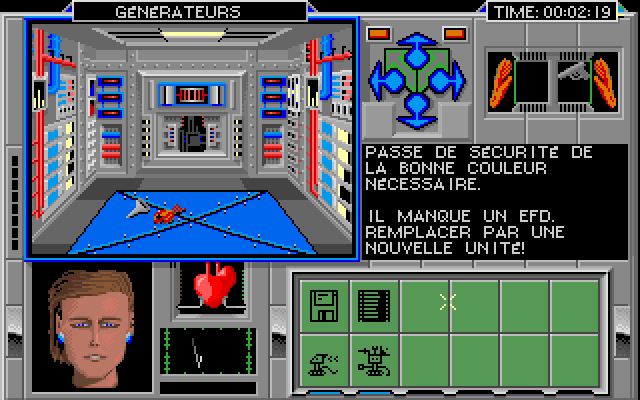
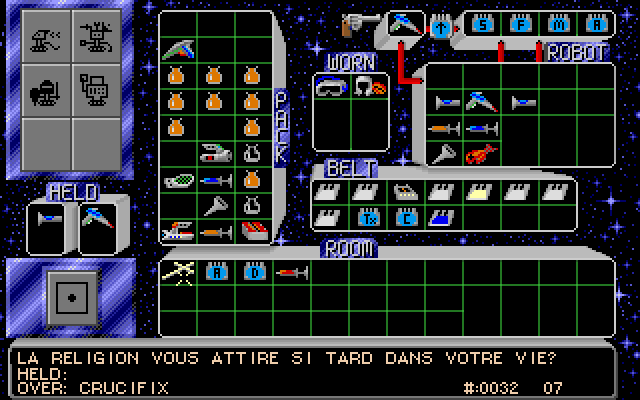
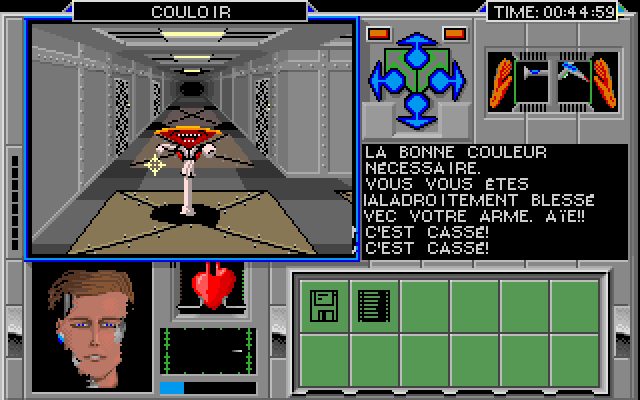
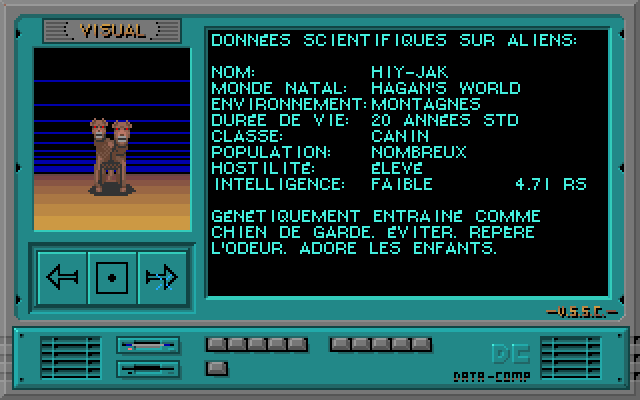
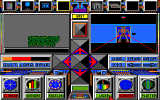
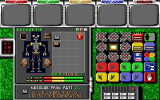
This game presents itself as a Dungeon Master clone in space, with a sober but tidy interface, enhanced by text descriptions that contribute to the atmosphere. Computer terminals even give access to amusing illustrated entries on the monsters and crew members encountered throughout the mission. My only complaint: I didn’t immediately spot the green arrows used for turning. So I spent my first game clicking only on the blue buttons, which left me thoroughly disoriented, all the more so as the controls respond with some lag. All I managed to do was bump into walls and swipe everything lying on the floor. That’s how I noticed a first subtlety: objects displayed on screen don’t react when you click on them. You have to open a separate (and intimidating) inventory before picking them up.
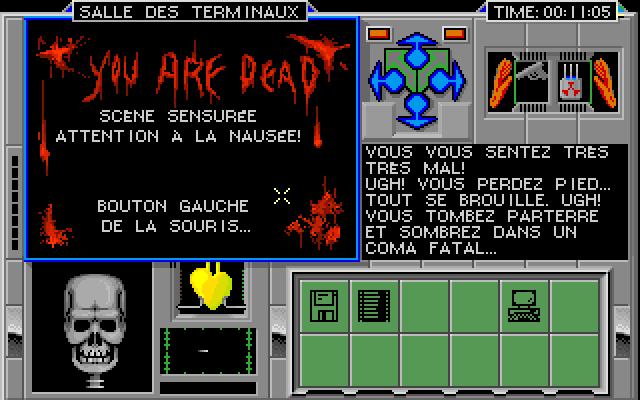
Just a few minutes later, my heart turned fluorescent yellow and I died suddenly, without having met a living soul. Alrighty then…
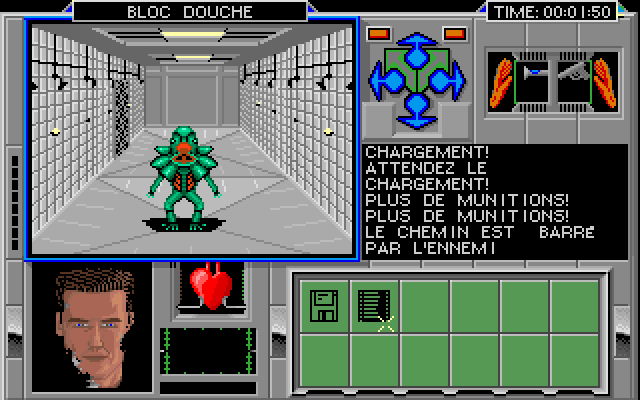
On my second game, I came nose to snout with a green monster that licked me until death ensued. The episode lasted a good while, during which I tried everything to fire the pistol I was holding, in vain.
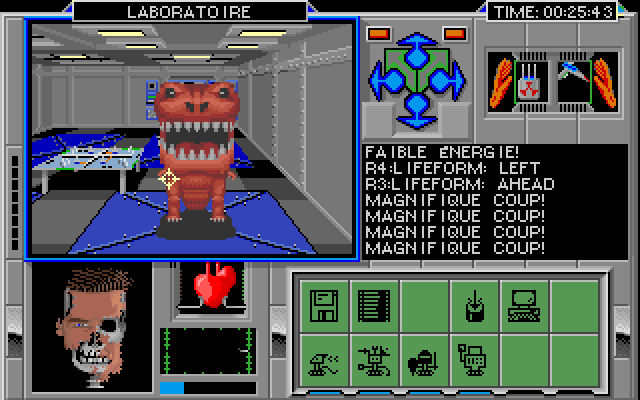
The third time, I learned how to use the pistol (place it in the right hand, then click on the target). I had wrongly concluded that the screen wasn’t interactive … except when an enemy is present. The cursor then turns into a crosshair, which trembles like Captain Blood’s hand at the end of his journey, supposedly to convey the protagonist’s stress. I don’t understand why they deliberately degraded such a central function, when the Amiga had plenty of crosshair shooters that were reasonably fun without the handicap. Anyway, I found my lizard and emptied my magazine into it, apparently without hitting it, and it chased me from room to room before cornering me in the shower block…
After which, I took a break, seized by a sudden urge to rewatch Midnight Express.
On the fourth, I came across a “proton blaster”. Aiming optional, very effective against the beasties. The problem is that it blasts gaping holes in the floor, and I cut off my own access on either side. I only understood much later that another piece of equipment, the “plexteel sprayer”, was there precisely to plug these holes… While I’m at it, let me mention the doors of every colour, which open with matching security cards, as in Slaygon, but with another twist: they lose a level with each use, changing colour, then recharge at will in a “recharge room”. In other words, a charged card can open any door, once, with no guarantee of being able to go back through it the other way!
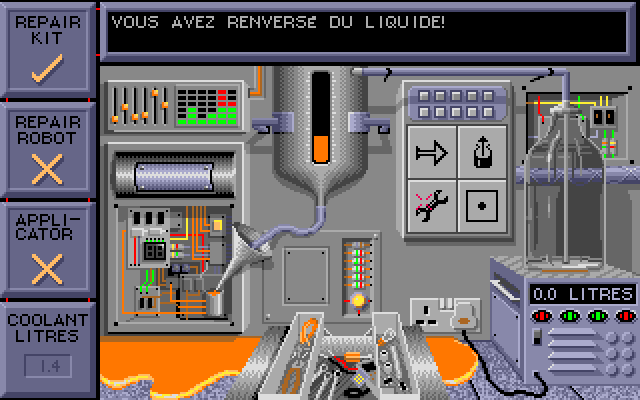
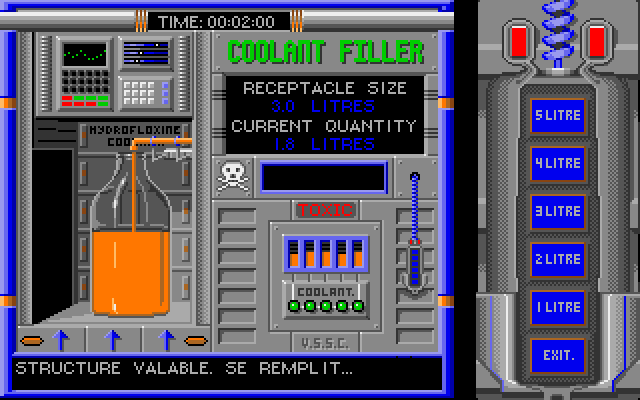
Fast forward … 25th game. I’ve begun to grasp, bit by bit, the aim of the game, which is to repair machines located in certain rooms of the ship, by bringing back coolant (hydrofloxine, to be pedantic). I’ll detail the procedure further on. Its difficulty comes from the undefined and oppressive time limit. The wreck you’ve just set foot in (which has been drifting through space for over five years if I’ve followed correctly) deteriorates by the minute, causing a series of breakdowns with heavy penalties, such as releasing new enemies, plunging you into darkness, cutting off your air supply or irradiating you (the fluorescent heart from earlier).
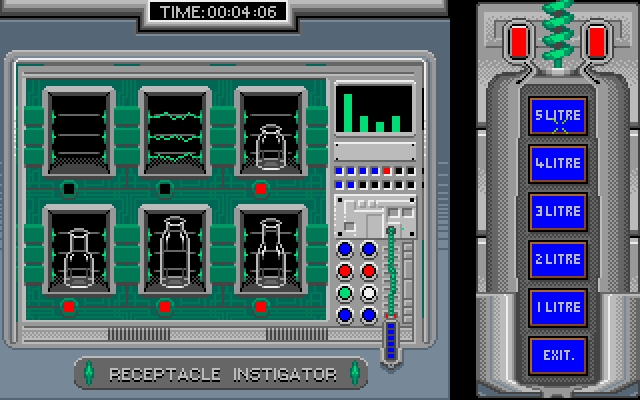
Lastly, you may stumble on programmable robots that are more complex to use. At first, you’ll mostly use them as inventory extensions. Later, you’ll learn to send them anywhere to carry out certain tasks, such as manufacturing canisters, filling them at the lab, then delivering them to the room of your choice. I never reached that level of skill. Besides, plenty of mechanisms still elude me. What are the different canister sizes for? Where is the ammo counter? How do I use the combat robot? What to do when the robot that was following me, carrying all my stuff, breaks down in the middle of a corridor? I still feel seasoned enough to give a few tips to beginners:
First, don’t even hope to finish level 1 without meticulously mapping the three decks of the ship, through scouting sessions punctuated by a thousand deaths. On that note, I’m outraged by the lack of a compass, combined with movement buttons that are packed too tightly together. The unspeakable agony of being unable to tell whether I’ve just sidestepped or turned 90°, at the junction of indistinguishable corridors!
If it helps, I can always share my level 1 map, which will serve as a base for all the following ones, given that the general layout remains identical (the rooms are shuffled, though). Once the map is complete, all that remains is working out the optimal route, because the time limit doesn’t let you visit everything. Your objectives:
Find weapons and key cards; less urgent: a torch, a repair kit and an “applicator” (funnel) to reduce the risk of failure during repairs (emptying canisters).
Locate a droid, activate it and order it to follow you.
Pick up a “power flow decoupler”, to be placed in the generator room.
Find a fabrication room to produce as many canisters as you can carry.
Reach a lab to fill these canisters.
Find a recharge room to … recharge … your robot, but also your cards and weapons (the “torch” icon covers various items).
Use the canisters filled with coolant in the special rooms (bridge, biological control, communications and life support), several times if necessary, until the various systems show at least 80% of their capacity (the wiggling green gauges).
Pick up a lock inhibitor and install it on the bridge.
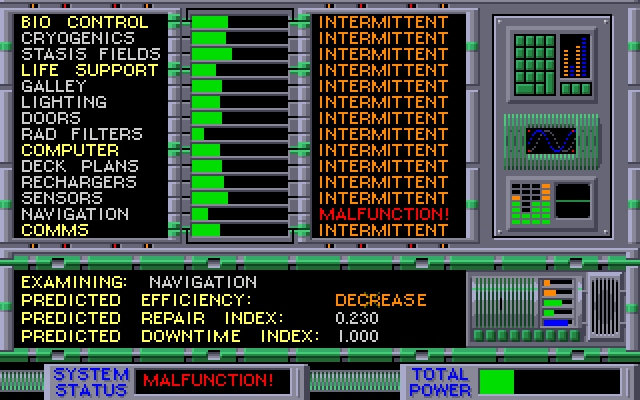
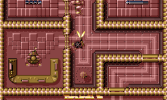
I advise against activating several robots. Stick to just one, fully charged (the most useful is the computer droid, which gives access to an automap and the ship’s real-time diagnostic screen). Don’t lug too many items around either: four or five keys are enough, and you can ignore the blue cartridges to begin with.
Perhaps you’d like to know what I thought of my weekend? Well, the experience was interesting … if not enjoyable. I felt neither the sense of progression nor the depth of Eye of the Beholder, nor, sadly, the satisfaction of blasting monsters as in Hired Guns; blame that trembling crosshair, so painful to handle. I’d also have done without weapons that break at every turn. Federation Quest 1 should therefore be regarded as a pure orienteering game rather than an adventure game. A sophisticated puzzle, forerunner of System Shock (PC-DOS, 1994), demanding hours of patient fumbling.
A password system and a save-to-disk option are provided. The WHDLoad patch even allows installation on a hard drive, which noticeably smooths the animation, at the cost of making enemies faster and more dangerous.
Several days later, I was still learning… While arranging my screenshots on this page, I wondered whether my sudden irradiation (the fluorescent heart) might be linked to the item I was holding, marked with a radioactive trefoil? But then … the robot… Aaaah! …
To wrap up the trivia: Jane Seymour is probably a tribute to the British actress who played Serina in the original Battlestar Galactica series. As for the red herrings, they refer to a well-known English expression.