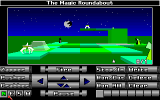
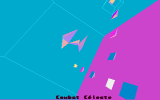
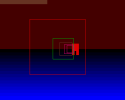
I’ve come across my fair share of “conceptual” games on the Amiga, sporting wacky aesthetics and mechanics so impenetrable they doom any poor soul lacking the manual to wander in utter despair (the Sega Saturn console was equally well stocked in that department…). I wonder how many of these “works” were born of chance. You know, those happy accidents?
“Serendipity”, to use a fancy word; a programming experiment, a demo gone off the rails … and voilà, abstract shapes spring to life. Meaning is then wrested from it, rules hastily sketched, before an improbable slab of science fiction is plastered on top, bristling with esoteric jargon so everything appears deliberate from the start. These titles stand as genuine little fragments of history, brimming with innovation (and blunders alike), steeped in a singular atmosphere (verging on the hallucinatory) and often heralding genres that would only emerge many years later. It is with all the more fascination that I examine these curiosities in 2026, at a time when the video game industry languishes under a sickly standardisation. Do note in passing that fascination is hardly synonymous with enjoyment…
Today’s science-fiction scenario appears to be derived from the novel Neuromancer. The story takes place in a futuristic cyberpunk-style society, supposedly devoted to entertainment (in particular, escapism into simulated worlds, from the comfort of one’s home, a virtual reality headset strapped on). Our hero is a Dreamer, an author of virtual worlds whose latest creation has been hijacked by a corporation to oppress the population. You team up with your girlfriend in an attempt to retrieve this dangerous programme, kept at the top of a heavily secured twelve-storey tower.
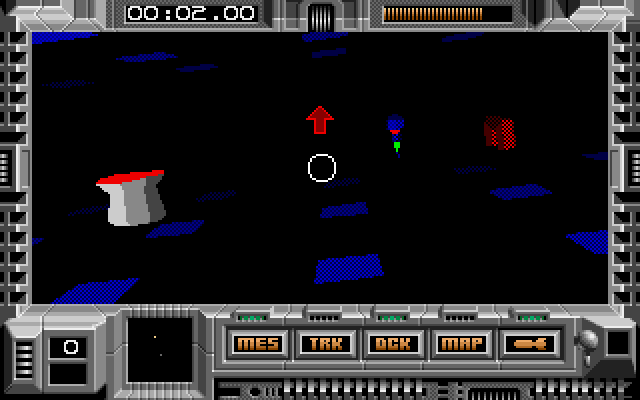
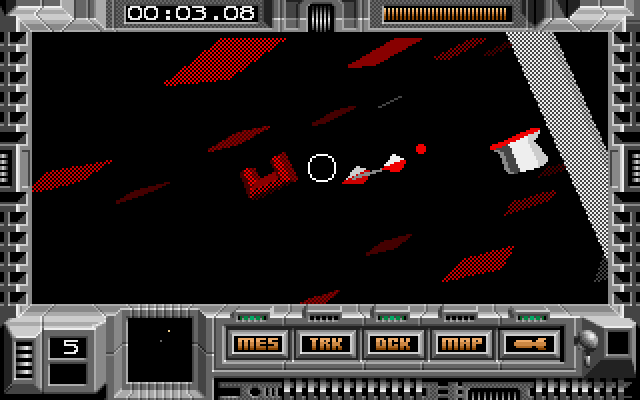
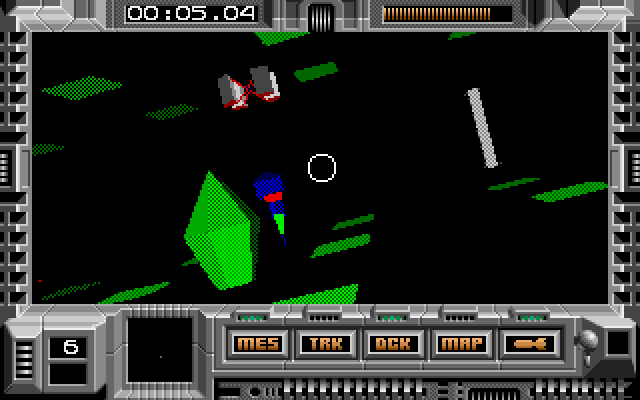
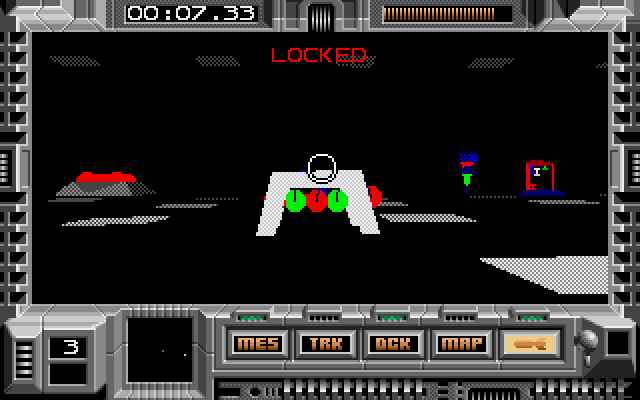
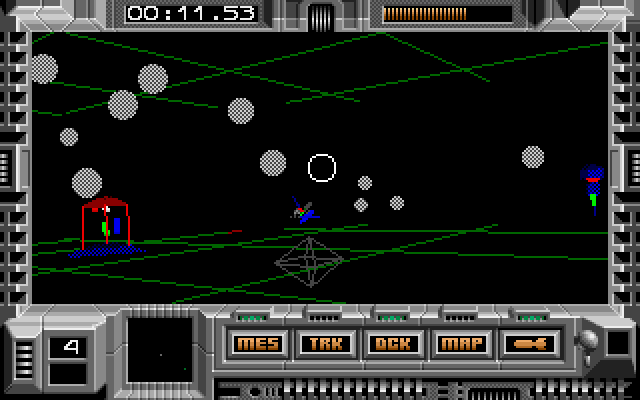
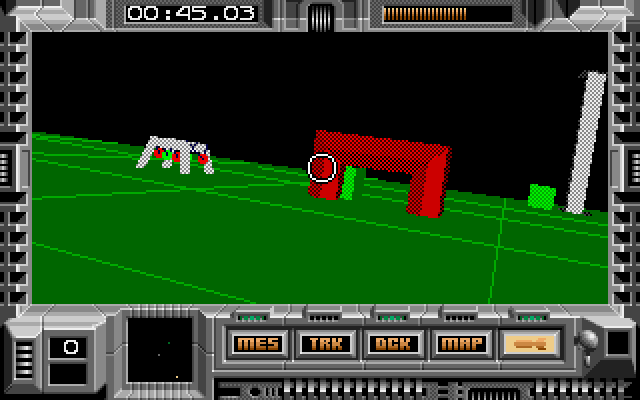
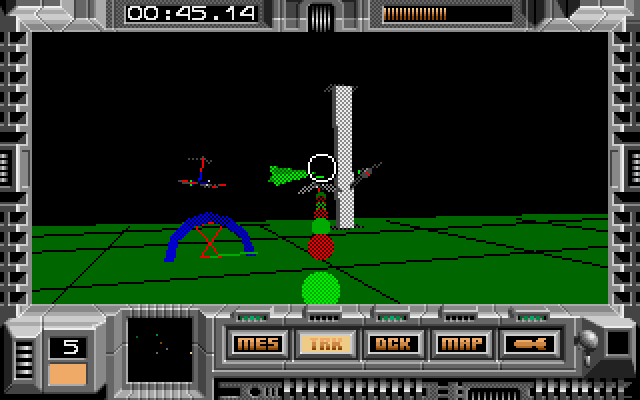
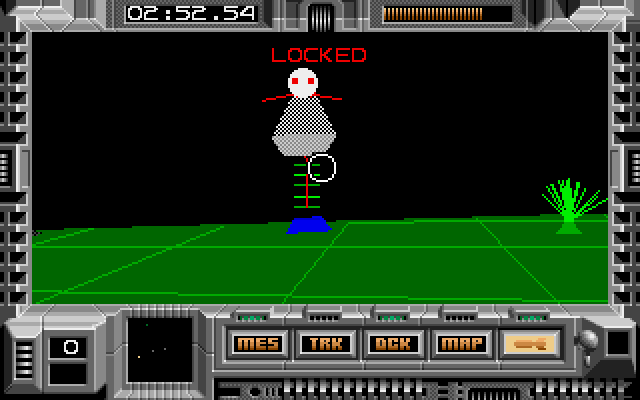
You control Chad, who operates within cyberspace. Cyberspace is terribly convenient for justifying a psychedelic 3D shooter, populated with disparate assemblages of polygons that wriggle, pulsate, fly, spin, hop or ride a unicycle… It is nevertheless inadvisable to fire indiscriminately in all directions, as your actions affect the real world. The primary concern is to assist your girlfriend, Kaf-E, who has physically infiltrated the building, where killer drones are patrolling.
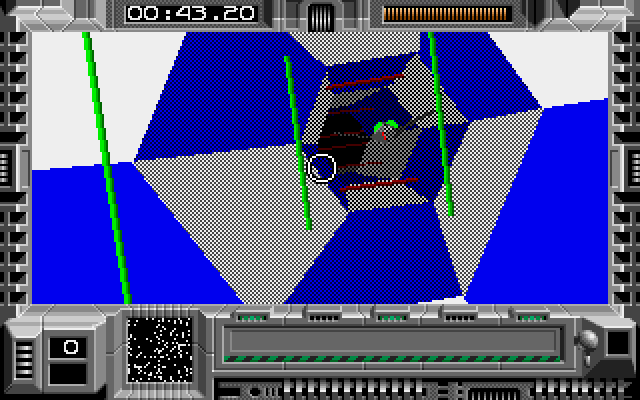
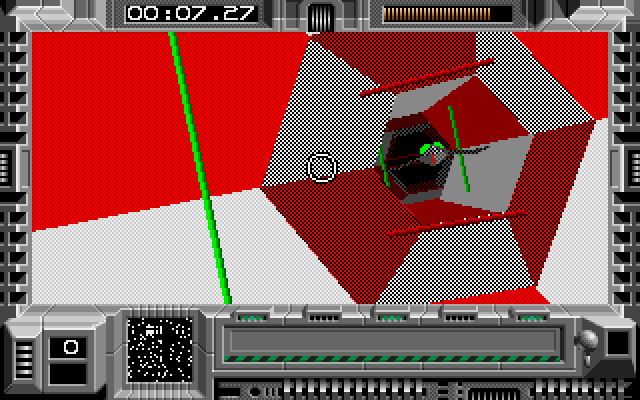
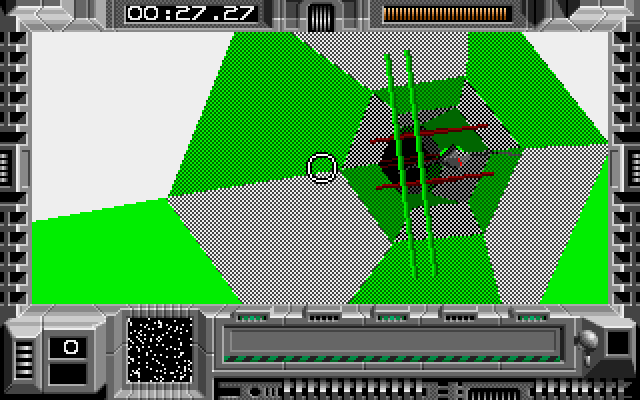
Each level, corresponding to one of the twelve floors of the building, opens with a brief journey through a 3D tunnel, impressive to watch in motion, but of limited interest (other than showing off the programmer’s skills). It is only within this tunnel that one can save by pressing Space; an action I am invariably unable to perform without colliding with a wall and losing energy before I have even begun… The manual even recommends saving twice, at the start and then at the end of the tunnel. I find the procedure needlessly laborious, all the more so as it requires a formatted floppy disk per save slot, when a simple password system would have sufficed.
At the end of the tunnel, a door leads to a grid-like space stretching as far as the eye can see, made up of eight superimposed planes (numbered 0 to 7), which interconnect via coloured tiles placed at regular intervals on the floor and sometimes on the ceiling. Crossing them loops around: above 0, one reappears at 7; below 7, one returns to 0. The mouse-based control scheme does not allow acceleration and orientation to be adjusted simultaneously (right click held down + forward or back to move, and a left click to fire). I therefore frequently find myself losing control and crossing one of these tiles unintentionally. This is most aggravating in the advanced levels, when one can only change plane in a single direction (forcing me to descend 7 additional levels to return to where I was). Add to this the same brilliant idea as in Magic Carpet: simultaneously clicking both mouse buttons disables the controls in order to bring up a cursor. This is wholly ill-suited to a shooter that requires both buttons to be used constantly in the heat of the action!
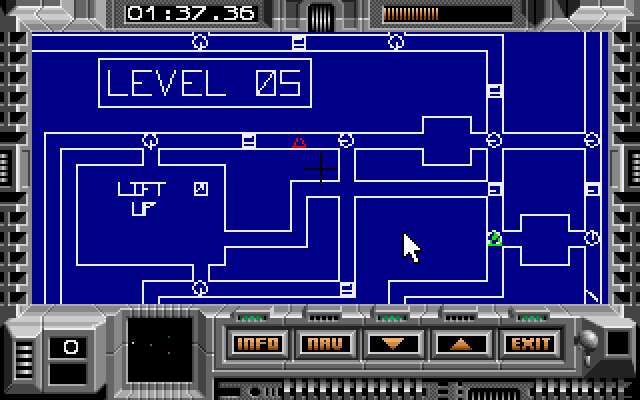
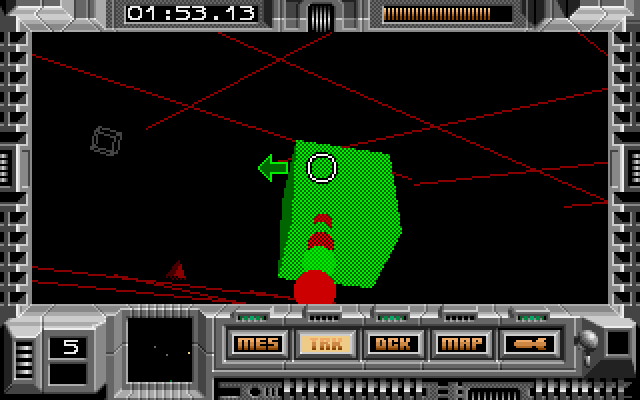
The B key displays the floor map. The green thing represents your companion, the red things are drones (to be avoided, or lured in another direction). The objective is to guide the girl towards the lift leading to the floor above. This screen also reveals the positions of doors, cameras and “turntables” (akin to points on a railway), which can only be operated in cyberspace by docking with or shooting their digital effigy (respectively: green cubes, red tetrahedra and … blue triangular bipyramids). To locate them, centre the view on them, then click the “NAV” button. Back in the 3D view, an arrow will indicate the direction to follow, like a GPS. Two other elements exist only in the real world: pressure triggers, which alert the drones when Kaf-E steps on them, and electrified floor tiles (lethal to everyone).
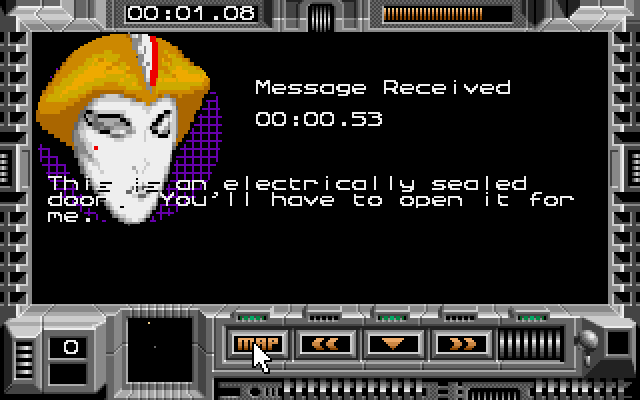
The deterministic behaviour of both the drones and the young lady gives the impression of manipulating a printed circuit board, or organising a railway network. She takes no initiative whatsoever, waits indefinitely behind a closed door, walks straight ahead once it opens, with no regard for whether a drone is bearing down on her from the opposite direction. It is therefore a logic (and speed) exercise in the vein of Lemmings, consisting of indirectly influencing your charge’s progress by neutralising the traps laid in her path on her behalf. The interface is reasonably legible but slow to use, bearing in mind that the creatures of the virtual world continue shooting at you whilst you consult it. On top of that, the incessant messages from your partner whenever she encounters an obstacle, accompanied by relentless beeping, quickly become unbearable. There is a key to dismiss the message, but it must be pressed again each time. Memories of Mega Man X6 come flooding back…
The “shooter” phase is not particularly difficult, merely oppressive, as you do not always have the luxury of defending yourself; your teammate’s safety takes precedence (unlike Chad, she is killed or captured instantly, bringing the game to an end). On the other hand, your “spaceship” has infinite ammunition, a fairly generous energy bar, and two means of replenishing it (fly under the red arches or dock with a generator, which is single-use). The primary constraint remains time, when for instance Kaf-E is in a drone’s path, or an electrified tile lies in hers. Familiarity with the terrain through trial and error, and above all speed of reaction, far outweigh anticipation and strategy. To my mind, this is a sign that the game’s concept has not been sufficiently thought through.
Another telling symptom is the manual’s step-by-step walkthrough for completing level 1. The developers appeared to be aware that they had failed the player’s self-learning process. Personally, I would never have understood on my own what the game expected: disabling the first camera but not the second, so that the drone stationed in front of the lift goes on alert and leaves the room, at the precise moment my companion takes a parallel route. It is absurd, when one thinks about it. The drone could just as easily have left by the other way and come face to face with her. And were those cameras absent, the drone would remain at its post, making the building’s security utterly insurmountable…
The overall experience leaves a mixed impression. At first, the atmosphere intrigues (aided by the amusing 3D shapes and the fluid engine), and if one genuinely makes the effort to progress … the experience becomes increasingly unpleasant! The real test comes at level 4, which demands a lengthy series of precise actions, under pressure, while being harassed by enemies throughout. I have written it many times: the time limit is a contrivance to conceal a lack of depth. That said, there are also interludes, such as level 5, in which Kaf-E is not in immediate danger. That one was almost enjoyable, as it afforded me the time to clear the area and then think. But how many players made it that far, without a quick save? This brings me to my second favourite refrain, which I am fond of repeating: Asking the player to solve puzzles under relentless fire is to risk putting them off entirely…
In any case, I have never had such a dreadful time describing the inner workings of a game on this site. The Horde has just been dethroned!
[Editing the translation was quite the ordeal too! – Ed.]
* * *
Below you will find a description of the main controls (to be learnt by heart before level 4), along with a few practical tips.
T: use a tractor beam.
D: docking (used in particular to operate the turntables).
Enter: activates a missile (then left click to lock and fire).
B (blueprint): displays the map.
M: displays the message sent by Kaf-E.
A: dismisses the message without reading it and silences the beeping.
If you accidentally destroy an important object, or wish to close a door after opening it (by having fired at a green cube), it is possible to rebuild it by docking with a “workshop”. Then replace the device in its original position using your tractor beam. I only resorted to this from level 6 onwards.
Method for killing the large bird: select the missile, lock on, fire, accelerate to overtake your missile in flight, select the tractor beam, click once, slow down. Boom goes the spadger!
At level 7, blue flying rays join the menagerie. These creatures orbit specifically around devices marked by your navigation system. Shooting at them risks destroying the object. The best approach is to stop in front of them, out of firing range, then press B and select any other target using the NAV button. The ray will move away.
Last piece of advice: make sure to save between levels (preferably onto a save disc), or at the very least multiply your quick-save slots on the emulator. When the girl is captured, you are sent back to the title screen with no option to restart the current level. It is therefore very easy to find yourself in a losing situation immediately after a quick save, without realising it, and with no hope of recovery.
The same developers are behind Cybercon 3. Interphase may have prepared me sufficiently to give it a second chance, one day…
Special mention to System Shock (PC-DOS, 1994), which likewise serves up a hacking mini-game set in an abstract 3D world. Otherwise, the cooperation between a field spy and their hacker partner in the virtual world would be explored a few more times (do let me know if you are aware of other titles): Clandestine (2015), Hacktag (2018) and Operation: Tango (2021).