Mr. Bones (Saturn)
| Developer: Zono | Graphics: |
 | |
| Publisher: Sega | Sound: |
| |
| Year: 1996 (USA), 1997 (Europe and Japan) | Difficulty: |
 | |
| Genre: Platformer/rhythm | Lastability: |
 | |
| Number of players: 1 | Rating: |
4/10 | |
When I watch programmes about video games, I frequently hear talk of game design, a set of (evolving) rules serving as recommendations for developers. For example, good practice advocates introducing a new mechanic gently, without describing it explicitly, so that the player experiments himself, before it’s reused later in a more hostile environment, possibly combined with another, thus constituting a stimulating and “fair” challenge. There are many other “codes” specific to all genres, often highlighted after the fact to explain successes and replicate them. The fact remains that confirmed grumblers (like me) sometimes have a dogmatic reading of them.
It’s exactly the same in cinema, in series, in literature, when for example the phrase story arc is used, generally to reproach its absence. I always think back to The Black Company, my favourite fantasy series, one of the only ones that doesn’t follow the hackneyed writing guide called the Hero’s Journey, and I love it precisely for that. I could invoke great painters (Monet, Picasso…) or even great chess players (Jobava, Rapport…), but you’ve grasped the idea: transgressing conventions is riskier, it demands more mastery; but it’s the best way to evolve. Conversely, scrupulously respecting norms optimises the chances of success … and leads to stagnation.
Now, the Sega Saturn contained heaps of “non-conformist” games, with an experimental or artistic approach. Some names come back to mind: Nights into Dreams, Lunacy and its sequel, The Mansion of Hidden Souls, D … to name only the cream of the crop. Disconcerting titles, sometimes incomprehensible, which swallowed up my pocket money when I was a teenager, but which taught me to cultivate my tastes … leading me later to swap my Saturn for a PlayStation, without regret!
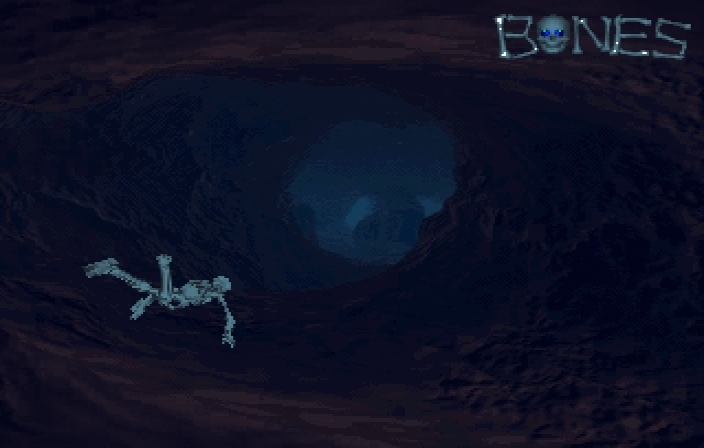
Mr. Bones is part of these envied exclusives of the black console, an offbeat game, rough to say the least and with a surrealist atmosphere, which absolutely had to delight the teenager who’d just blown a hundred quid at Score Games and thought he’d bought a zany platformer! It nonetheless aroused my curiosity and left a … vivid impression, for which I’m grateful to it.
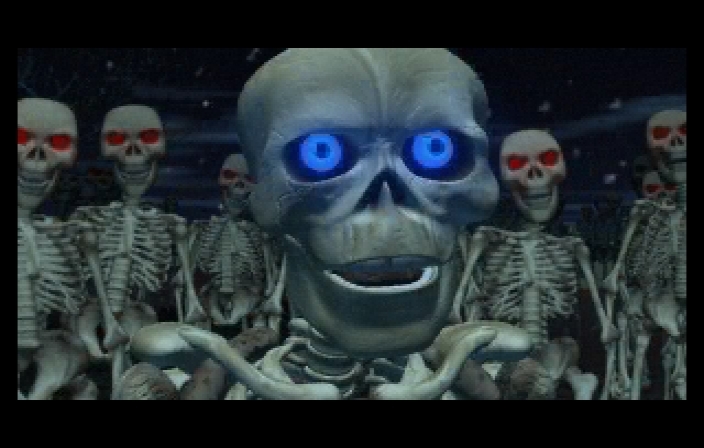
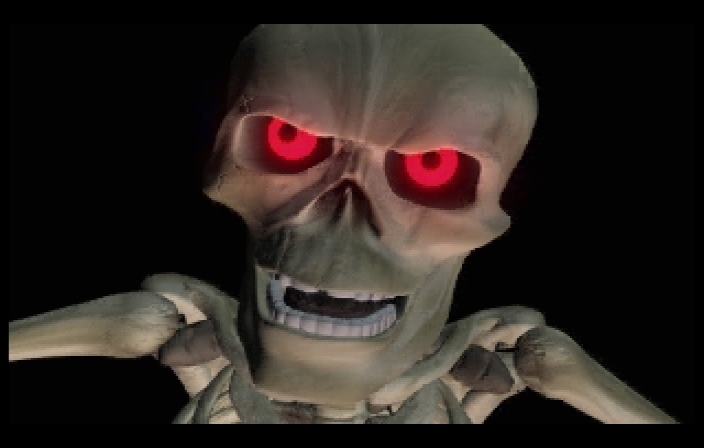
The storyline might seem familiar to you: a misanthropic necromancer with questionable hair has turned up in a cemetery, raised the dead, whom he intends to unite under his banner to conquer the world. Only one individual can stop him: a skeleton (with impeccable teeth) who has mysteriously escaped his control…
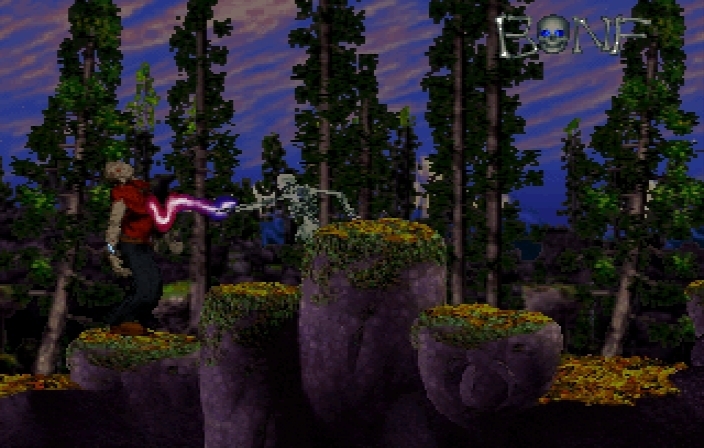
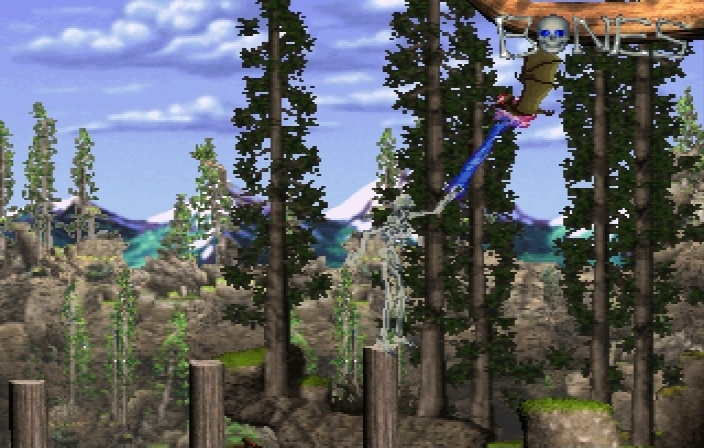
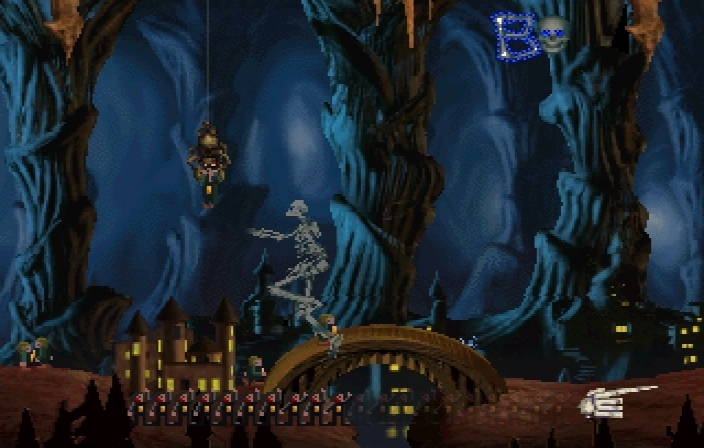
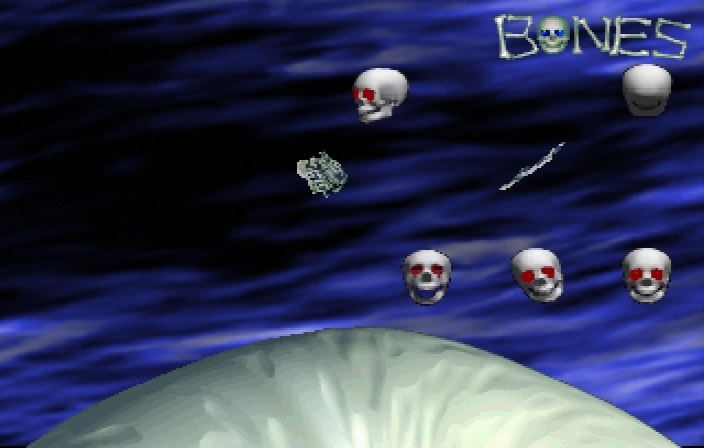
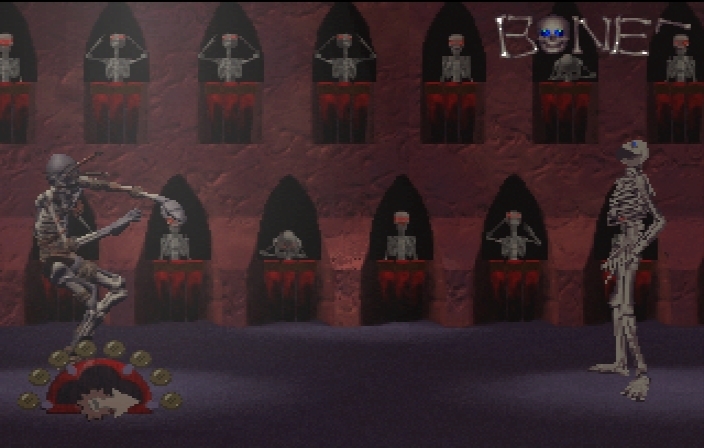
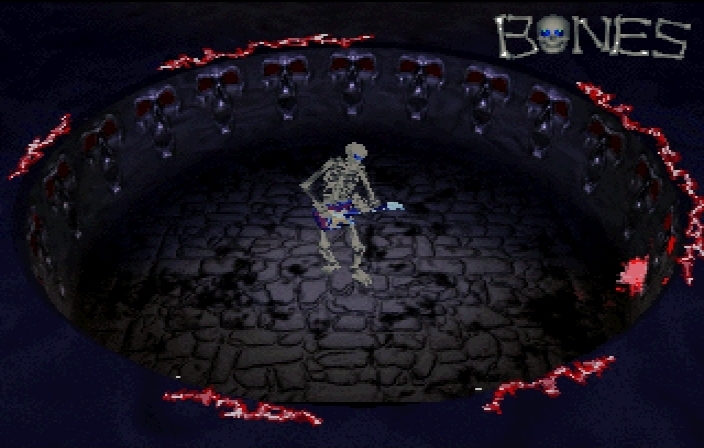
The bizarre aesthetic results from collaging 2D elements (most objects and enemies) or 3D (the hero) in front of a “digitised” landscape scrolling on several planes. This “compressed photo” aspect reminded me of Entity and Zelda’s Adventure on CD-I, world-renowned references as everyone knows. What do you say? Donkey Kong Country? What’s that?
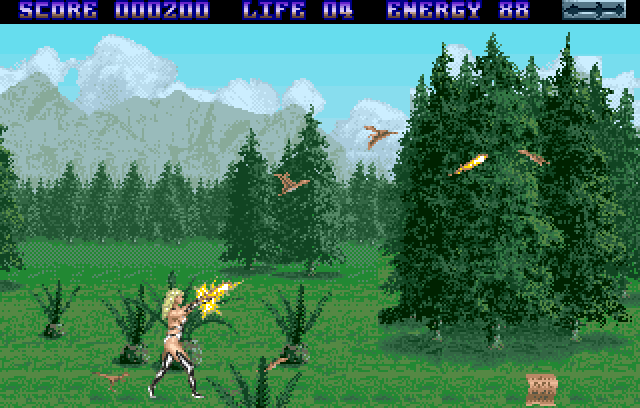
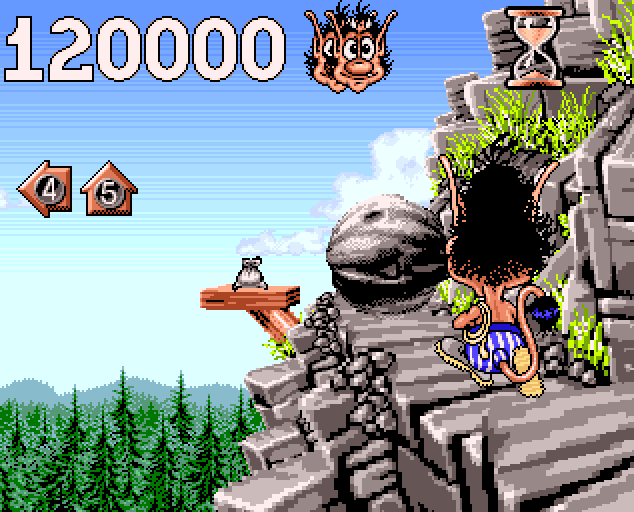
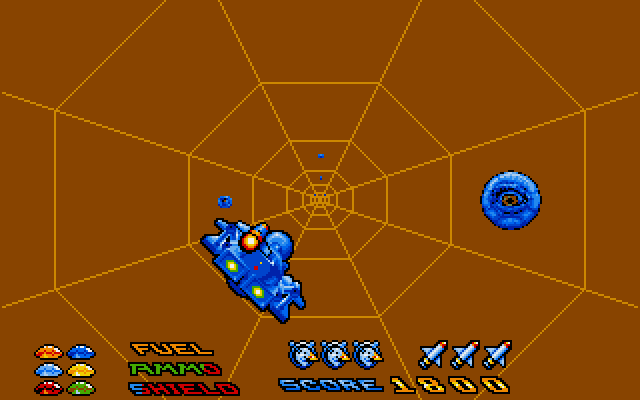
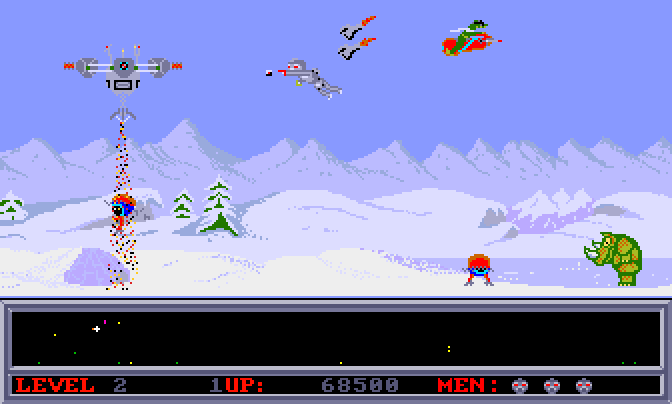
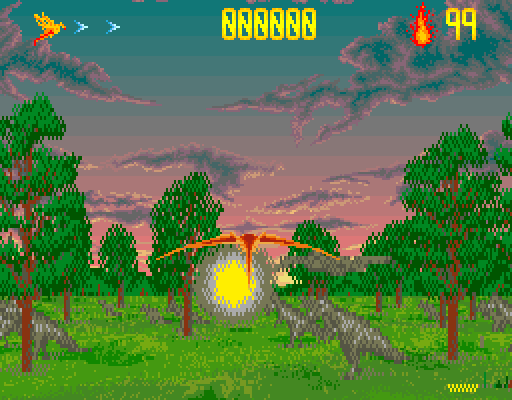
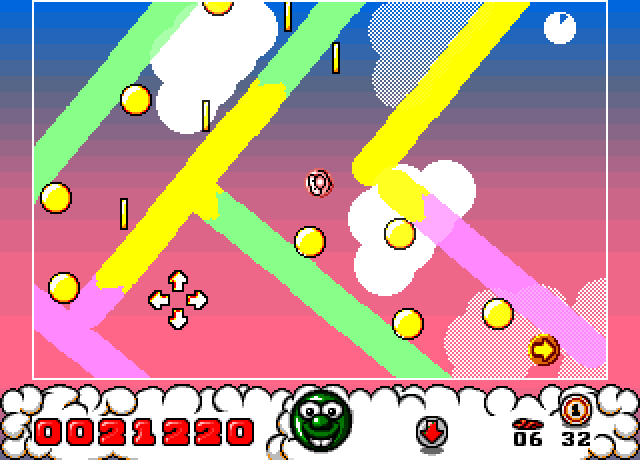
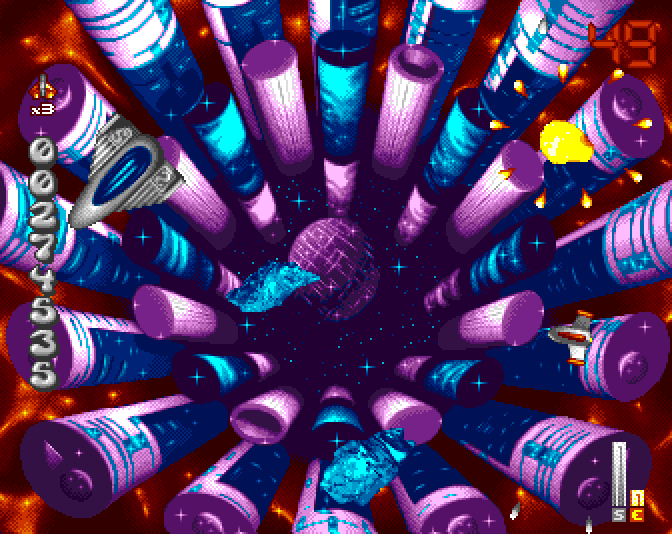
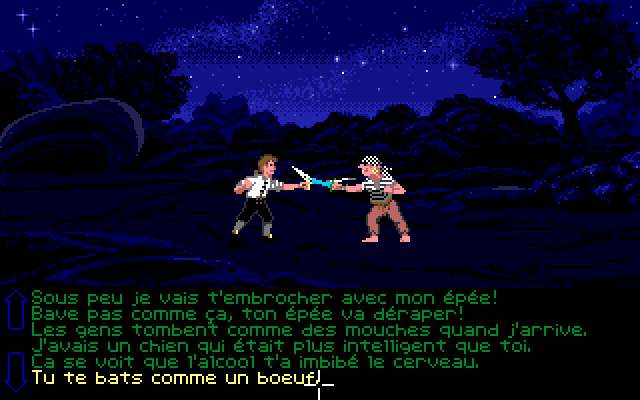
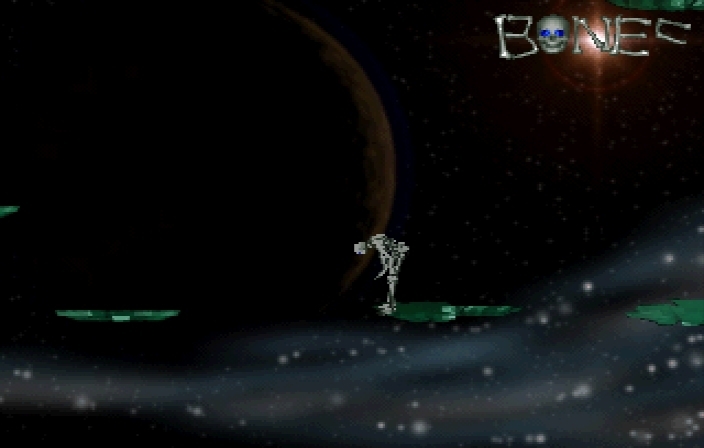
Occasionally, the background gives way to a CGI animation, creating an illusion of depth. Although no interaction is possible with the scenery, it doesn’t refrain from injuring the player who wouldn’t be in a delimited zone on the screen. I’d already encountered this process in Microcosm; it must be said that the Amiga library didn’t lack “eccentric” titles either. The ecosystem around the computer was conducive to creativity: communities of artists, musicians, programmers, close to the demo scene (less close to game design conferences, I dare say…). It’s therefore not surprising that whilst playing Mr. Bones, I didn’t stop reminiscing about the games of my childhood:
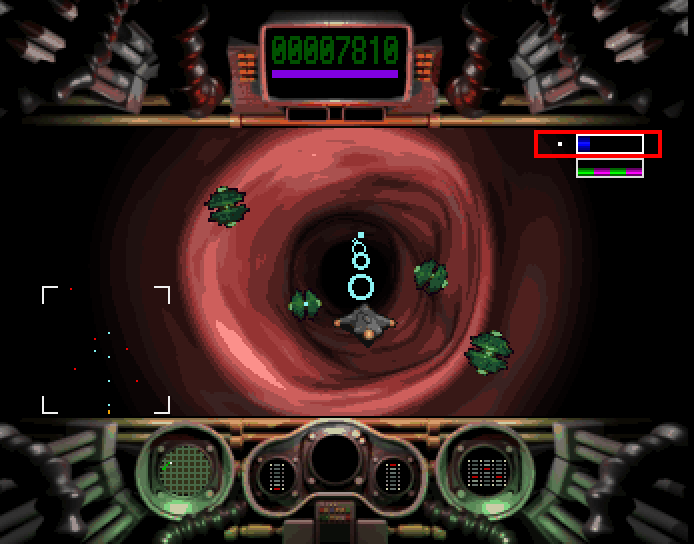
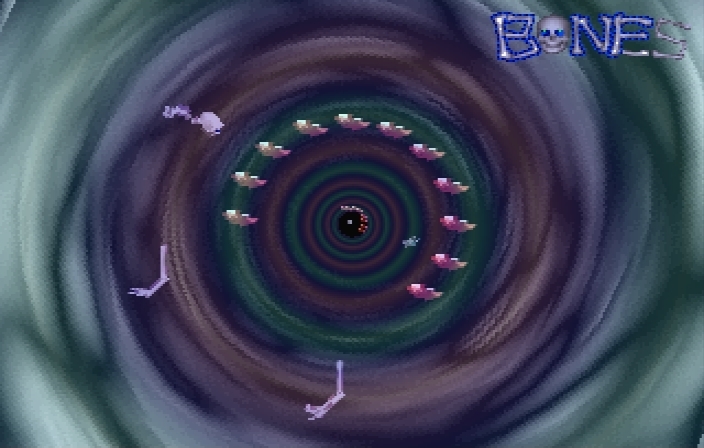
This is where a first observation emerges: most of the ideas presented in Mr. Bones had already been explored elsewhere, which gives the impression of a technically outdated title as early as 1996. Worse still, it never really develops any of them and is content to string together very short prototype levels before abandoning them. It seems to me that this variant of Gyruss (arcade, 1983) would in particular have deserved to be expanded across different levels.
The game tries to compensate through its artistic merits, which are undeniable. The famous musician, the late Ronnie Montrose, collaborated closely by creating the soundtrack, even making an appearance in a video scene (the blind guitarist in the cabin). The so-called “FMV“ sequences, mixing actors and CGI, are particularly well made. They serve as rewards for persistent players. By the way, if you’re still hesitating between trying it or running away screaming, know that its creative director, Ed Annunziata, is behind Ecco the Dolphin…
This is perhaps the moment for me to enumerate the violations of game design codes whilst shaking my fist at the sky and stamping my feet. I took notes during my playthrough, and I see “the worst part” written several times! Ah, poor me, unaware of what lay ahead… A word of advice: when you’ll be struggling in the bat levels, savour that moment!
Letting the player find their bearings:
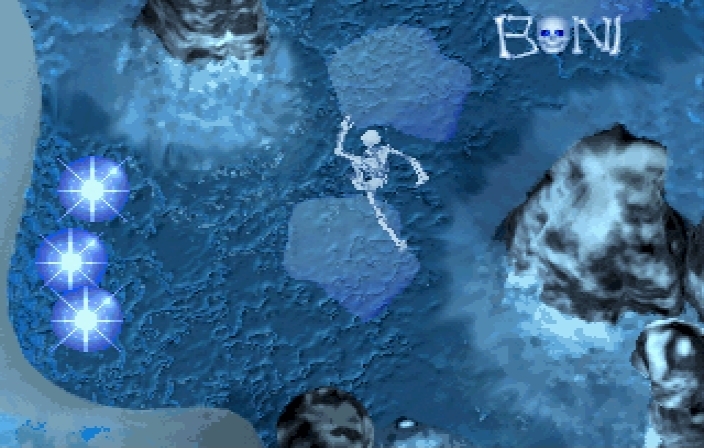
The game starts with a platforming course with forced screen scrolling and a horde of enemies on your tail. It’s particularly sadistic for a level 1, where traditionally, the player assimilates the controls. Admittedly it’s not very complicated: left, right, jump; but with each contact with any object deemed lethal (not always clearly defined), Sir Skeleton begins to lose energy (represented by the bones at the top right of the screen), then a piece … an arm, two arms, a leg. There he is hopping on one foot, before losing the other leg and beginning to crawl, like the Terminator at the end of the film (er sorry, minus the arms!). You end up controlling a bouncing head, shortly before witnessing a game over sequence for the first time (which won’t stop tormenting you). The total experience will have lasted less than twenty seconds.
Personally, I understood bugger all. So I went to get a manual… I understood bugger all from the manual… So I went back to the game and applied the method taught by Eat Mine: start again, again and again, and again… It’s mad, the power of repetition on the human mind. I eventually managed it. Today, I’m proud to announce that level 1 no longer poses problems for me, and somehow, I’ve come to appreciate it. But my God, what a miserable first impression!
I’ll skip level 2, jump, jump, die, jump … little interest. It’s only at level 3 that the game gives us a breather to test the controls calmly! Five other buttons will be used, and you’ll do as I did, read the manual. It’s indispensable.
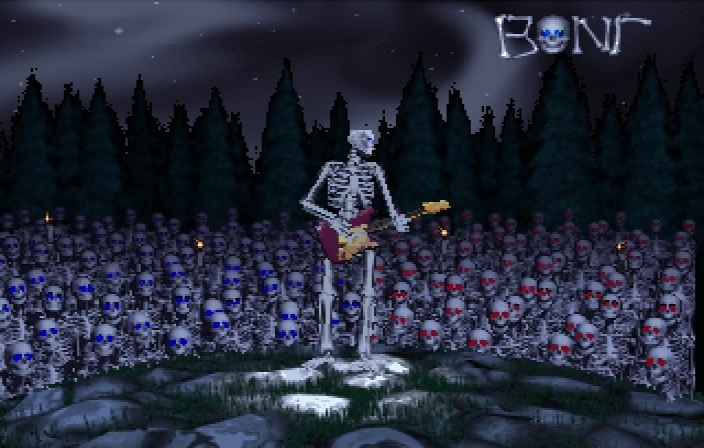
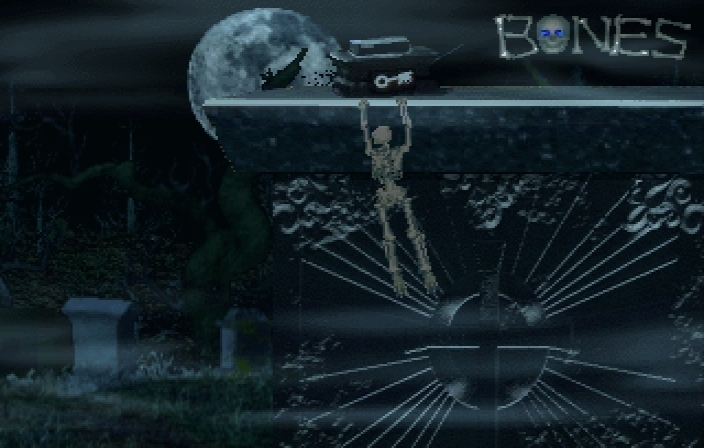
Giving the player clues: Second violation of game design precepts, the lack of indications about what to do, or about what one is capable of doing. Who has never complained in front of a verbose tutorial that pauses the action and drags on? Here, on the contrary, its absence is sorely felt. I remained stuck in front of a wall at level 3. After vain comings and goings, I had to consult a solution. I wonder how many players stopped there, just before the iconic level where one plays the guitar… It’s a shame. To be honest, I hadn’t read the manual carefully enough. That too, I’ve lost the habit… It clearly indicated how to grip a ledge and reach a platform seemingly out of reach.
Not making the player wait: Without wanting to demoralise you, you have no chance of succeeding on the first attempt, nor on the second… Most levels change the rules, between platforming, rhythm game, puzzle, or skill test; and no save point within a level is granted. Fortunately, it’s possible to restart at leisure … after having endured yet another viewing of the ending scene, a return to the title screen, a passage through the menu, possibly a disc change, punctuated by a loading time.
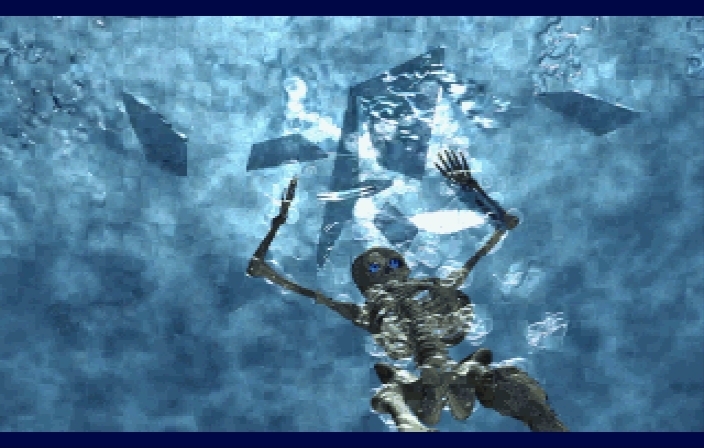
Difficult or unfair levels are perfectly bearable for me. It’s moreover the credo of all these “hardcore” games, surprisingly popular: The Unfair Platformer (2008), Meat Boy (2008), Getting Over It with Bennett Foddy (2017), Celeste (2018)… But being obliged to wait thirty seconds to a minute between attempts is unacceptable. I would never have endured it without the emulator’s “quick save” function. There’s notably a level that takes place under the ice (you’ll recognise it easily) which can be solved in five seconds… But my little finger tells me you’re going to bite them off!
A “fair” difficulty:
Granting the player a reasonable margin of error is subjective. One can perfectly well accept that a game is aimed at a certain segment of players. However, my feeling evolved like a yo-yo, because the difficulty was inconsistent. There are good moments, inventive challenges, but which end too quickly, and which lose all interest once one has understood the principle (this is notably the case with the guitar rhythm game). Some levels are more reminiscent of technical demos than games. I appreciate the artistic approach in some of them, but the admiration lasts two minutes, while the more painful moments drag on for hours.
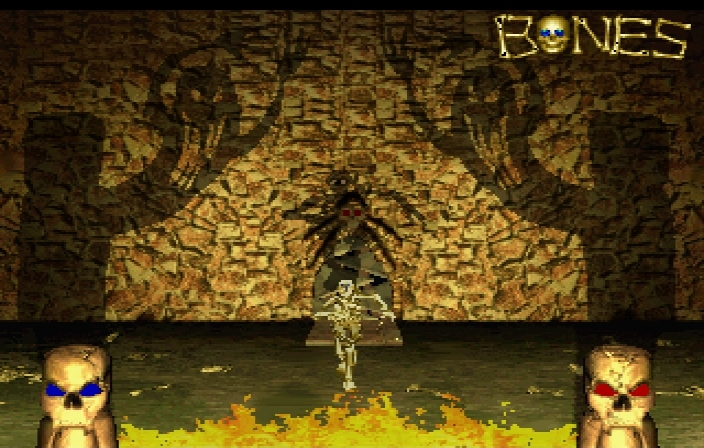
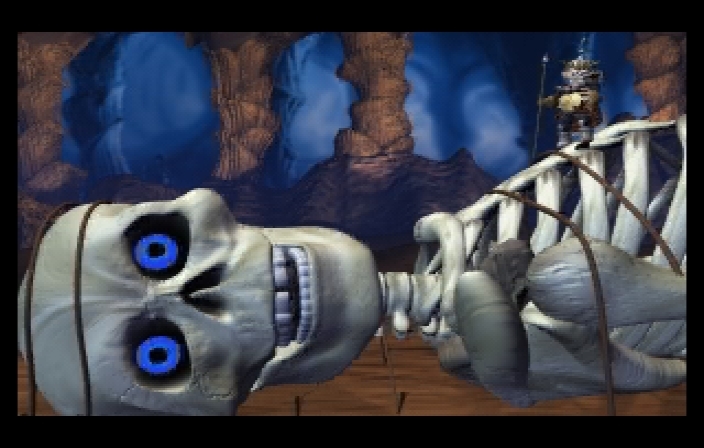
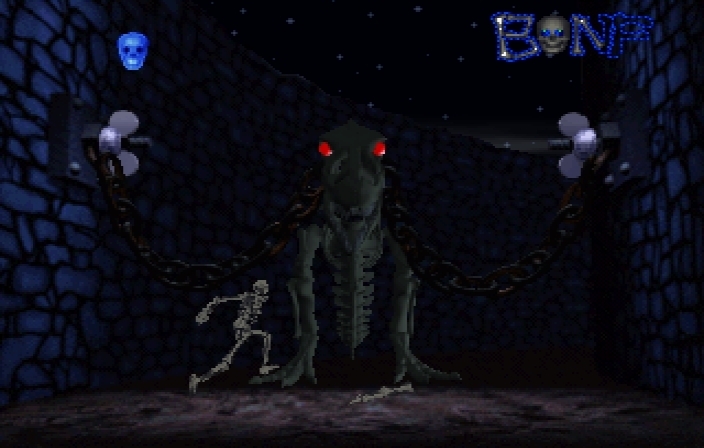
I quite liked the mini-game in the cellar, with a brazier in the foreground that generates shadow puppets behind. I was impressed by the swimming scene (not the one under the ice) which perfectly renders the illusion of moving through a 3D tunnel. I appreciated the reference to Gulliver’s Travels, even if the adapted mini-game simply consisted of running left and right. The encounter with the dinosaur was amusing, a genuine boss fight, well executed. Even the level on the ice, I found it interesting, and ultimately rather manageable with enough practice (I must suffer from a form of Stockholm syndrome).
Another notable passage, when the game takes the form of a Stardust clone (glorified Asteroids), I couldn’t understand why I couldn’t manage to steer the thing. It took me ten minutes before realising with dismay that the controls were absolute (press “left” to head towards the left of the screen). As if they’d tried to copy Stardust only by looking at photos. Enough to wonder whether the creators were used to holding a controller…
In conclusion, Mr. Bones is an inventive “work” that lacks neither atmosphere nor humour, but which demands considerable time and effort to enjoy. Well, not to the same degree as Weird Dreams either! One clearly feels the care taken in certain levels, but also unfortunately the lack of know-how, particularly in the platforming sections. As for collections of little challenges, the genre lends itself better to multiplayer, like the sports titles released by Epyx. Hazy concepts and difficulty go down better when you can take it out on your friends or treat yourself to a slice of pizza.
Unlike MediEvil which I found flat from start to finish, I found Mr. Bones alternately execrable and brilliant. That makes it a mediocre game, but one of those that keeps a place in our libraries and our conversations. The place of a turkey or an artistic performance, depending on your sensibility. In any case, it makes a change for me to see a creative game, for real, not a game that’s content to copy the work of a creative director. And a hero endowed with personality, rather than a tall one-eyed oaf who only communicates through muffled grunts.
The Japanese version of the game was reworked somewhat, made easier. Ironic, when one remembers that they exported a simplified version of Final Fantasy for the Western market.
|