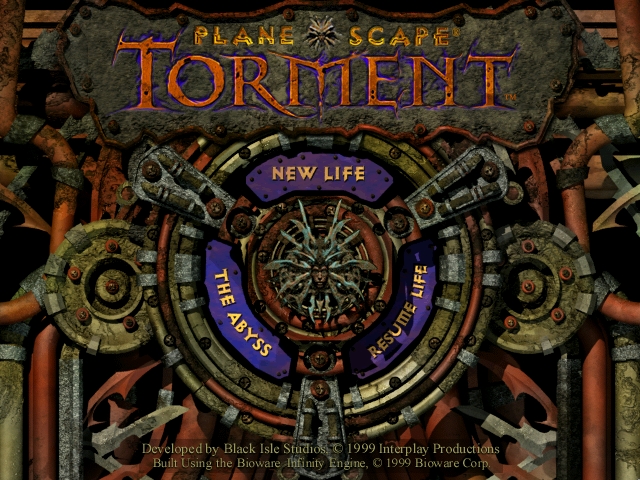
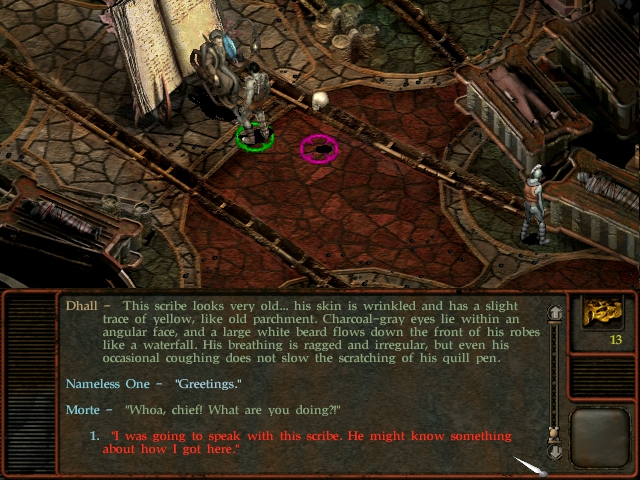
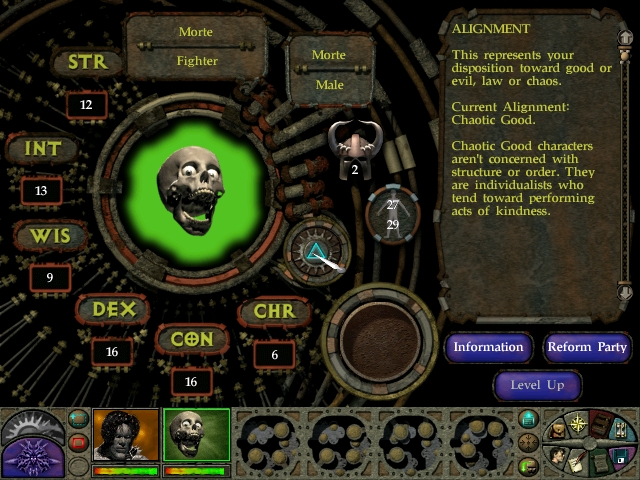
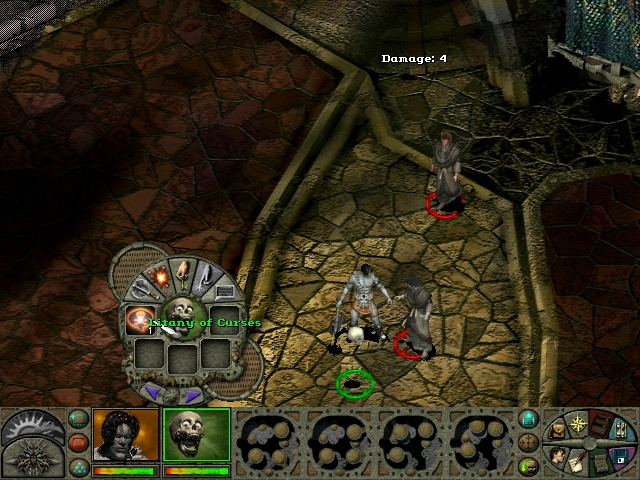
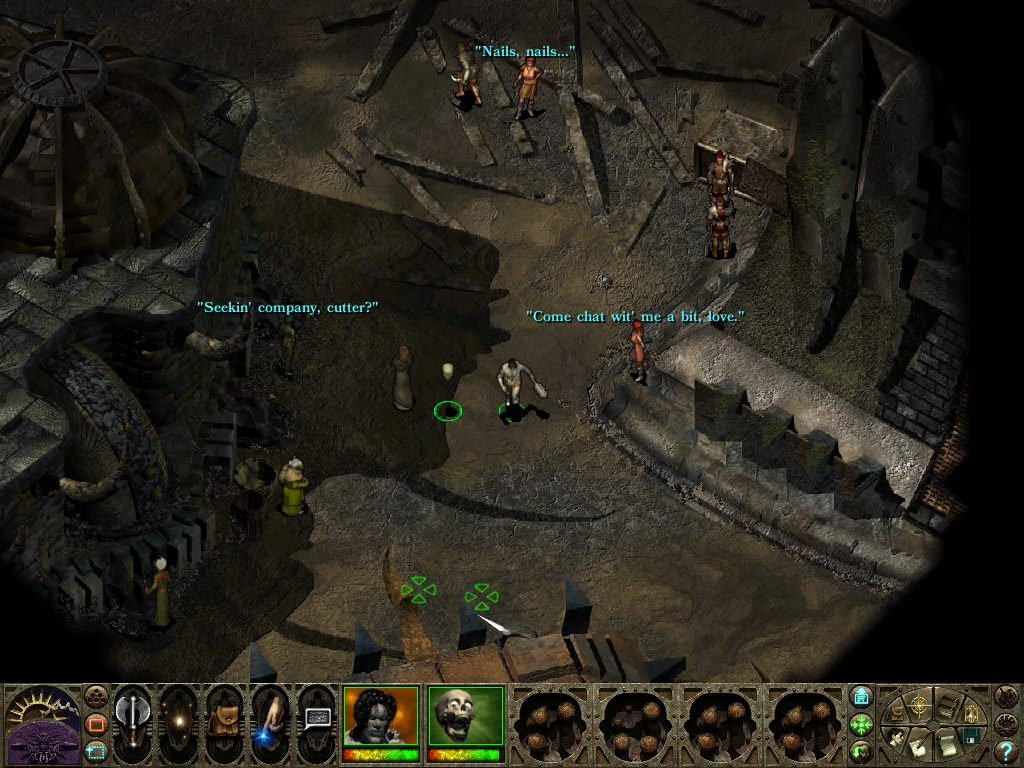
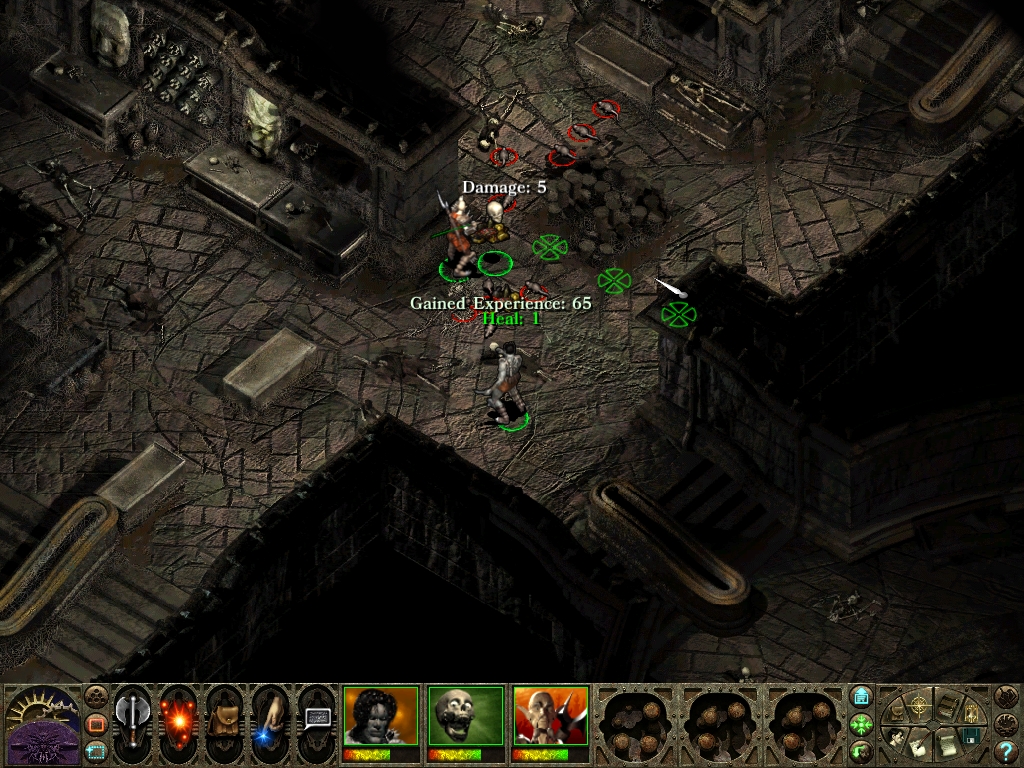
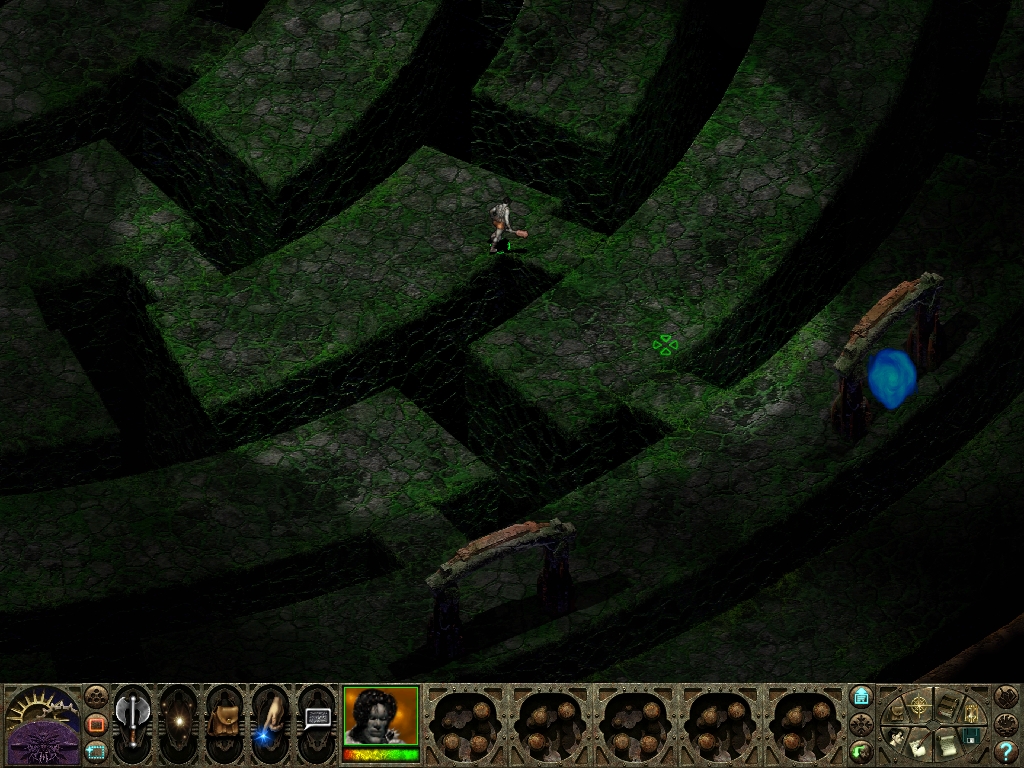
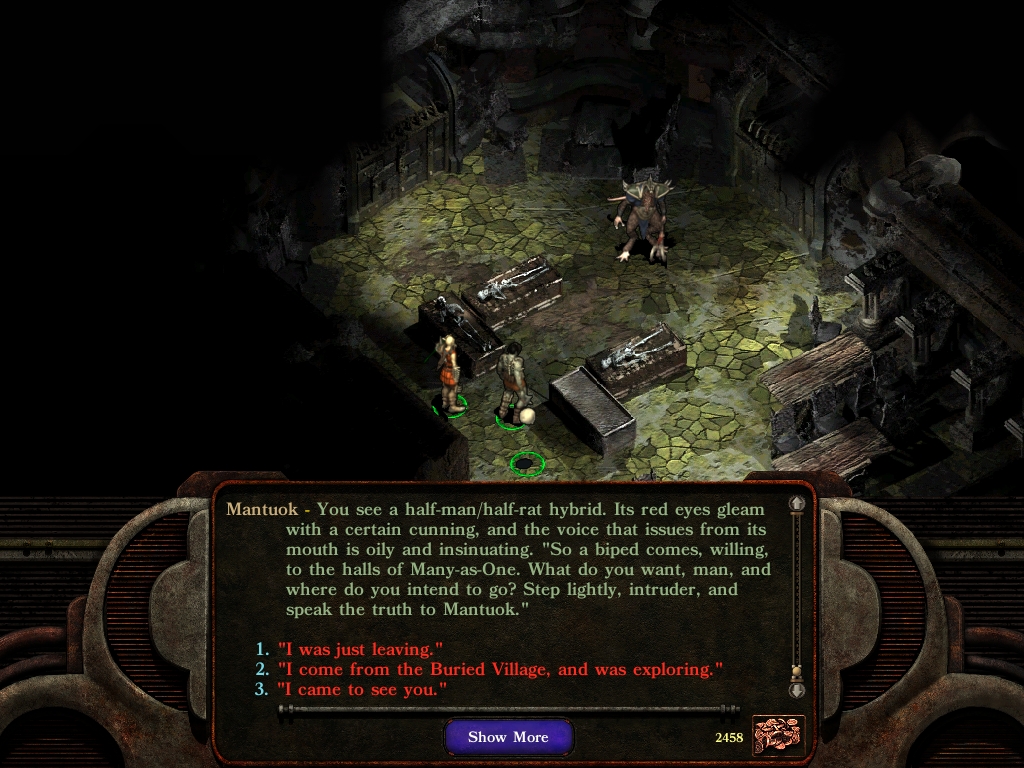
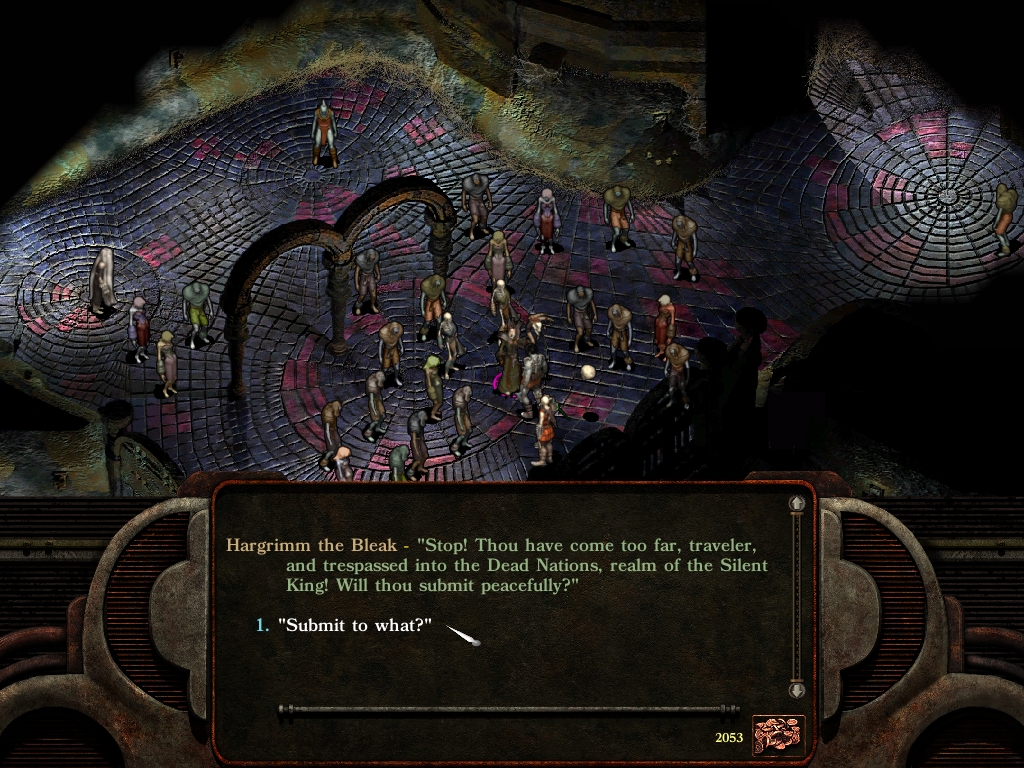
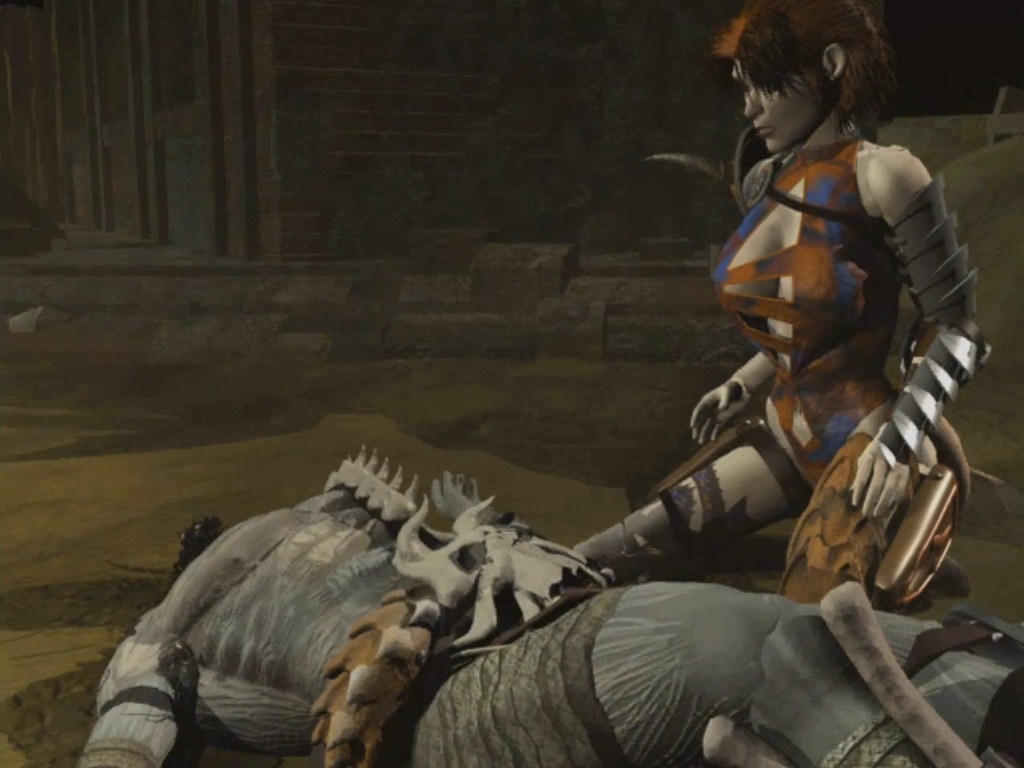
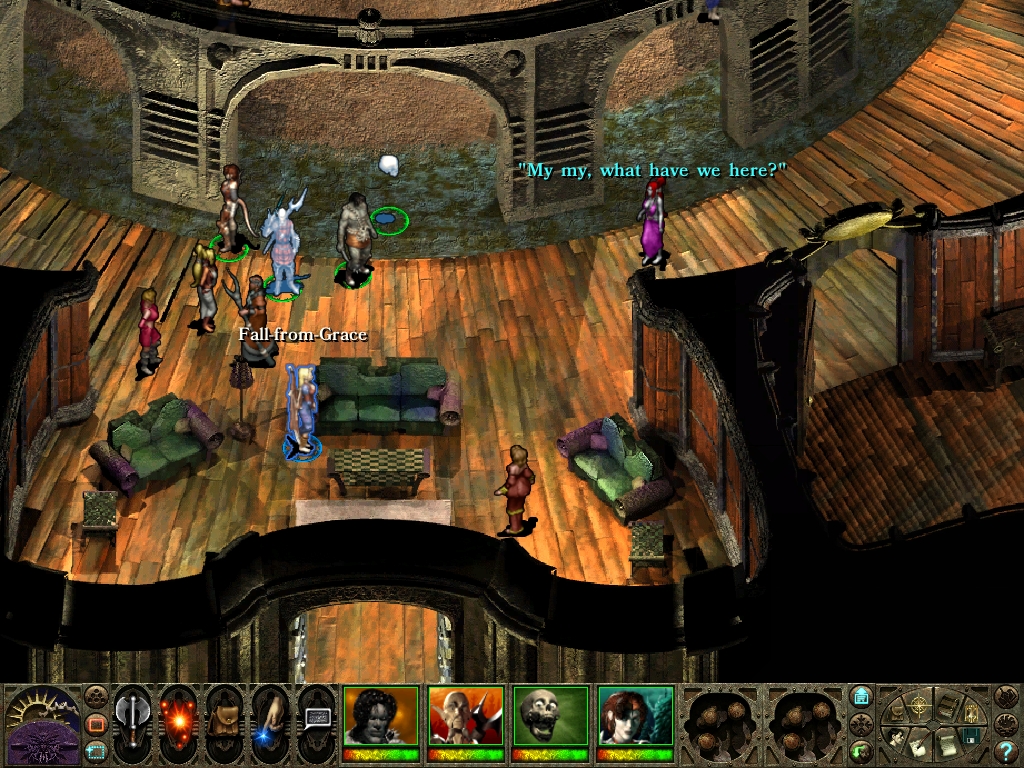
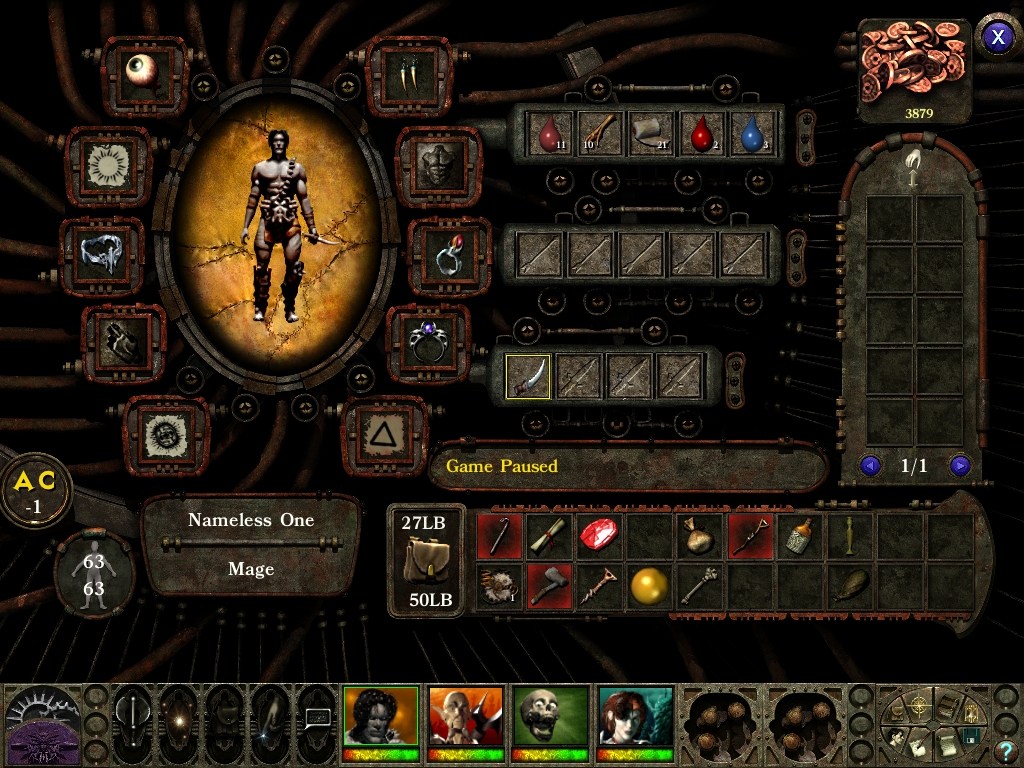
The images above come from the original version (which I couldn’t get working beyond the Mortuary), and those below, from the remaster released in 2017.
Planescape: Torment is a CRPG made with the same engine as Baldur’s Gate, therefore similar in appearance. Both titles are adapted from the famous tabletop role-playing game Dungeons & Dragons, but derived from distinct campaigns (the Forgotten Realms for Baldur’s Gate and Planescape for the one we’re concerned with).
The Planescape universe, reputed to be more sophisticated, and extensivelydocumented, is defined by its “parallel” worlds, ordered according to the two axes of moral alignment; like a spatial materialisation of the concept well known to role-players. These dimensions are populated by native races (angels, demons, devils), organised into rival factions, who meet or clash after having traversed magical portals linking the “planes of existence” to one another, often hidden, and often one-way, condemning the careless traveller to remain prisoner of a foreign world. The story takes place in Sigil, nicknamed the “City of Doors”, which is considered the central capital of the multiverse, connected to all planes, provided one possesses the right keys.
Besides the universe, the game rules faithfully reproduce those of D&D (stat sheets, descending armour class, temporary spell memorisation…). Certain jargon terms such as THAC0 or d20 might leave you as perplexed as a guinea fowl facing a knife, but rest assured: the combat phases remain rudimentary, and equipment is limited to a few weapons and accessories (rings, bracelets, tattoos). It’s a game that prioritises story and dialogue, conveyed through walls of text…
I’d been warned about the copious amount of reading, but during my first attempt in 2010, I must not have been in the right frame of mind, and it didn’t grab me. It wasn’t so much the quantity of text as the impossibility of customising my avatar (after Dragon Age and its range of scripted prologues, disappointment was inevitable). But this first failure wasn’t enough to settle my opinion. I hadn’t warmed to the first viewing of the first episode of The Wire either, and yet it became my favourite series.
Beginning my second attempt, in 2025, I knew what to expect: the imposed main character (whose personality is yours to define, at least), the verbosity, the macabre atmosphere. I felt particularly motivated because I’d just published three rather unfavourable “reviews”; I was keen to be positive, for a change. I chose this title because of its reputation as one of the best-written role-playing games. Moreover, I like dark universes, non-Manichean characters, dirty, ugly and damaged… On paper, it was very appealing to me.
Alas, after several dozen hours, I must acknowledge that I don’t share the same definition of “well written”, and aside from its narrative, I can’t see any other quality to latch onto. It’s a subjective opinion, of course. You may well appreciate this game for the same reasons that put me off.
The story begins in a gigantic underground mortuary. You awaken, amnesiac, on a table, in a physical state that could hardly claim to be in the first flush of freshness, covered in scars and tattoos. You’re joined by a levitating skull named Morte, with a sarcastic wit, who provides you with the first clues by reading you instructions that have been tattooed on your back: go and see a chap who’ll be able to explain who you are and what you’re doing there…
It later emerges that the protagonist is an immortal who has lived multiple existences, not always virtuous, and whose past actions have marked the city’s history. Many inhabitants will recognise you without necessarily revealing it. The main quest therefore consists of piecing together your history and unravelling the mystery of your identity.
The structure seems quite original; I don’t believe I’ve ever experienced such a rupture, so early in the game: after a short introduction in the Mortuary, one suddenly finds oneself dumped in the middle of a large city with dozens of people to talk to. It’s quite intimidating, because there’s an enormous amount of information to absorb all at once, but very little context. As a result, the game takes time to “get going”. Is this a flaw or, on the contrary, a welcome transgression in an excessively codified genre? One feels free, but this freedom comes at a price, that of losing a third of players within the first few hours, and finding the second third lost at the bottom of a dungeon…
I remember another title that had similarly thrown me into the maze of a huge bustling market, full of people to talk to, miscellaneous objects to buy; but it was relatively late in the adventure, at the end of a long journey that had allowed me to immerse myself in the universe. These exchanges with merchants offered a welcome interlude, awakening my curiosity. It was for me the most memorable moment of the game. It was called Secret of Evermore.
Planescape: Torment has chosen an unconventional path, providing little explanation and allowing the player few activities beyond reading. “Getting into it” therefore represents its main difficulty, especially as combat is initially rare (most avoidable), and devoid of tension, given that the hero is immortal. For the rest, even the choice of class (between fighter, mage and thief) is postponed until later, in the course of a side quest.
Confrontations take place in “real-time turn-based” (I don’t know how else to describe them). I found them unreadable and boring, but once again, I’d been warned.
It’s also the sort of game that lets you do anything and then makes you pay for it. For example, exploring the catacombs (just after the large city) exasperated me, for want of sufficient preparation. The frequency of combat increased and I hadn’t recruited the third character, making the task even more tedious than anticipated. Moreover, my two companions’ inventories were perpetually full and it was an ordeal deciding what to discard and what to keep, knowing that any innocuous-looking object can serve as a key to open a hidden portal. After several hours, failing to find my way out of there, I resolved to start everything again from the beginning. Needless to say, going through all the dialogues in the city again finished off my patience.
Moreover, for a game reputed to be well written, I was surprised that my companions joined me with practically no justification. I tried to communicate: “Hey, who are you again? What do you want?” and remained dubious about their motivations. Mine weren’t much clearer… Track down some pen-pusher so he can explain to me how to recover my memory? After bringing him some trinket, naturally. And before he admits that he ultimately had nothing useful to say… Very well. Do I go back to wandering about the city now?
And besides, what is a “well written” game anyway? A game that contains a lot of text, varied vocabulary, without spelling mistakes? Long descriptions, profound philosophical references? Sorry, I loathe philosophy. In my opinion, The Name of the Wind is well written (in English), Gagner la guerre is well written (in French). To be provocative, even a game like Borderlands 2is well written. As long as the text or dialogue immerses me in the story or makes me laugh, as long as there’s rhythm, I want to continue.
Conversely, in Planescape, you’ll discover lengthy descriptions of decomposing bodies that stink, of purulent wounds that ooze; I’ve nothing against it, but where’s the plot? What’s at stake? I held on until the visit to a brothel. I was asked to speak to ten prostitutes who insisted on telling me their life stories. It was so long and mind-numbing that I couldn’t bear it all in one session. I had to stop at the sixth. The next day, I didn’t feel like restarting the game. The day after, I opened it, read one dialogue, and quit the game directly. A week passed before I tried again. An existential question struck me: is it normal to be bored in a brothel? (Now that is a fine philosophy essay topic!)
Beyond the writing, the game doesn’t stray all that far from the beaten path, with its share of uninteresting side quests (buggy and unfinishable for some) and objects to fetch here and there. Paradoxically, despite the sordid atmosphere, it’s neither intended nor encouraged to play an “evil” character. The majority of quests are there to help people, but if your moral alignment forbids it, ignore them; only there’s nothing else to do instead… And really to nitpick, the game commits other small blunders, like lines repeated in a loop when a character automatically attacks a target impervious to their weapon. I’ve never understood how developers could leave these things in such a state.
The designated spiritual successor is called Disco Elysium (2019), also centred on dialogue, and non-Manichean. As with its predecessor, I gave up fairly quickly … but I’ll doubtless give it a second chance one day, when I’m in the right mood.