Grim Fandango (PC)
| Developer: LucasArts | Graphics: |
 | |
| Publisher: LucasArts | Sound: |
 | |
| Year: 1998 | Difficulty: |
| |
| Genre: Adventure | Lastability: |
 | |
| Number of players: 1 | Rating: |
6/10 | |
I had planned to conclude my “skeletons” period in spectacular fashion, after my mixed reviews of MediEvil and Mr Bones. I didn’t think I was taking a risk in choosing Grim Fandango, which I had heard great things about. Among other accolades, it was voted “adventure game of the year” by several magazines, and even received an award at the E3 exhibition.
Without further suspense, I must be honest once again… This game disappointed me, but I hope to provide enough objective arguments to appease its fervent admirers (otherwise, they can join the MediEvil fans sitting on the other side of the crocodile moat).
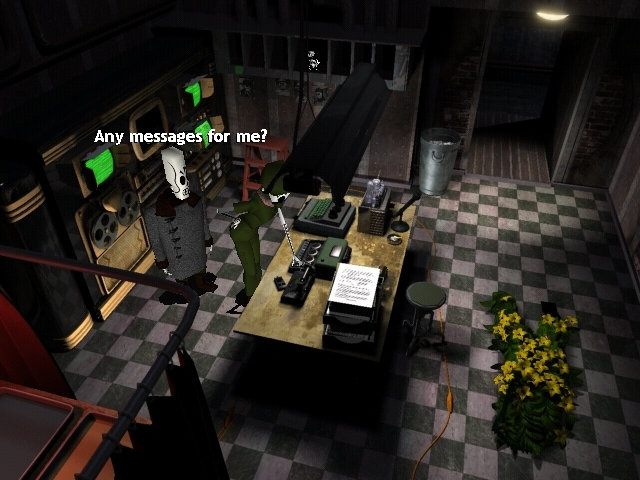
LucasArts studio was renowned for its prestigious lineage of point and click adventure games, a system I briefly described in my Maniac Mansion page. Whilst the genre was running out of steam in the late ’90s, Grim Fandango represents a commendable attempt to reinvigorate it, both through its universe (a blend of film noir and South American folklore) and its graphical technique (pre-rendered 3D instead of traditional drawing). Moreover, it’s no longer a point and click game; the character is controlled directly with the keyboard or controller in a “relative” manner: up and down to move forwards and backwards, left and right to turn. I thought I detected the influence of Alone in the Dark (PC-DOS, 1992) or Resident Evil (PlayStation, 1996), but the project lead cited Bioforge (PC-DOS, 1995) instead. The photorealistic rendering, very fashionable in the ’90s, was achieved by capturing 2D images of environments previously modelled in 3D by very powerful computers.
Incidentally, Grim Fandango was remastered in 2015, notable for its restoration of point-and-click mode, supporting the view that using the mouse remains superior to controlling the character “like a tank”. However, I decided to play the original version (with keyboard), as it wasn’t too difficult to find or install on Windows 11 (follow this guide; what they call ResidualVM is now integrated into the ScummVM programme, and Web Archive will provide you with the … erm … missing files). The main difference between the two versions lies in how interaction points are identified (relatively prominent and quite large, for once). In the original, move about and watch the character’s head tilt when near a useful object. In the remaster, simply sweep the screen with the mouse.
The manual tells us that in Aztec culture, the deceased were frequently buried with food and a bit of money to prepare for their journey into the afterlife. The world of the dead is described as a sort of purgatory divided into nine regions, inhospitable and fraught with obstacles, which souls must traverse over four years to reach “paradise” (one of the thirteen celestial planes, if I’ve understood correctly). The game offers a modern, satirical vision, modelled on Western civilisation of the 1930s, with the difference that all inhabitants are fleshless skeletons (inspired by traditional Mexican figurines).
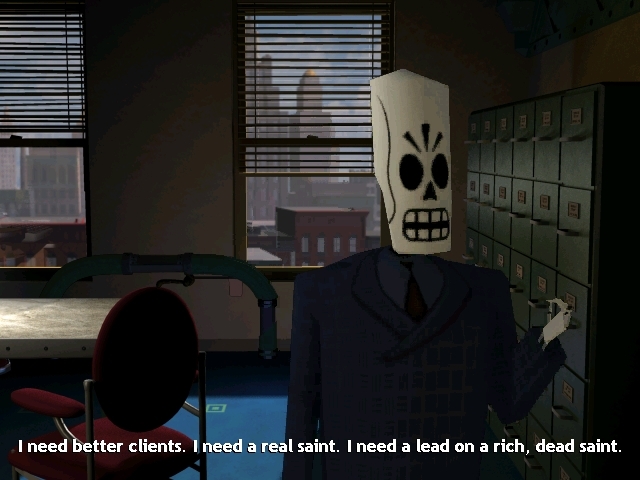
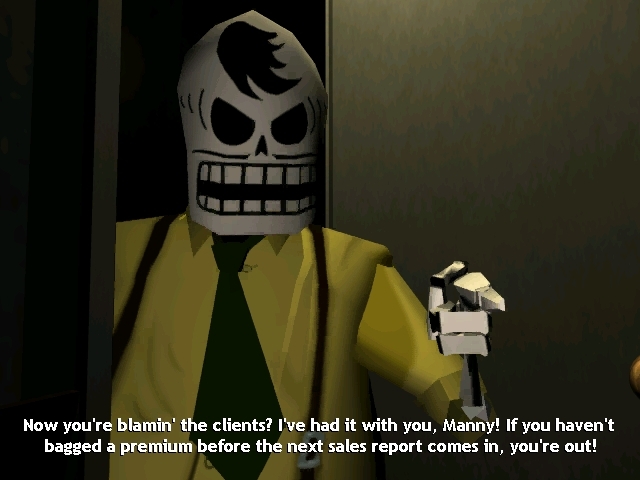
You control Manny Calavera, a travel agent working for the Department of Death. Your job consists of reaping souls (with a scythe), which amounts to welcoming newly deceased people before trying to sell them transport facilities (according to their profile, and also their purse) in order to shorten their journey to the Ninth World. Recently, however, business has been flagging. Your “clients” are broke, while your colleague and rival, Domino Hurley, closes one luxury “cruise” sale after another. You suspect foul play, which will soon compel you to undertake this dangerous four-year pilgrimage yourself, logically structuring the game into that many independent acts.
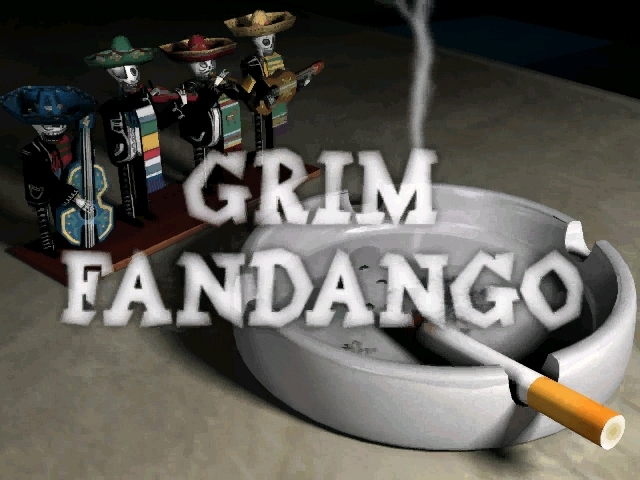
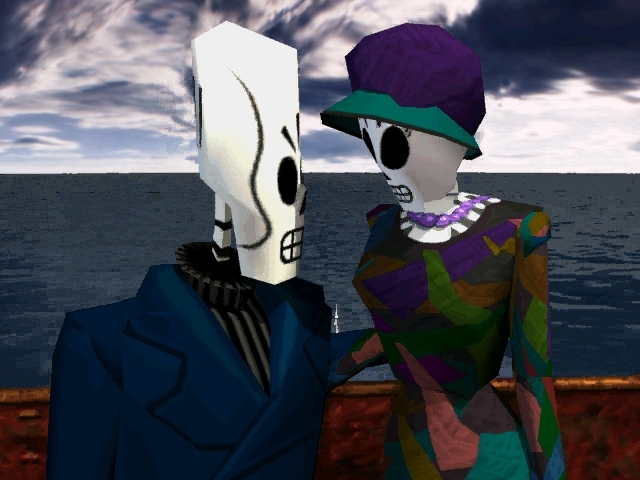
I’ve developed a habit of praising games for their atmosphere. This one is masterfully established by the cinematic introduction sequence: the film noir aesthetic (stereotypical characters in elegant attire, a glass of alcohol in hand and a cigarette in their mouth); the detailed settings, highlighted by expertly studied camera angles; the “physique” of the characters, skulls with individualised “features”; the jazzy soundtrack, and of course the high-quality voice acting (even in French, although the Spanish accent seems a bit forced and some puns are lost in translation).
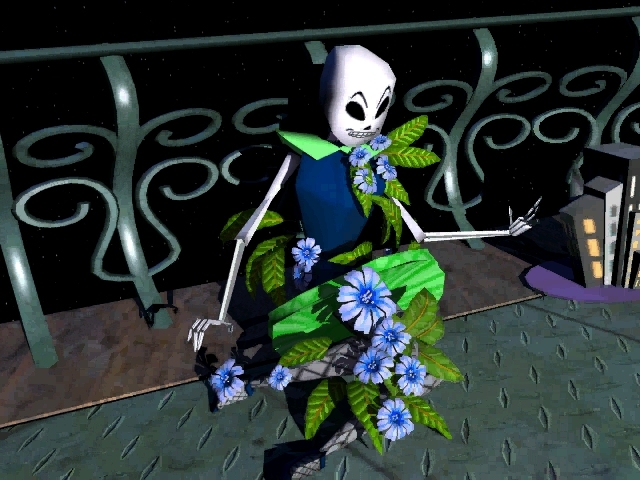
There are other interesting ideas, such as the inverted symbolism of flowers. In the world of the dead, these grow exclusively on bones. They are injected as seeds by a firearm (“sprouting” someone means shooting them). This botanical prescription leads to the rapid and permanent “death” of skeleton people (or animals). Their inert body then becomes covered in leaves, stems and petals. Consequently, flowers in this universe evoke putrefaction; they inspire disgust and repulsion (like necrophagous flies or maggots in our world). And to punctuate this delightful anecdote, the flowering species varies according to the personality of the corpse serving as its compost!
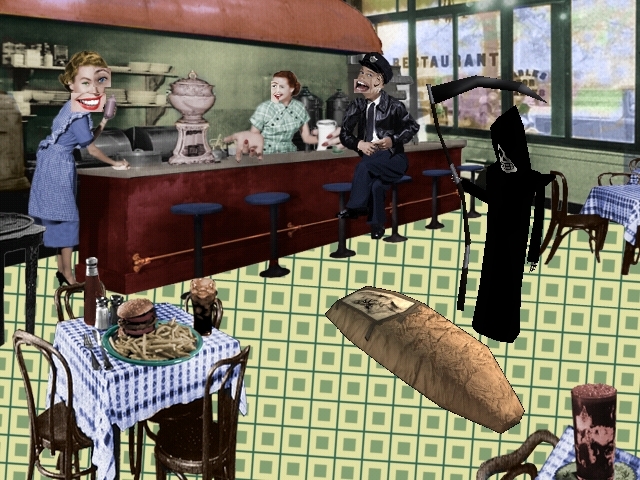
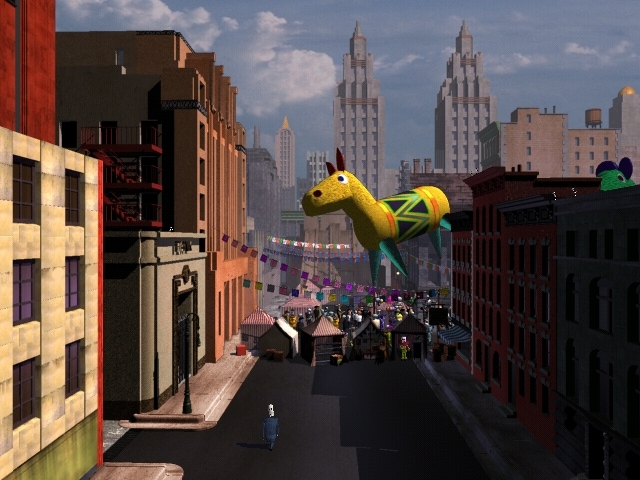
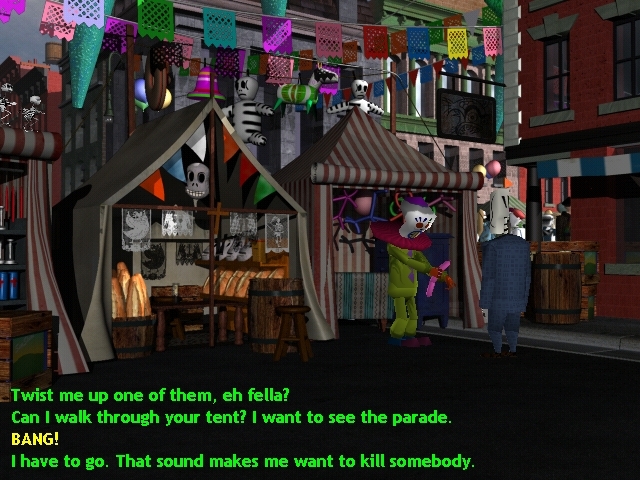
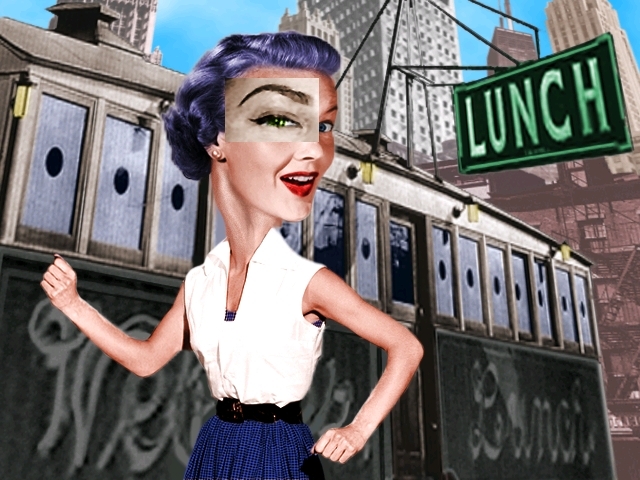
Good atmosphere; however, I fairly quickly perceived its limitations, for a multitude of reasons. Firstly, the environments, however well-crafted they may be, seemed compartmentalised to me. I would have liked to witness the Day of the Dead parade, for example, suggested by the decorations and hubbub in the town, but located just behind the stalls blocking the entire width of the road. Later, I was intrigued by the brief visit to the world of the living, which resembled a work of modern art. People were represented by crude photographic collages, giving them a grotesque and unsettling appearance. Alas, this unique passage lasts only a few seconds, and this surrealist staging is never explored again. Even further on, I would have liked to witness the cat race, mentioned insistently, never shown. I imagine that all this explains the very positive reviews in magazines. The premises are engaging, but prolonged play dispels the illusion.
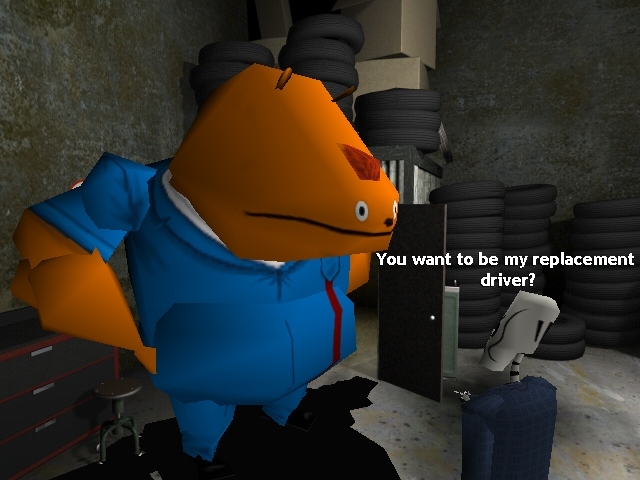
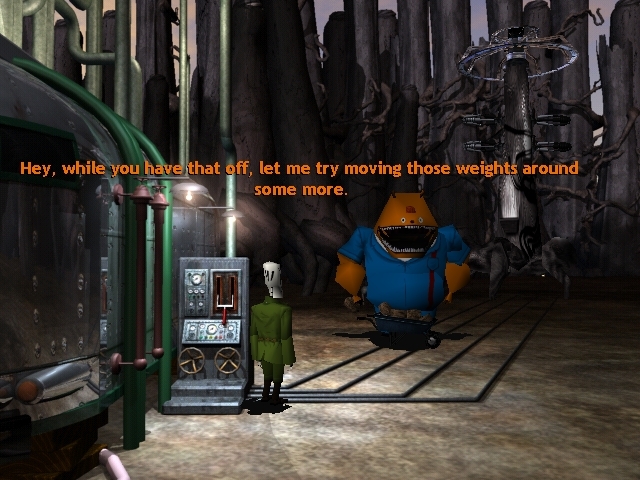
Even the dialogues, so well written, seem “diluted”, because I spent, in each scene, a minute or two being interested in them, followed by several hours wandering aimlessly. In the end, I could no longer stand my friend Glottis (the big orange demon … without a red tie), having vainly solicited his help dozens of times in the cat track… Mind you, my negative feeling stems from my initial motivation: I vowed to finish the game without resorting to a walkthrough. What a mistake!
In a puzzle-based investigation game, I consider the quality of the latter to be a far more important criterion than the context, but that’s only the opinion of an utter dogmatist… Already, structurally, the puzzles are markedly less elaborate than in the old classics, such as The Secret of Monkey Island, because it’s not possible to combine objects with each other, the number of objects in the inventory rarely exceeds three or four, and the explorable environments prove more restricted and poor in interactions. The second act is a happy exception: you’re released into the town of Rubacava, with multiple leads to follow simultaneously. It’s the best part of the adventure, and I expected acts 3 and 4 to maintain, or even amplify, this level of complexity. Instead, they regress towards a linear structure, clearly showing that the developers ran out of time to finish their game.
I suppose they sought to compensate for this linearity by making the puzzles more difficult (not to say absurd). I got through most of them by accident, or by trying all possible combinations of all objects with all notable locations and characters. It brought me no satisfaction. For example, in act 2, there’s a place in the forest with twelve paths that lead nowhere. After hours of wandering, I opened a hidden passage without meaning to, and instead of feeling relieved or proud of myself, I was very annoyed. I admit that most point and click games contain somewhat “oblique” puzzles, but here, it’s practically constant, with no distraction to diminish the frustration. Take Maniac Mansion or Simon the Sorcerer: I remember getting stuck all the time, but I kept having fun, because the locations were teeming with details I noticed after several visits. I was still going round in circles, but big circles, which makes all the difference!
I mentioned above that I wanted to finish the game without consulting a walkthrough; I failed. I’m going to explain (without spoiling) the two episodes that forced me to “cheat”. It’s an opportunity to talk about game design again…
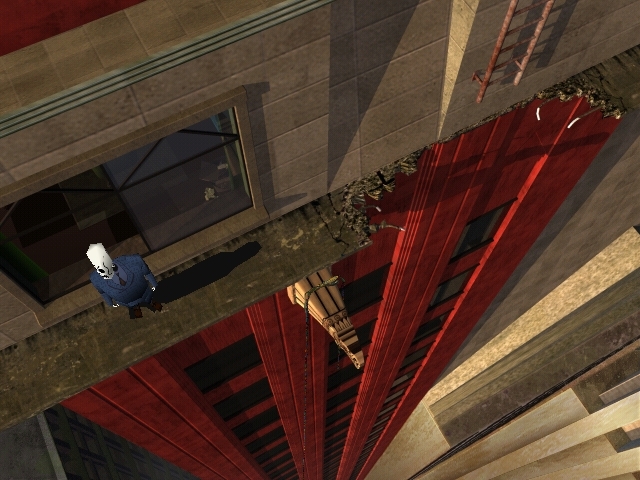
The forklift passage in the lift made me sick.
I can conceive of a difficult game, convoluted puzzles, but as someone would say…
This puzzle upset me because it breaks an unspoken rule: the player cannot intervene during an FMV animation (computer-generated imagery). At least I believed so until then. It’s normal, these are used as transition sequences, where the player usually puts down their controller and becomes a spectator. Second disruptive factor: the use of means of transport in this game is notoriously buggy. My character got stuck in the scenery when trying to experiment with the forklift. I was forced to load an earlier save. The “funniest” thing is that even after watching the solution and trying to reproduce it, I found myself immobilised again, several times! I’m willing to put that one down to the emulator (ScummVM), giving it the benefit of the doubt. Whatever the case, don’t forget to save every hour, in separate slots. Advice also valid in the remaster, from what I’ve read.
I wasn’t able to solve the “bone grinder” puzzle in the fourth act.
All I had left to do was pick up the item in front of me, but I wasn’t pressing the right button! It turns out there’s a button for “pick up” and another for “interact”. Now, I don’t recall using the first one throughout the entire game! I restarted the game to check: the “interact” button did indeed allow me to pick up previous objects. It’s a major design flaw that cost me hours yet again, and which further erodes what positive appreciation I had left.
In conclusion, atmosphere, atmosphere … well, atmosphere isn’t enough. That’s the difference between a film and a game. And having vilified MediEvil for its shot-by-shot imitation of The Nightmare Before Christmas, I feel obliged to point out that Grim Fandango borrows just as much from Casablanca.
“Good artists copy…”
Ultimately, the right way to appreciate the game is the same as for solving chess problems: set yourself a time limit beforehand. Once it’s exceeded, don’t inflict any more suffering upon yourself. One must accept that this genre required a walkthrough, just as others required a manual or a cardboard code wheel. Besides, it helped sell magazines and sustained premium-rate telephone services…
If you like that sort of thing, other classics worth knowing are Beneath a Steel Sky, Sam and Max Hit the Road and Day of the Tentacle (PC-DOS, 1993). And for something a bit different, easier but more logical, I suggest Lumino City (2014).
Look, I endured another technical problem, this time attributable to Windows 11, which I’m going to describe in case someone else finds themselves affected. Whilst playing, keyboard control was suddenly disabled, and the keys emitted a slight “tick” sound with no other effect. It infuriated me for hours, because it persisted even after quitting the game. I understood that it must be a “filter keys” shortcut, one of the many intrusive options that nobody asks for, which is triggered by holding down the “Shift” key for several seconds (the same one used for running in the game). Where it’s really maddening is that I thought I’d disabled it, as you can see here. Wrong: I had to notice the little “>” symbol on the right and click on it to display a second batch of options in a nested panel. Why hide these options on two levels when there’s so much unused space in the control panel? Because *** Windows *** *** become a *** of *** to the ***.
And did you know that Microsoft has also innovated by silently installing rounded edges on windows? … which cause unsightly marks to appear in the lower corners of my screenshots? I’ll leave you now, I need to take a cold shower.
Where to buy it?
I’d recommend waiting for a sale to snag it for under 3 euros.
 GOG
Steam
|
|